Address
Busubait Fiberglass Factory
P.O Box 63113, Dammam 31516
Kingdom of Saudi Arabia
Work Hours
Monday to Friday: 7AM - 7PM
Weekend: 10AM - 5PM

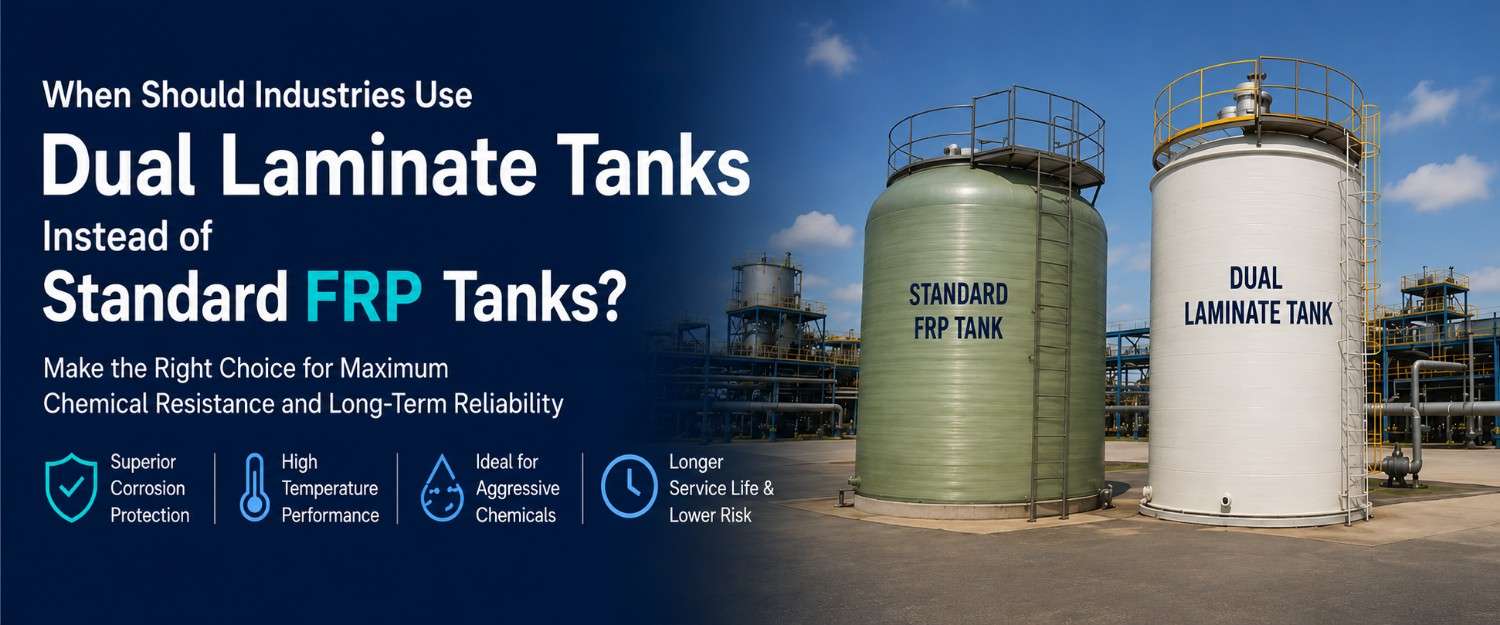
Learn when dual laminate tanks are the right choice for corrosive chemicals, high temperatures, and demanding industrial storage applications.
FRP (Fiber Reinforced Plastic) tanks are widely used across chemical processing, water treatment, mining, and petrochemical industries because of their corrosion resistance, lightweight construction, and long service life. For many applications, standard FRP tanks provide reliable performance and excellent value.
However, some operating conditions place demands on storage systems that go beyond the capabilities of conventional FRP corrosion barriers. Highly aggressive chemicals, elevated temperatures, chemical permeation concerns, and high-purity process requirements can all influence tank selection. In these situations, engineers often evaluate whether a dual laminate tank would provide better long-term performance and protection.
This article explains the key differences between standard FRP and dual laminate tanks, explores the operating conditions where dual laminate construction becomes advantageous, and provides a practical framework for selecting the right solution for demanding industrial applications.
"Corrosion remains one of the most expensive industrial challenges worldwide. According to the NACE International IMPACT Study, the global cost of corrosion is estimated at USD 2.5 trillion annually, equivalent to 3.4% of global GDP. The study further estimates that implementing available corrosion-control practices could save industries between USD 375 billion and USD 875 billion every year."
Source:
NACE International IMPACT Study – Executive Summary
For decades, FRP has been one of the most trusted materials for industrial chemical storage. Its ability to resist corrosion while remaining lightweight and structurally strong has made it a preferred alternative to traditional steel tanks in many industries.
Modern FRP tanks are used across a wide range of industrial storage applications due to their durability, low maintenance requirements, and long service life. They are commonly used for storing process water, wastewater, acids, alkalis, and numerous industrial chemicals.
Excellent corrosion resistance
Lower weight than steel/concrete
Reduced maintenance requirements
Cost-effective installation
Long-term performance
| Feature | Standard FRP Tank | Dual Laminate Tank |
|---|---|---|
| Construction | Resin-rich corrosion barrier + structural layers | Thermoplastic liner + structural FRP shell |
| Chemical Contact | Direct contact with resin system | Contact with inert thermoplastic liner |
| Permeation Protection | Depends on resin selection | Superior protection via thermoplastic barrier |
| Best For | General industrial chemicals, water | Highly aggressive acids, high-purity processes |
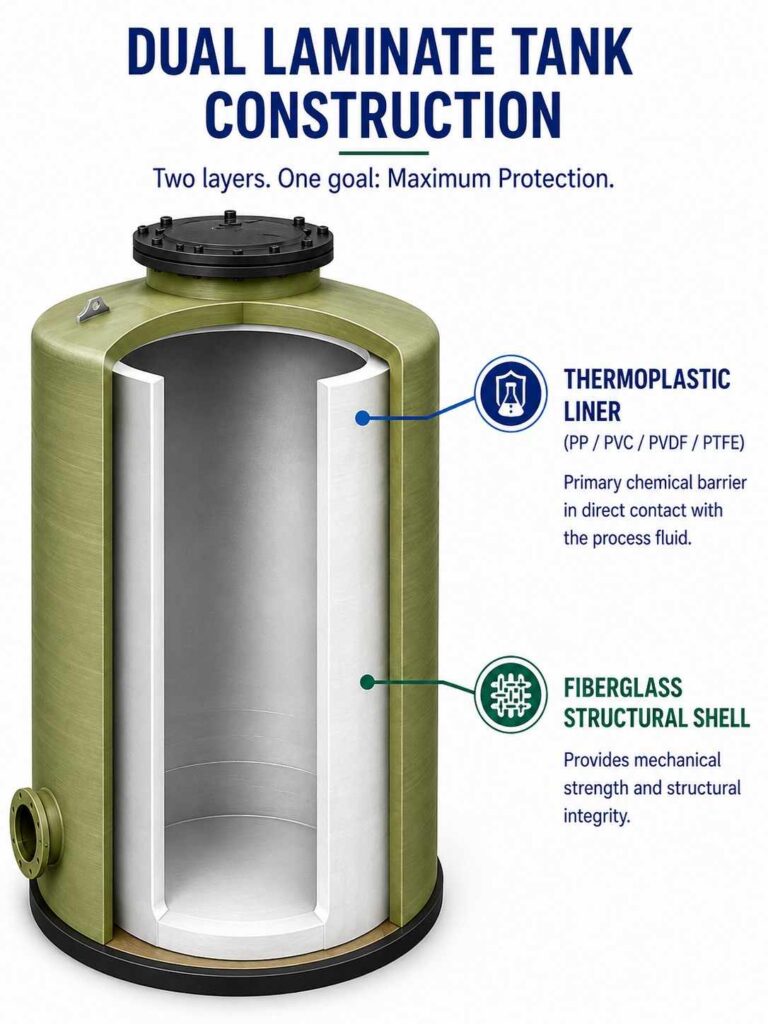
Polypropylene is a widely used liner material known for its excellent chemical resistance to acids and alkalis at moderate temperatures. It is cost-effective and provides a reliable barrier for many industrial applications.
PVC liners are excellent for handling many acids and oxidizing agents. They are commonly used in water treatment and chemical processing where high chemical stability is required.
PVDF offers superior chemical resistance and can handle higher temperatures than PP or PVC. It is often used for concentrated acids and high-purity applications.
PTFE provides the ultimate chemical resistance, capable of withstanding almost all industrial chemicals even at high temperatures. It is the gold standard for the most aggressive environments.
Chemical permeation occurs when molecules gradually migrate through the resin-rich corrosion barrier. While the tank may appear undamaged externally, permeation can create internal deterioration over time.
Not every application requires dual laminate construction. However, the following scenarios often justify the additional investment.
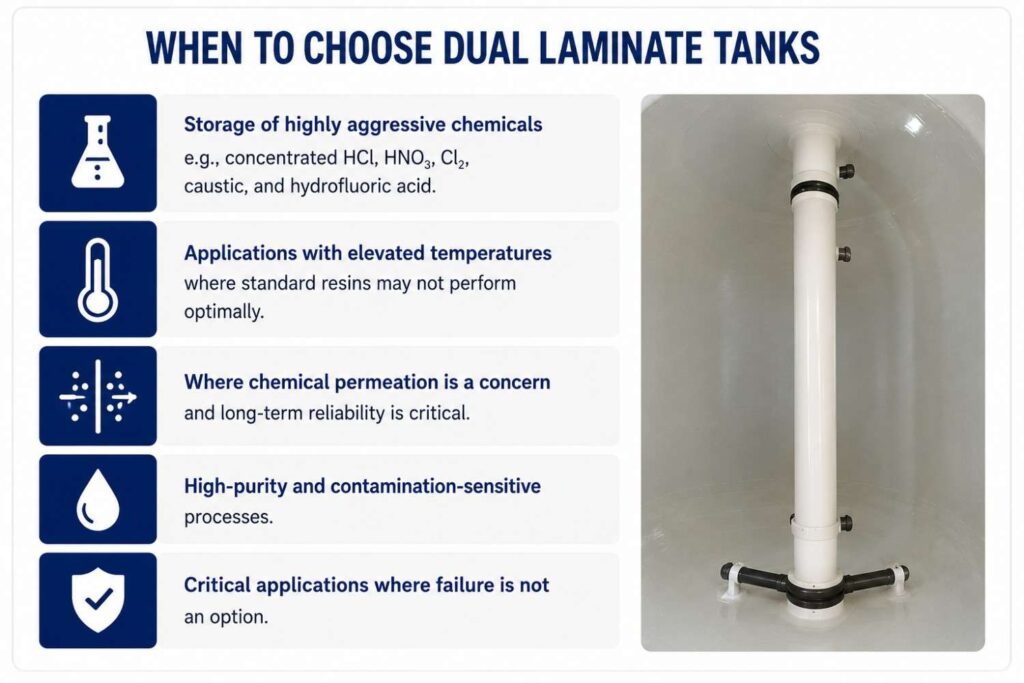
Some chemicals present challenges that go beyond traditional corrosion resistance. They can attack resin systems, permeate corrosion barriers, or accelerate material degradation over time. Examples include: Concentrated hydrochloric acid (HCl), Sulfuric acid, Hydrofluoric acid, Chlorine compounds, and Strong oxidizers.
Temperature plays a major role in chemical compatibility and tank longevity. As operating temperatures rise, resin systems soften more rapidly and chemical diffusion rates increase. Dual laminate tanks address this by using thermoplastic liners that maintain integrity in demanding thermal environments.
Certain facilities cannot tolerate even small levels of chemical migration into structural materials. These include hazardous chemical storage, toxic reagent containment, and environmental protection systems where safety and compliance are paramount.
Product purity is critical in pharmaceutical, biotechnology, semiconductor, and specialty chemical industries. Dual laminate tanks prevent contamination through resin leaching because the process fluid only contacts an inert thermoplastic surface.
Industrial systems exposed to continuous attack from corrosive liquids, vapors, and gases—such as exhaust scrubbers and bleach manufacturing plants—frequently specify dual laminate construction for its superior durability.
• Exceptional chemical resistance
• Smooth internal surfaces
• Low permeation rates
• Excellent purity performance
• Reduced rigidity as size increases
• Increased deformation risks
• Greater support requirements
• Limited pressure/vacuum handling
According to DataIntelo, the global FRP Dual Laminate Tank market was valued at approximately USD 1.2 billion in 2023 and is projected to reach USD 2.3 billion by 2032, growing at a CAGR of approximately 7.2%.
Source: Global FRP Dual Laminate Tank Market Report
| Factor | Standard FRP Tank | Dual Laminate Tank |
|---|---|---|
| 💰 Initial Cost | Lower | Higher |
| 🧪 Chemical Resistance | Excellent | Superior |
| 🛡 Permeation Protection | Moderate | Excellent |
| 🌡 High-Temperature Performance | Limited | Better |
| 💧 Purity Control | Moderate | Excellent |
| 🏗 Structural Strength | Excellent | Excellent |
| ⚙ Severe Corrosion Service | Moderate | Superior |
| 📈 Long-Term Reliability | Application Dependent | Higher in Severe-Duty Applications |
The comparison highlights an important reality: dual laminate tanks are not intended to replace standard FRP tanks. They are designed for situations where operating conditions exceed the practical limits of conventional corrosion barriers.
“The right tank selection should be based on operating conditions rather than initial cost alone.”
Storing concentrated acids, alkalis, and specialty chemicals.
Handling chlorine, sodium hydroxide, and treatment chemicals. Used in Fiberglass Lift Stations
Handling corrosive reagents and leaching solutions in harsh conditions.
Severe-duty storage where long-term protection is essential.
Prioritizing purity and contamination control. Integrated with Process Vessels
In most cases, an existing FRP tank cannot be converted into a true dual laminate tank because the thermoplastic liner is integrated during the manufacturing process. While relining solutions may be available for certain applications, replacement is often the most practical approach when dual laminate construction becomes necessary.
Engineers evaluate permeation risk by considering the chemical type, concentration, operating temperature, and exposure duration. Chemical compatibility data, manufacturer recommendations, and industry standards help determine whether a thermoplastic liner is required.
Not necessarily. Routine inspections focus on the liner condition, weld integrity, nozzles, supports, and structural shell. In many severe-duty applications, dual laminate tanks can actually reduce long-term maintenance concerns by providing enhanced corrosion protection.
Dual laminate tanks may be designed in accordance with standards such as ASME RTP-1, ASTM material standards, BS EN 13121, and relevant thermoplastic fabrication standards. The specific requirements depend on project specifications and regional regulations.
No. The best material depends on the chemical environment, operating temperature, pressure requirements, and lifecycle cost considerations. In many corrosive chemical applications, dual laminate tanks offer superior corrosion resistance, while stainless steel may remain suitable for other process conditions.
Standard FRP tanks remain one of the most reliable and cost-effective solutions for industrial chemical storage. However, when facilities handle highly aggressive chemicals or face significant permeation risks, dual laminate tanks provide the additional level of protection needed for long-term reliability.
The right choice depends on more than initial purchase cost. In severe-duty environments, investing in the appropriate tank construction helps prevent costly failures and unplanned downtime.
Busubait designs and manufactures custom FRP chemical storage tanks, Dual Laminate Equipment, and Fiberglass Process Vessels engineered for demanding industrial conditions.
