Address
Busubait Fiberglass Factory
P.O Box 63113, Dammam 31516
Kingdom of Saudi Arabia
Work Hours
Monday to Friday: 7AM - 7PM
Weekend: 10AM - 5PM
Address
Busubait Fiberglass Factory
P.O Box 63113, Dammam 31516
Kingdom of Saudi Arabia
Work Hours
Monday to Friday: 7AM - 7PM
Weekend: 10AM - 5PM

Manufactured in Saudi Arabia
Corrosive fumes, chemical vapours, mist, and moisture-heavy exhaust can quickly damage standard metallic systems. In industrial plants, this can lead to repeated repairs, leakage, unplanned maintenance, and process disruption.
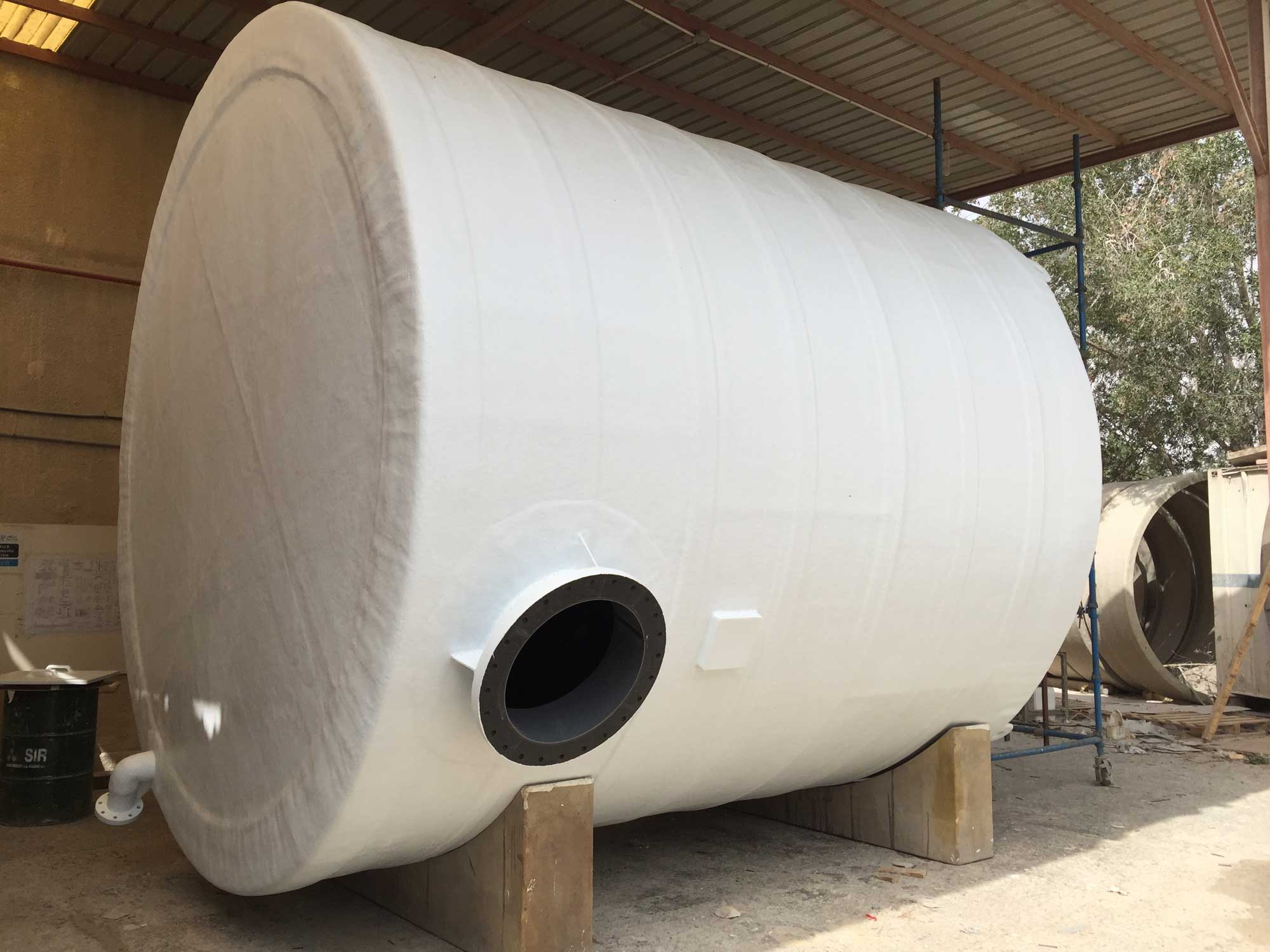
Busubait manufactures FRP air pollution control equipment in Saudi Arabia for industrial exhaust and fume treatment applications. Our scope can include scrubbers, FRP ducting, stacks, hoods, fans, mist eliminators, dampers, and other custom components based on the project requirement.
If you are planning a new system or replacing corroded equipment, the right solution depends on the pollutant, airflow, temperature, chemical concentration, and site conditions.
The complete exhaust pathway
An air pollution control system is not just a scrubber. Each component has a specific role in collecting, transporting, treating, and discharging the exhaust.
A typical system may follow this sequence:
The actual setup depends on the type of exhaust being handled and the treatment objective. Chemical compatibility, airflow, temperature, moisture, and pressure also affect equipment and material selection.
FRP is commonly considered where corrosion is a major concern and conventional metallic systems need frequent maintenance.
Equipment range
Busubait manufactures individual FRP components and connected equipment for industrial exhaust treatment systems. Equipment can be fabricated according to project drawings, process conditions, and client specifications.
01 / Treat
FRP scrubbers are used to treat contaminated exhaust containing chemical fumes, gases, mist, or other pollutants.
Depending on the application, the system may include packed media, spray arrangements, recirculation piping, pumps, mist eliminators, and other components.
For detailed product information, see our FRP scrubber systems.
02 / Transport
FRP ducting carries contaminated air between the source, treatment equipment, fan, and final discharge point.
It is commonly used in chemical and industrial environments where moisture and corrosive vapours can attack conventional duct materials.
Busubait manufactures round, rectangular, and custom duct sections for different project layouts. Learn more about our FRP ducting systems.
03 / Discharge
FRP stacks and chimneys are used to discharge treated exhaust after the required pollution-control process.
They may be connected directly to a scrubber system or through downstream ducting and fans. Material selection depends on exhaust composition, moisture, temperature, and outdoor exposure.
Busubait can fabricate FRP stack assemblies in project-specific sizes and configurations.
04 / Capture
Capturing fumes close to the source is an important part of an effective exhaust-control system.
FRP hoods and enclosures can be used around tanks, process areas, chemical handling equipment, and other emission points. They can then be connected to ducting and downstream treatment equipment.
05 / Move
Fans and blowers help move contaminated air through the ducting, scrubber, and stack.
The correct fan selection depends on airflow, pressure drop, operating conditions, and gas composition. Corrosion-resistant construction may be required where the fan is exposed to aggressive fumes.
06 / Separate
Mist eliminators help remove liquid droplets carried in the gas stream after wet treatment.
They are commonly used downstream of scrubbers where liquid carryover needs to be reduced before the exhaust reaches downstream equipment.
07 / Control
Dampers help control or isolate airflow within an industrial exhaust system.
They can be fabricated in corrosion-resistant materials where chemical vapours or moisture-heavy exhaust make standard metallic components less suitable.
Built for industrial applications
Withstands acids, alkalis, solvents, and saline atmospheres without rusting or pitting.
Easier handling and installation compared to steel, while maintaining structural integrity.
Molded or filament-wound components in custom sizes/shapes; integrates nozzles, access doors, internals, and supports.
Smooth, non-reactive surfaces reduce fouling and simplify cleaning.
Non-conductive FRP options and airtight fabrication support safe, leak-free operation.
Delivered as standalone units or fully integrated lines with ducts, fans, controls, and accessories.
From capture to discharge
A well-designed industrial exhaust system manages the air stream from the point where fumes are generated to the point where treated exhaust is discharged.
Hoods, covers, or enclosures collect fumes before they spread into the surrounding work area.
The capture arrangement should match the process and the location where gases, vapours, or mist are released.
Once captured, the exhaust is transported through ductwork.
In corrosive environments, FRP ducting can help reduce damage caused by moisture, acid vapours, and chemically aggressive gases.
The exhaust is then passed through a scrubber or another treatment stage.
The equipment selected depends on the contaminant, concentration, required treatment objective, and process conditions.
Wet treatment processes can carry fine liquid droplets in the outgoing air stream.
Mist eliminators help reduce this carryover before the gas moves to downstream equipment.
Fans provide the airflow needed to move the exhaust through the system.
The treated gas is then discharged through the stack according to the project and process requirement.
For a deeper explanation of scrubber systems, see our FRP scrubber system page.
Industrial applications
FRP air pollution control equipment is commonly used in industrial facilities where exhaust contains corrosive gases, chemical vapours, moisture, mist, or odours.
Busubait supports applications across:
The exact system depends on the process, pollutant, and operating conditions.
Start with the operating conditions
No two industrial exhaust systems are exactly the same. The right equipment should be selected around the actual gas stream and site requirement.
Key factors include:
01 / Selection factor
The first step is identifying the type of contaminant.
This may include:
02 / Selection factor
Airflow affects duct sizing, scrubber sizing, fan selection, and overall system performance.
Provide the design airflow wherever available.
03 / Selection factor
Temperature can affect the suitability of the resin system and material construction.
04 / Selection factor
Chemical concentration and moisture content affect corrosion risk and material compatibility.
05 / Selection factor
The system should be selected based on what needs to be controlled, such as gas treatment, fume extraction, odour control, or mist removal.
06 / Selection factor
Equipment layout affects duct routing, access, maintenance, stack location, and installation.
Existing plants may also have dimensional or connection restrictions that need to be considered before fabrication.
Project experience
FEATURED PROJECT
Bee’ah
Thermal Capacity
Expansion Project
Busubait has supplied integrated FRP equipment for industrial exhaust and air pollution control applications.
One example is the Bee'ah Thermal Capacity Expansion Project, where Busubait supplied a scrubber, FRP ducting, and an FRP stack for flue gas handling.
The project involved large-diameter, custom-fabricated equipment designed around specific process and site requirements.
View the Bee’ah ProjectMade in Dammam
Busubait Fiberglass Company has been manufacturing fiberglass products in Dammam, Saudi Arabia, since 1997.
The company supplies FRP products for chemical processing, water and wastewater, petrochemical, mining, industrial, and infrastructure applications.
Our air pollution control equipment can be fabricated around project drawings, operating conditions, and client requirements. The scope can include individual FRP components or connected equipment for exhaust collection, treatment, and discharge.
For related industrial equipment, see our fiberglass process vessels and equipment.
If your project involves a wider FRP requirement, you can also explore our FRP products in Saudi Arabia.
Your questions, answered
Let’s discuss your project
The right air pollution control system starts with the actual gas stream, operating conditions, and site layout.
Busubait can manufacture FRP scrubbers, ducting, stacks, hoods, and related exhaust components for industrial applications in Saudi Arabia.
If you are planning a new system, replacing corroded equipment, or reviewing an existing exhaust setup, share your drawings or project specification with our team.