Address
Busubait Fiberglass Factory
P.O Box 63113, Dammam 31516
Kingdom of Saudi Arabia
Work Hours
Monday to Friday: 7AM - 7PM
Weekend: 10AM - 5PM
Address
Busubait Fiberglass Factory
P.O Box 63113, Dammam 31516
Kingdom of Saudi Arabia
Work Hours
Monday to Friday: 7AM - 7PM
Weekend: 10AM - 5PM

Chemical-contact protection. FRP structural support.
Aggressive chemicals can place more demand on a storage tank than standard FRP construction is designed to handle. In these applications, a thermoplastic liner can provide the required chemical-contact surface while FRP provides structural support.
Busubait manufactures dual laminate tanks and equipment in Saudi Arabia for chemical processing, pickling, water treatment, petrochemical, and other industrial applications.
Depending on the chemical and operating conditions, liner materials may include PP, PVC, CPVC, PVDF, PFA, and other compatible thermoplastics.
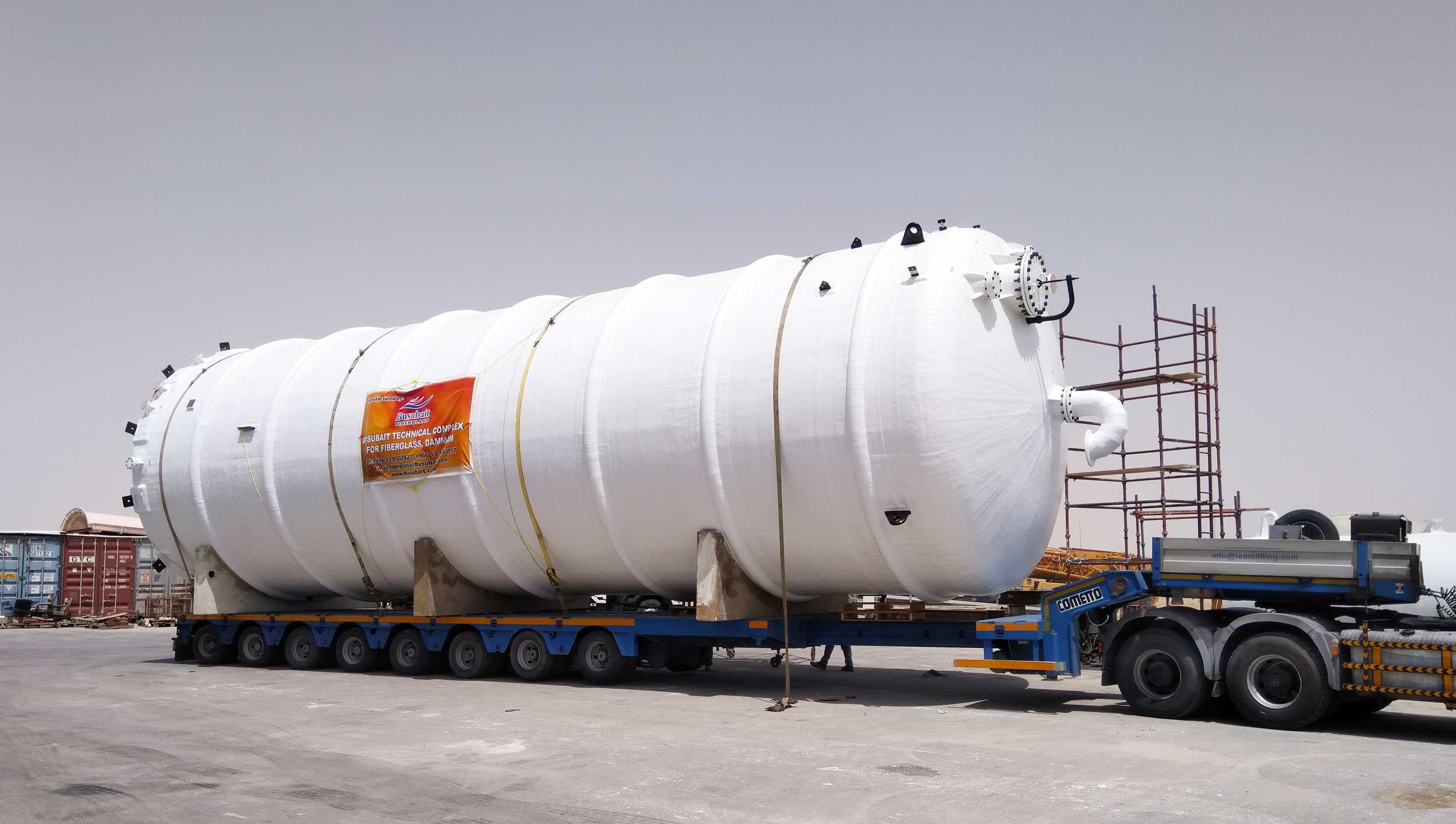
Built for corrosive service
A dual laminate tank combines two materials, each with a different role.
The inner thermoplastic liner provides the chemical-contact surface.
The outer FRP shell provides mechanical strength and structural support.
This construction may be considered when highly corrosive chemicals, temperature, permeation, or process requirements make a thermoplastic liner preferable.
For applications where standard fiberglass construction is suitable, see our FRP tanks in Saudi Arabia.
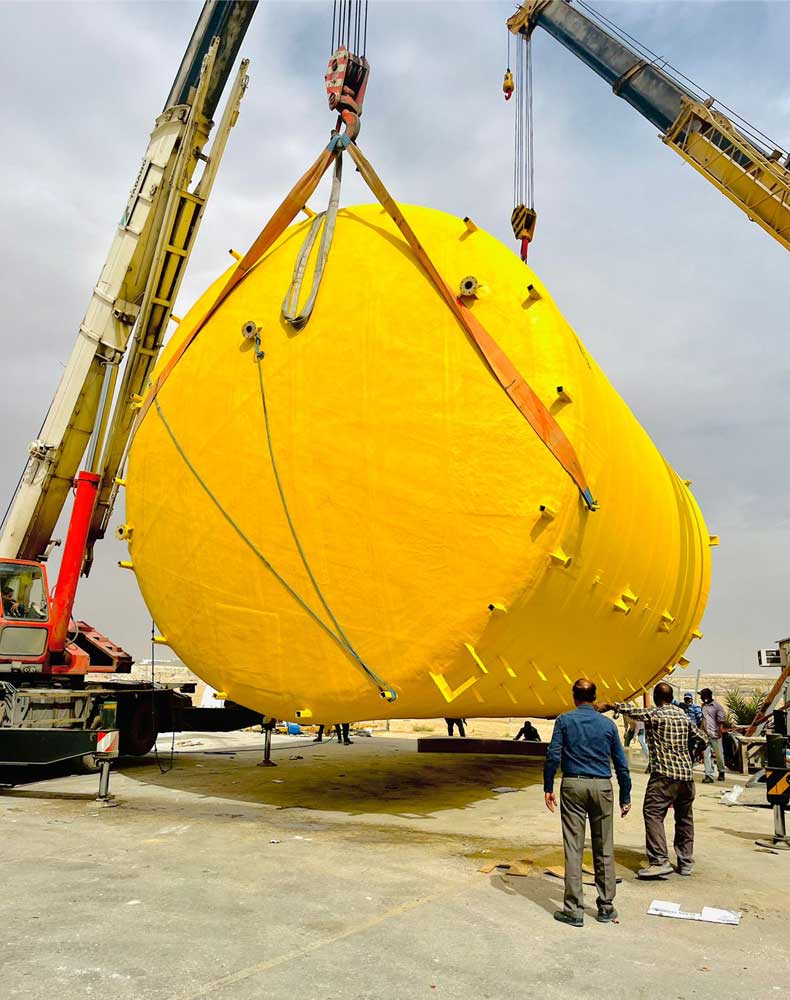
Project-specific fabrication
Busubait manufactures project-specific lined tanks and equipment for industrial chemical service.
01 / Lined equipment
PP lined FRP tanks combine a polypropylene chemical-contact liner with an FRP structural shell.
They can be considered for compatible acids, alkalis, and other chemical services where polypropylene is selected based on operating conditions.
02 / Lined equipment
PVDF and PFA liners may be considered for more demanding chemical applications where higher chemical resistance is required.
The liner should always be selected according to the chemical, concentration, temperature, and project specification.
03 / Lined equipment
Pickling and galvanizing processes often involve aggressive chemical solutions that require careful material selection.
Busubait manufactures dual laminate pickling tanks for project-specific metal treatment and galvanizing applications.
04 / Custom scope
Dual laminate construction is not limited to storage tanks.
Depending on the project, Busubait can manufacture lined:
For mixing and reaction applications, see our FRP reaction and mixing vessels.
One construction. Two distinct roles.
The main advantage of dual laminate construction is that the liner and structural shell perform different jobs.
The liner is selected for direct contact with the stored chemical. Depending on the application, materials may include:
The outer fiberglass reinforced plastic shell provides the mechanical strength required to support the equipment.
This allows the chemical-contact material to be selected separately from the structural material.
For a more detailed explanation of where this construction makes sense, read When Should Industries Use Dual Laminate Tanks Instead of Standard FRP Tanks?.
Industrial applications
Dual laminate tanks are commonly considered in industrial applications where chemical compatibility is a major design concern.
Typical uses include:
Material selection should always be based on the actual chemical and operating conditions, not only on the industry or application name.
Material performance
Standard FRP works well for many industrial services. Dual laminate is normally considered when the chemical-contact surface needs a thermoplastic liner.
01
The thermoplastic liner provides the primary barrier between the stored medium and the structural FRP shell.
02
The FRP outer layer provides strength without relying on the thermoplastic liner to carry the full structural load.
03
Tank size, nozzle arrangements, manways, vents, supports, and other details can be manufactured around project requirements.
04
Because the equipment does not depend on a metallic surface exposed to the process medium, it can reduce corrosion-related maintenance in suitable applications.
Compare construction options
The right construction depends on the chemical service and project requirements.
| Standard FRP Tank | Dual Laminate Tank |
|---|---|
| Uses an FRP corrosion barrier and structural layers | Uses a thermoplastic liner with an outer FRP structural shell |
| Suitable for many industrial storage applications | Considered for more demanding chemical service |
| Chemical resistance depends mainly on resin selection | Chemical resistance depends mainly on liner selection |
| Simpler composite construction | Specialist lined construction |
If you are comparing the two options for a chemical project, see our detailed guide on standard FRP vs dual laminate tanks.
For broader industrial storage requirements, visit our FRP tank manufacturer in Saudi Arabia page.
Select for the actual service
Material selection becomes especially important where acids, chlorides, hypochlorite, or other aggressive media can attack metallic equipment.
Dual laminate systems use a thermoplastic liner for chemical contact rather than relying on the corrosion resistance of metal alone.
The right choice still depends on factors such as:
For a more detailed comparison, read Dual Laminate vs Stainless Steel: Choosing the Right Material for Corrosive Environments.
Your questions, answered
A dual laminate tank combines a thermoplastic inner liner with an FRP outer structural shell. The liner provides the chemical-contact surface, while the FRP provides mechanical strength.
Depending on the chemical and service conditions, liner materials may include PP, PVC, CPVC, PVDF, PFA, and other compatible thermoplastics.
Dual laminate may be considered when highly aggressive chemicals, higher temperatures, permeation concerns, or process requirements call for a thermoplastic chemical-contact surface. Standard FRP remains suitable for many industrial applications when the correct resin system is selected.
Yes, dual laminate tanks can be manufactured for compatible pickling and galvanizing applications. The liner material must be selected according to the specific chemical, concentration, temperature, and process conditions.
LET’S DISCUSS YOUR PROJECT
Busubait manufactures dual laminate tanks and lined equipment in Saudi Arabia for chemical processing, galvanizing, water treatment, petrochemical, and other industrial applications.
If your project requires PP, PVDF, PFA, or another thermoplastic-lined FRP system, Busubait can review the service conditions and manufacture a project-specific solution.