Address
Busubait Fiberglass Factory
P.O Box 63113, Dammam 31516
Kingdom of Saudi Arabia
Work Hours
Monday to Friday: 7AM - 7PM
Weekend: 10AM - 5PM
Address
Busubait Fiberglass Factory
P.O Box 63113, Dammam 31516
Kingdom of Saudi Arabia
Work Hours
Monday to Friday: 7AM - 7PM
Weekend: 10AM - 5PM

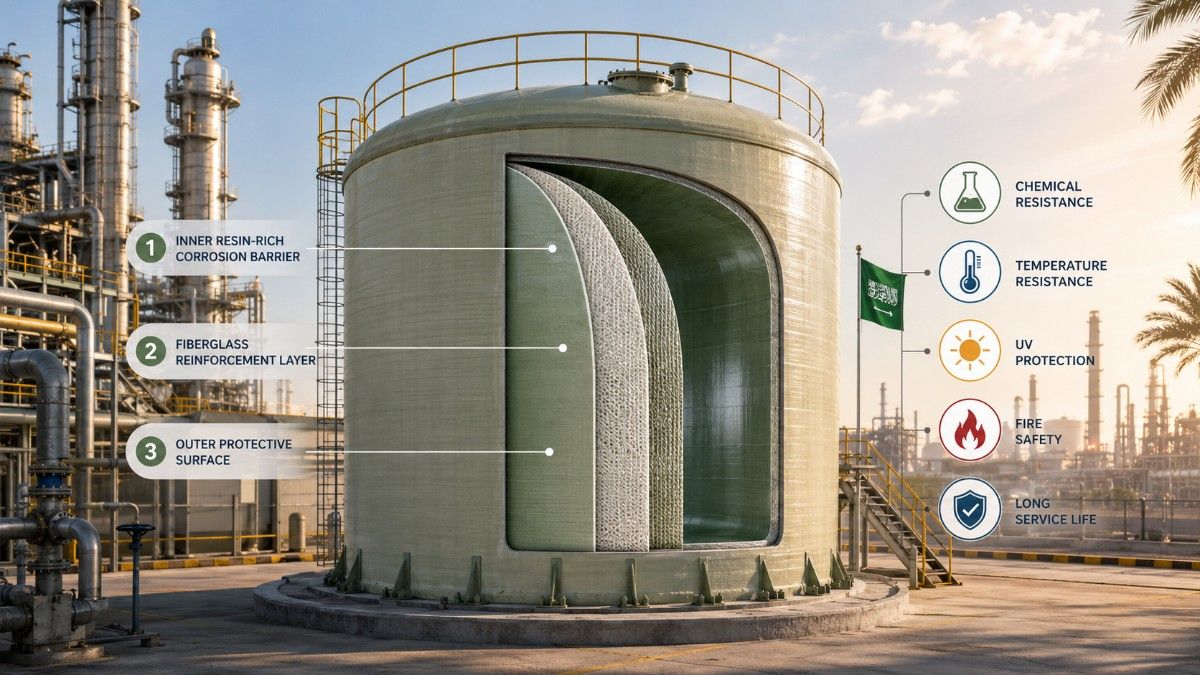
Learn how to choose the right FRP resin for chemical storage tanks, pipes, scrubbers, ducting, and industrial applications in Saudi Arabia and the GCC.

Choose resin based on real service conditions: chemical exposure, concentration, temperature, site environment, fire safety, and lifecycle cost.
FRP is often selected because it resists corrosion better than many traditional materials. But FRP does not perform well just because it is FRP.
The resin system inside the FRP product decides how well it handles chemicals, heat, fumes, moisture, sunlight, and long-term industrial use. This matters even more for FRP chemical storage tanks, where the inner surface stays in direct contact with acids, alkalis, solvents, wastewater chemicals, or process liquids.
A tank made with the wrong resin may look fine during installation. The problem usually appears later as blistering, softening, cracks, leakage, or early replacement. That is why FRP resin selection should happen before fabrication, not after failure.
In this guide, we will explain how to select the right resin for FRP industrial applications, especially chemical storage tanks. We will also cover resin selection for FRP pipes, fittings, scrubbers, ducting, process vessels, gratings, and other industrial fiberglass products used in Saudi Arabia and the GCC.
FRP products can look similar on the outside, but their long-term performance depends on the resin and corrosion barrier inside.
ChemicalTemperatureUVFire safetyThe resin is the matrix that holds the glass fibers together. Think of it as the protective body of the FRP product. The glass fibers provide strength, but the resin protects the product from the actual service environment.
Exact chemical, concentration, exposure duration, and cleaning cycles shape compatibility.
Heat can increase chemical attack and reduce resin strength over time.
UV, humidity, salt air, dust, and fumes matter across Saudi Arabia and the GCC.
The right resin balances purchase price, inspection needs, downtime, and replacement risk.
For industrial buyers, this means one thing clearly: two FRP products can look similar but perform very differently if they use different resin systems.
In FRP chemical storage tanks, the inner laminate is constantly exposed to the stored chemical. If the resin is not compatible with that chemical, the tank can degrade from the inside.
This is why chemical resistant FRP resin selection must consider:
For example, a resin that works for process water may not be suitable for hydrochloric acid, sodium hydroxide, sulfuric acid, or sodium hypochlorite. The chemical name alone is also not enough. Concentration and temperature can change the resin requirement.
Heat can reduce resin strength and increase chemical attack. A mild chemical at room temperature may become more aggressive at a higher operating temperature.
Before selecting resin for FRP tanks or process vessels, the operating temperature should be compared with the resin’s heat resistance. It is safer to check continuous service temperature, not only short-term exposure limits.
A lower-cost resin may reduce the initial price of an FRP product. But if the product is exposed to strong chemicals, heat, or industrial fumes, the wrong resin can increase maintenance costs later.
This is especially important for:
A good resin choice should balance cost, chemical resistance, temperature, fire safety, and service life.
According to a 2025 industry article citing NACE International, now AMPP, the global cost of corrosion in the oil and gas industry alone was estimated at over USD 60 billion annually. This includes corrosion-related impact on pipelines, storage tanks, offshore platforms, drilling equipment, and refineries.
Why this matters for FRP resin selection: Resin selection is not a small material decision. In chemical, oil and gas, wastewater, and petrochemical projects, corrosion control directly affects safety, downtime, maintenance cost, and asset life.
Source: Hidden Cost of Corrosion
Use this flow before comparing quotations or approving fabrication.
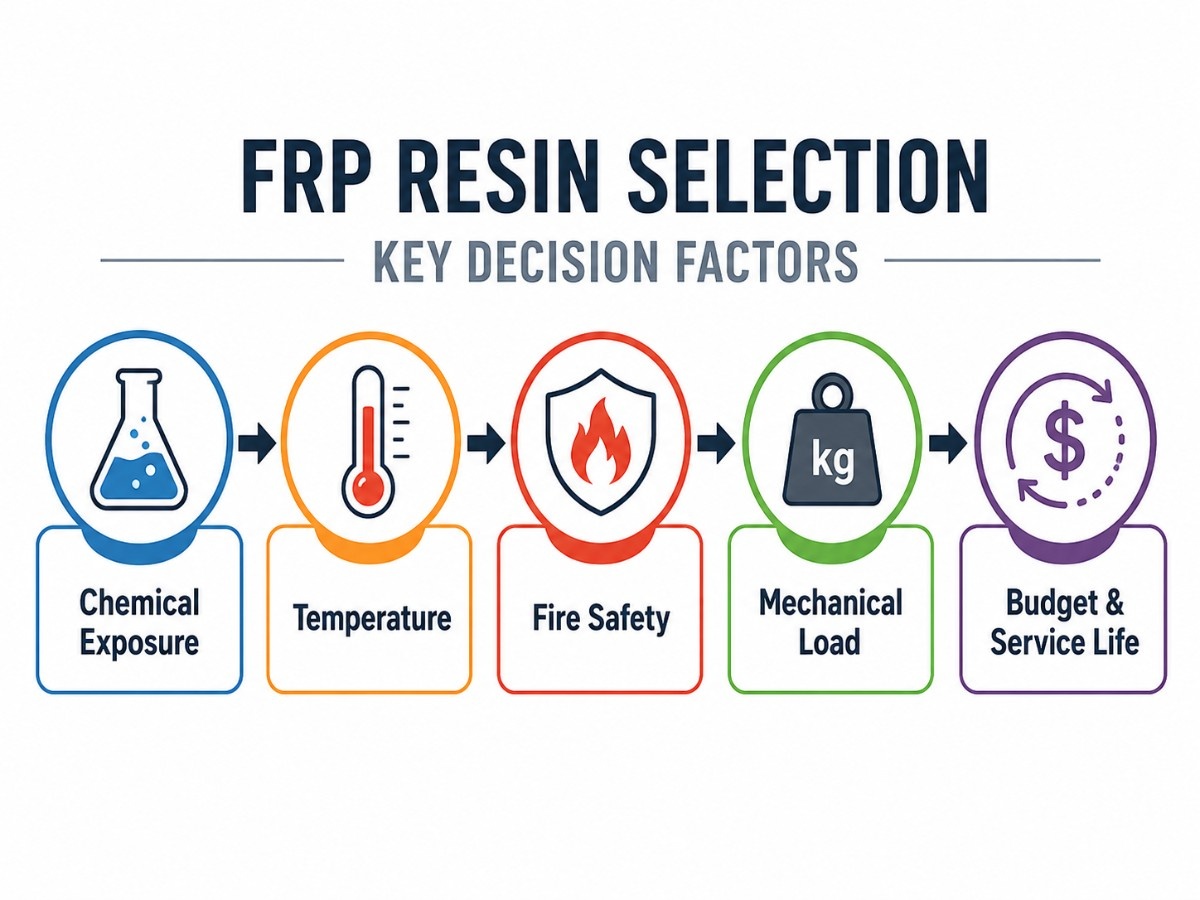
There is no single resin that fits every FRP product. The right choice depends on the application, chemical exposure, temperature, fire safety needs, and project budget.
Orthophthalic polyester resin is a cost-effective resin used in general-purpose FRP applications. It is usually selected when chemical exposure is mild and the product does not face harsh industrial conditions.
It may be used for:
However, it is usually not the best choice for aggressive chemical storage tanks or highly corrosive environments.
Use this resin when: The exposure is mild, the chemical risk is low, and the product is not mission-critical.
Avoid this resin when: The application involves strong acids, alkalis, solvents, high heat, or continuous chemical contact.
Isophthalic polyester resin offers better chemical and moisture resistance than standard orthophthalic polyester. It is often used in moderate industrial environments where the exposure is not extremely aggressive.
It may be suitable for:
For many industrial applications, isophthalic polyester gives a good balance between cost and performance. But it should still be checked against the actual chemical exposure.
Use this resin when: The application needs better durability than general-purpose polyester but does not require high-end corrosion resistance.
Avoid this resin when: The FRP product will handle aggressive chemicals, strong caustics, high concentrations, or elevated chemical temperatures.
Vinyl ester resin is one of the most important resin systems for FRP chemical storage tanks. It provides strong corrosion resistance and better toughness than standard polyester resins.
This resin is commonly considered for:
Vinyl ester is usually more expensive than polyester. But in corrosive environments, that higher initial cost can be justified by better resistance and longer service life.
Use this resin when: The FRP product will face acids, alkalis, solvents, wastewater gases, or aggressive industrial environments.
Avoid assuming: All vinyl ester resins are the same. The final choice still depends on the chemical, concentration, temperature, and tank design.
Epoxy resin is known for strong bonding, low shrinkage, good mechanical strength, and fatigue resistance. It is often used when structural performance is more important than low cost.
It may be suitable for:
Epoxy is not always the first choice for large FRP chemical storage tanks. Vinyl ester is often more common for corrosion-focused tank applications. But epoxy can be useful where strength, bonding, or special performance is needed.
Use this resin when: The application needs high mechanical strength, strong adhesion, or specialized performance.
Avoid this resin when: The project requires a more cost-effective resin and the service conditions do not need epoxy-level performance.
Phenolic resin is used where fire resistance, low smoke, and low toxic fume emission are important.
It may be suitable for:
Phenolic resin is not needed for every FRP product. It is selected when fire performance is a major project requirement.
Use this resin when: Fire safety, low smoke, and low toxic emissions are key requirements.
Avoid this resin when: The application does not require special fire performance and another resin can meet the chemical and mechanical needs more economically.
The table below gives a simple comparison of common FRP resin types. It should be used as a starting point, not as final design approval.
| Resin Type | Best For | Chemical Resistance | Temperature Resistance | Cost Level | Common Industrial Uses |
|---|---|---|---|---|---|
| Orthophthalic Polyester | General FRP applications | Low to moderate | Moderate | Low | Covers, panels, light-duty products |
| Isophthalic Polyester | Moderate industrial exposure | Good | Moderate | Medium | Gratings, water treatment, mild chemical environments |
| Vinyl Ester | Corrosive chemical service | Excellent | Good to high | Higher | Chemical tanks, scrubbers, pipes, wastewater systems |
| Epoxy | High-strength applications | Good, depending on chemical | High | High | Structural profiles, coatings, specialized components |
| Phenolic | Fire-sensitive applications | Good | High | High | Oil and gas, tunnels, enclosed industrial areas |
Important note: Final FRP resin selection should always be based on chemical concentration, operating temperature, pressure, outdoor exposure, fire safety requirements, and project specifications.
Share the chemical, concentration, temperature, and site conditions before fabrication so the FRP system is matched to the application.
Chemical storage tanks need the most careful resin selection because the stored liquid is in direct contact with the tank’s inner surface.
If the corrosion barrier is not designed correctly, the tank may lose performance long before the expected service life.
The first question is simple: what chemical will the FRP tank store?
This includes chemicals such as:
But the chemical name is only the first step. You also need to know the concentration, temperature, purity level, and whether the tank will hold one chemical or different chemicals over time.
For example, sodium hydroxide storage may need a different resin decision compared with acid storage. Oxidizing chemicals may also require special care because they can be more aggressive than expected.
A common mistake is checking chemical compatibility at room temperature only. That can be risky.
Chemical attack usually increases when temperature rises. A resin that works for a diluted chemical at low temperature may not perform well with a concentrated chemical at elevated temperature.
Before finalizing resin for FRP tanks, ask:
This is especially important for FRP chemical storage tanks used in chemical plants, water treatment, desalination, mining, petrochemical, and utility projects.
In a chemical tank, the inner corrosion barrier does most of the protection work. The structural laminate gives strength, but the inner layer protects against chemical attack.
A suitable corrosion barrier may include:
For aggressive chemicals, vinyl ester resin or fiberglass tanks and dual laminate equipment may be considered. In some highly corrosive services, thermoplastic-lined systems such as PP, PVDF, PFA, or PTFE may be more suitable depending on the chemical.
FRP resin selection for Saudi Arabia and GCC projects should also consider outdoor exposure. The tank may not only face the chemical inside. It may also face heat, sunlight, humidity, dust, and industrial fumes outside.
Local site conditions to check include:
For areas such as Dammam, Jubail, Ras Al Khair, and other GCC industrial zones, resin selection should consider both chemical compatibility and local environmental exposure.
A 2025 FRP tank guide states that FRP tanks typically last 20 to 50 years depending on resin type and environmental conditions. The same guide notes that with the right resin system, FRP tanks can resist temperatures up to 120°C.
How to use this data carefully: These figures should not be treated as a guarantee for every tank. Service life depends on resin selection, chemical concentration, temperature, laminate design, installation quality, inspection, and operating conditions.
Source: FRP Tanks Cost, Applications and Leading Manufacturers 2025
Chemical tanks may be the main concern, but resin selection also affects other FRP products used across industrial sites.
FRP pipes and fittings handle chemical flow, pressure, temperature, and sometimes outdoor exposure. The resin should match the fluid being transferred.
For corrosive chemical transfer, vinyl ester resin is often considered. For moderate water or wastewater service, isophthalic polyester may be enough depending on the exposure.
When selecting resin for FRP piping, check:
For industrial chemical transfer applications, explore FRP pipes and fittings.
FRP scrubbers and ducting systems handle fumes, vapors, moisture, and condensate. These conditions can be harsh, especially in chemical plants and air pollution control systems.
The resin should resist:
Vinyl ester resin is often used for stronger chemical fume resistance. Fire-retardant resin may also be needed in some industrial areas.
For fume control and ventilation systems, see FRP air pollution control equipment and FRP ducting systems.
FRP gratings, handrails, and pultruded profiles may not store chemicals, but they are often installed near corrosive areas. Chemical splashes, UV exposure, humidity, and fire safety needs should be considered.
For general industrial areas, isophthalic polyester may be suitable. For chemical plants, wastewater zones, or offshore exposure, vinyl ester may be a better option.
For areas with higher fire risk, fire-retardant resin systems should be discussed during specification.
For access platforms and structural fiberglass components, see fiberglass gratings and pultruded profiles.
Process vessels may face chemicals, agitation, heat, pressure, and cleaning cycles. This makes resin selection more complex than a simple product selection.
For fiberglass process vessels and equipment, resin selection should consider:
Custom FRP products should always be reviewed based on actual operating conditions. Standard assumptions can lead to wrong material choices.
The wrong resin does not always fail immediately. That is what makes the problem difficult.
Many failures start slowly and become visible only after the FRP product has been in service for some time.
Watch for these warning signs:
These signs should not be ignored, especially in chemical storage tanks and transfer systems.
Wrong resin selection can create more than a maintenance issue. It can affect plant safety and operations.
Possible risks include:
This is why resin selection should involve engineering review, not only price comparison.
Use this checklist before finalizing resin for FRP tanks, pipes, scrubbers, ducting, gratings, or process equipment.
A simple rule: do not select resin from a generic product name. Select it from the service condition.
Two FRP quotations may not describe the same performance unless the resin, corrosion barrier, and service condition assumptions are clear.
The table below gives general direction for common FRP industrial applications.
| Application | Common Exposure | Suitable Resin Direction | Notes |
|---|---|---|---|
| Chemical storage tanks | Acids, alkalis, oxidizers, solvents | Vinyl ester or dual laminate depending on chemical | Always check concentration and temperature |
| Water storage tanks | Water, outdoor exposure, moisture | Isophthalic polyester or approved resin system | UV protection may be needed outdoors |
| Wastewater systems | Sewage gases, moisture, chemicals | Isophthalic polyester or vinyl ester | Consider hydrogen sulfide and cleaning chemicals |
| FRP pipes and fittings | Chemical transfer, pressure, flow | Vinyl ester for corrosive service | Check pressure, temperature, and joints |
| Scrubbers and ducting | Acidic fumes, condensate, gases | Vinyl ester or fire-retardant resin | Match resin to gas stream |
| Gratings and handrails | Chemical splashes, UV, load | Iso polyester, vinyl ester, or fire-retardant resin | Choose based on exposure and fire safety |
| Process vessels | Chemicals, agitation, heat | Vinyl ester, epoxy, or dual laminate | Engineering review is recommended |
Industrial projects in Saudi Arabia and the GCC often operate in harsh service conditions. Resin selection should reflect that reality.
A chemical tank installed outdoors in Saudi Arabia may face:
This is especially relevant for petrochemical, desalination, mining, wastewater, utility, and water treatment projects.
For example, an FRP chemical tank in a coastal industrial area may need both chemical resistance inside and UV resistance outside. A ducting system in a chemical plant may need resin that can resist fumes, condensate, and fire safety requirements.
Busubait Fiberglass manufactures a wide range of fiberglass products for industrial applications, including FRP tanks, dual laminate equipment, process vessels, pipes, fittings, gratings, ducting, scrubbers, enclosures, and custom fiberglass products.
Before approving a quotation, procurement teams and engineers should ask a few direct questions.
These questions help avoid one of the biggest procurement mistakes: comparing FRP quotations without comparing resin systems.
Resin selection is not just about choosing polyester, vinyl ester, epoxy, or phenolic resin. It affects the full FRP product design.
A proper recommendation should consider:
This is where an experienced FRP manufacturer can help. For industrial projects in Saudi Arabia and the GCC, Busubait can support application-based FRP product selection for chemical storage tanks, pipes, fittings, scrubbers, ducting, gratings, process vessels, dual laminate systems, and custom fiberglass products.
Relevant product pages:
Vinyl ester resin is commonly preferred for many corrosive chemical storage applications because it offers strong chemical resistance. However, the final selection depends on the chemical, concentration, temperature, and tank design.
Polyester resin may be suitable for mild or general-purpose applications. It is usually not the first choice for aggressive acids, strong alkalis, solvents, or high-temperature chemical service.
Vinyl ester resin is useful when the FRP product will face strong chemicals, wastewater gases, marine exposure, or harsh industrial conditions. It is commonly considered for chemical tanks, scrubbers, ducting, and pipes.
Isophthalic polyester offers good performance for moderate exposure. Vinyl ester provides stronger corrosion resistance and toughness for more demanding chemical environments.
Yes. High heat, strong sunlight, dust, coastal humidity, and industrial fumes can affect outdoor FRP products. UV protection, corrosion resistance, and temperature tolerance should be considered for Saudi Arabia and GCC projects.
Yes. Poor resin selection can lead to blistering, softening, cracking, chemical attack, leakage, and shorter service life. This is why chemical compatibility and operating temperature should be checked before fabrication.
Dual laminate tanks may be better for highly corrosive chemicals where a thermoplastic liner is needed along with FRP structural strength. The right choice depends on the chemical, concentration, temperature, and service conditions.
Selecting the right resin for FRP industrial applications is not about choosing the most expensive option. It is about choosing the resin that matches the actual job.
For FRP chemical storage tanks, the key factors are chemical type, concentration, temperature, corrosion barrier design, and site conditions. For pipes, scrubbers, ducting, gratings, and process vessels, the same logic applies. The resin must match the exposure.
In Saudi Arabia and the GCC, outdoor heat, UV exposure, humidity, coastal air, and industrial fumes make resin selection even more important.
The safest approach is simple: share the full service condition with the FRP manufacturer before fabrication. This helps ensure the tank, pipe, duct, scrubber, or custom FRP product is built for long-term performance, not just short-term installation.
For tanks, pipes, scrubbers, ducting, gratings, process vessels, and custom fiberglass products, resin selection should happen before fabrication.
