Address
Busubait Fiberglass Factory
P.O Box 63113, Dammam 31516
Kingdom of Saudi Arabia
Work Hours
Monday to Friday: 7AM - 7PM
Weekend: 10AM - 5PM

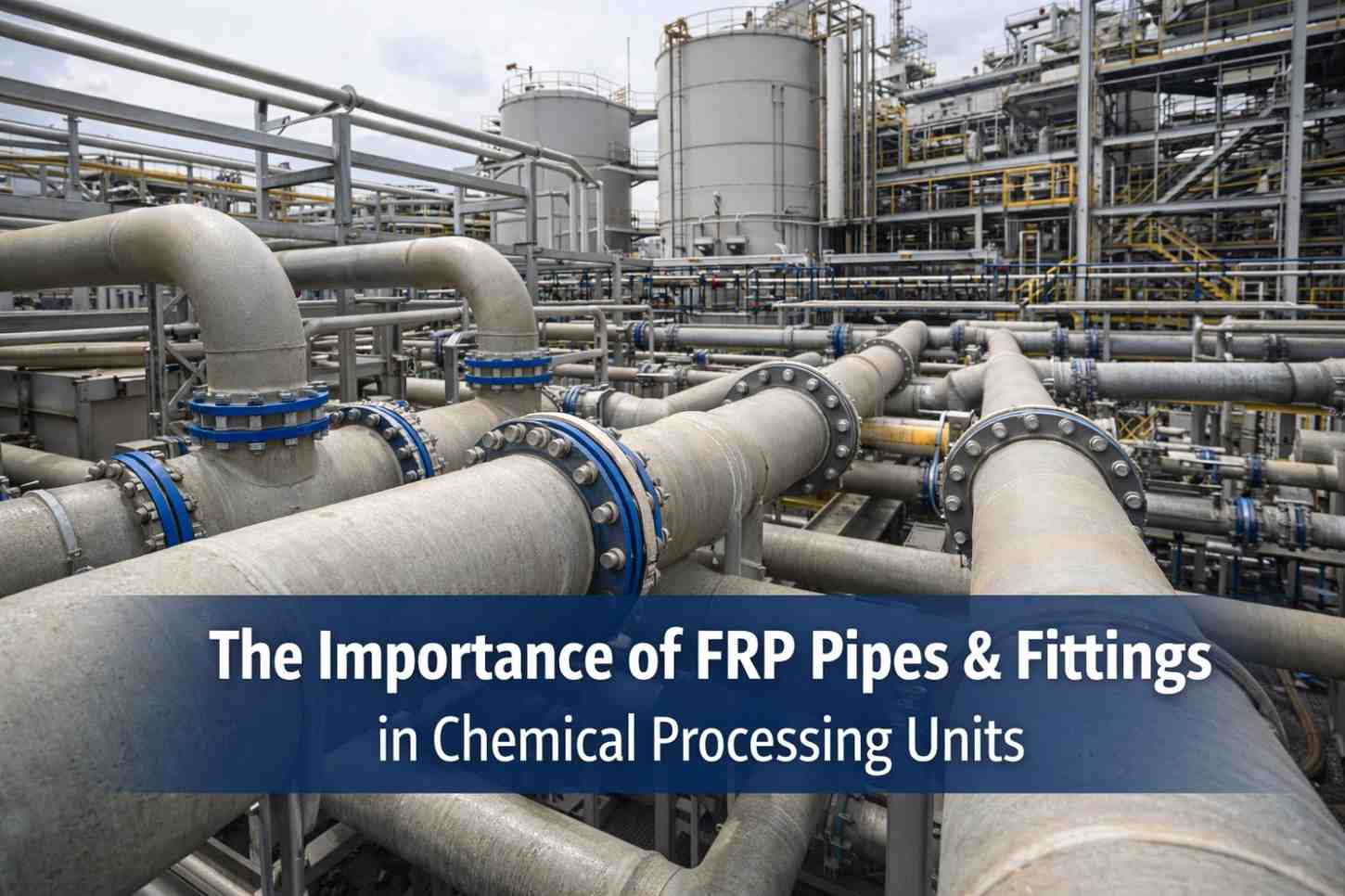
Expert guidance for engineers and procurement teams handling acid storage tanks, chemical transfer piping, and hypochlorite systems.
In many chemical plants, failure does not begin with a major breakdown. It starts with a small leak in an acid line or unexpected thinning inside a pipe. Maintenance visits increase. Planning becomes uncertain.
If you are involved in piping selection, you know how much depends on that early material decision. What you choose today affects reliability for years.
That is why FRP pipes and fittings are more than an alternative to metal systems. They are often a long-term corrosion control strategy in chemical processing units.
If you want to explore specifications and product configurations directly, you can review Busubait’s FRP Piping & Fittings solutions.
Let’s understand why FRP matters in chemical processing units.
Need a quick specification? Download our FRP piping datasheet or request a quote.
Chemical plants operate in aggressive environments. Acids. Alkalis. Chlorides. Solvents. Elevated temperatures. Continuous flow.
Traditional materials like carbon steel face:
Even stainless steel is not immune. Chloride-induced pitting is a real problem in many Gulf-based plants.
If you have already evaluated storage materials, you may have seen similar corrosion discussions in Why FRP Tanks Outperform Traditional Tanks in Chemical Storage.
Pipelines face the same chemistry. But with pressure and flow added. That makes the risk higher.
FRP piping is not “plastic pipe.” It is an engineered composite. Let’s break that down simply.
A corrosion-resistant inner liner, structural glass fiber layer, and UV-protective outer layer. The liner thickness and resin content are critical.
Polyester, vinyl ester, or epoxy systems. Choosing the wrong resin can reduce pipe life drastically.
Thermoplastic liners (PP, PVDF) combined with FRP structure for extreme chemical resistance.
Market context: The global fiberglass pipes market size was estimated at USD 4.59 billion in 2023 and is projected to reach USD 6.17 billion by 2030, growing at a CAGR of 4.5% from 2024 to 2030. Fiberglass pipes are used in several industrial applications, including the storage of corrosive materials and the handling of other materials in corrosive environments.
Most articles stop at “FRP does not rust.” That is not enough. In chemical processing units, corrosion challenges include concentrated acids attacking metal internally, and caustic solutions degrading carbon steel.
FRP eliminates electrochemical corrosion because it is non-metallic. It also removes the need for cathodic protection systems, frequent repainting, and complex insulation corrosion monitoring.
Chloride-rich environments cause pitting in stainless steel. FRP is inherently resistant. For integrated systems, piping should be evaluated together with FRP Chemical Storage Tanks and Fiberglass Process Vessels.
Chemical plants do not operate in isolation. Systems must match.
Research on atmospheric corrosion of carbon steel at marine sites in Saudi Arabia confirms that coastal industrial environments accelerate corrosion rates significantly, reinforcing why non-metallic piping systems are a more reliable long-term choice in GCC chemical plants.
From acid transfer to effluent lines — Busubait engineers FRP solutions for your exact process conditions.
Response within 24 hrs
Have you ever calculated pump energy losses due to internal pipe roughness? FRP pipes offer: smooth internal bore, reduced friction loss, lower scaling tendency, improved flow efficiency over time. In long chemical transfer lines, this can translate into measurable energy savings. This is rarely discussed. But it affects operational cost year after year.
lower maintenance
longer service life
cathodic protection
Initial cost comparison can be misleading. Steel piping systems often require internal coatings, external painting, periodic corrosion inspection, replacement sections due to pitting, downtime during maintenance. FRP systems eliminate most of these recurring expenses.
When lifecycle cost is evaluated across maintenance intervals, downtime impact, replacement cycles, and safety risk mitigation, FRP often proves financially advantageous. If you are already evaluating tank lifecycle benefits, compare similar principles on the FRP Tanks page. Short-term savings rarely beat long-term reliability.
Chemical processing units prioritize safety. FRP contributes by: being electrically non-conductive, reducing galvanic corrosion risks, offering fire-retardant formulations, lowering probability of corrosion-related leaks. Leak prevention is not just a maintenance topic. It is an HSE concern. For environmental compliance solutions integrated with piping, you may explore FRP Air Pollution Control Equipment. Safety design must be system-based.
FRP piping is commonly deployed in: acid transfer lines, alkali handling systems, effluent and wastewater lines, slurry handling pipelines, flue gas desulfurization systems. For gas and vapor handling, related solutions like FRP Scrubber Systems and FRP Ducting Systems are often integrated into the same plant design. Piping rarely works alone.
There are situations where pure FRP may not be enough. Highly aggressive chemicals or elevated temperatures may require PP-lined FRP systems, PVDF-lined FRP piping, PFA-based chemical liners. Dual laminate construction combines a thermoplastic inner liner for chemical resistance and an FRP outer shell for structural strength. This approach provides both chemical stability and mechanical reliability. It is a strategic upgrade, not a default option.
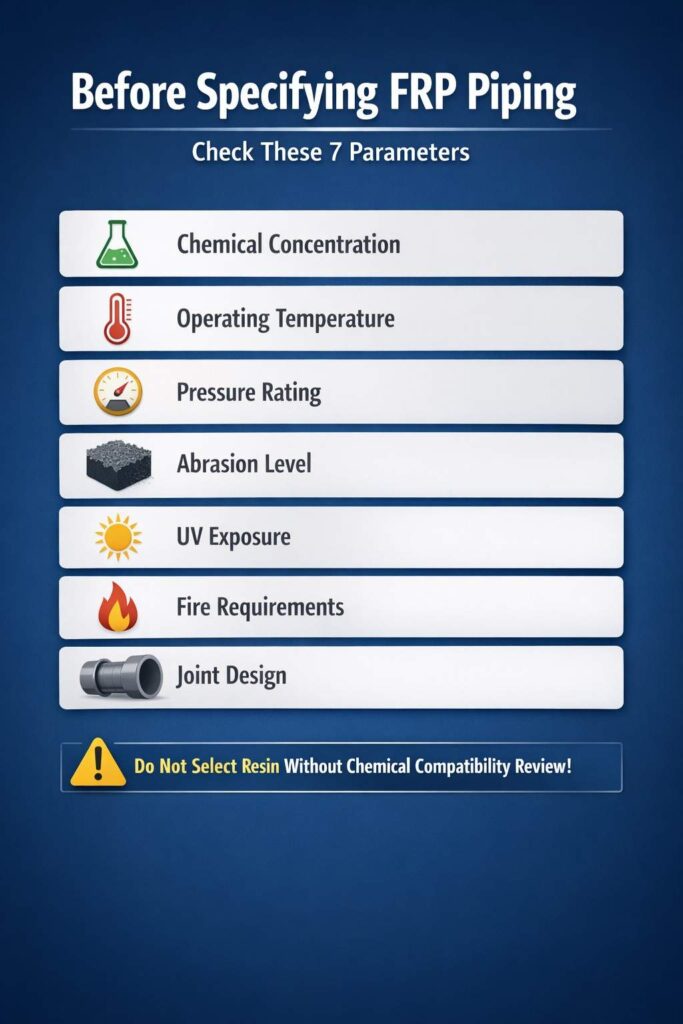
Trust increases when limitations are acknowledged. FRP may not be ideal in: extremely high temperatures beyond resin limits, severe abrasive slurry without proper liner engineering, poorly installed systems lacking correct support design. Material failure in such cases is not because FRP is weak. It is because engineering requirements were ignored. Material selection must follow proper process data.
Chemical plants include: Storage tank → Transfer piping → Reactor → Scrubber → Effluent system. When different vendors supply each component, compatibility risks increase. Working with a manufacturer offering a broader portfolio, like Busubait, reduces interface risks and ensures material compatibility.
Saudi and GCC industrial environments present: coastal humidity, high ambient temperatures, intense petrochemical exposure. Local manufacturing capability and regional experience improve response time, customization, and compliance with project specifications. Vendor credibility matters in large-scale industrial projects.
FRP pipes and fittings are not just corrosion-resistant alternatives. They are a lifecycle cost strategy, a plant reliability investment, and a long-term infrastructure upgrade.
If you are evaluating piping systems for a new chemical project or planning a retrofit, reviewing FRP specifications early in the design stage may prevent years of maintenance challenges.
The engineering team at Busubait can help you assess the right FRP configuration for your application.
