Address
Busubait Fiberglass Factory
P.O Box 63113, Dammam 31516
Kingdom of Saudi Arabia
Work Hours
Monday to Friday: 7AM - 7PM
Weekend: 10AM - 5PM

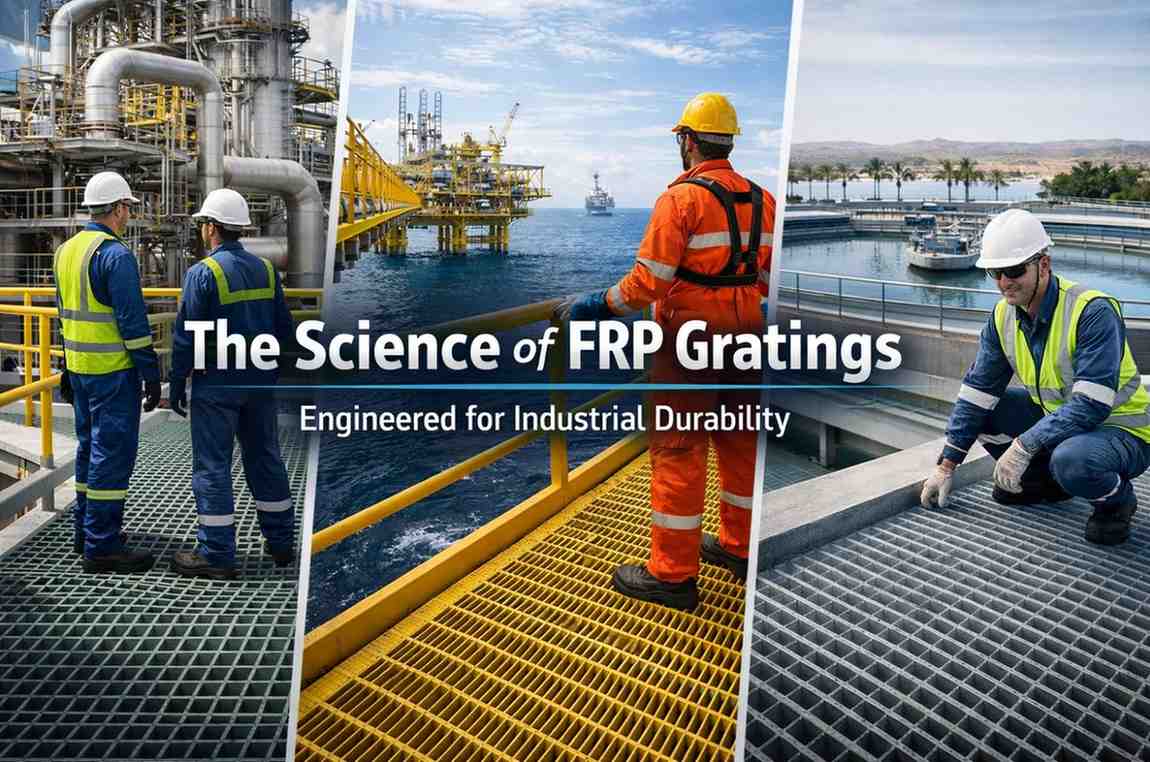
Fiber Reinforced Plastic (FRP) gratings are not generic industrial flooring products. They are engineered structural components designed for access systems, platforms, walkways, trench covers, and service areas where corrosion, electrical hazards, moisture, and chemicals make traditional materials unreliable.
The performance of FRP gratings is rooted in material science and structural engineering. High-strength glass fibers, thermoset resin chemistry, controlled fiber orientation, and strong interfacial bonding work together to deliver corrosion immunity, electrical non-conductivity, and long-term durability. Understanding these principles is essential for plant managers and EPC engineers responsible for risk mitigation, lifecycle cost control, and operational continuity.
Excellent electrical insulation; good tensile strength. Standard for most industrial & electrical safety.
Higher silica content; superior tensile strength & heat resistance. Specialized, high-load, extreme temperature environments.
Balanced resistance to acidic & alkaline environments.
Superior resistance to strong acids, bases, solvents; higher fatigue resistance.
High char-yields, minimal smoke, retains structural integrity under fire. Engineered for fire safety.
Scavenge free radicals, prevent polymer chain breakdown outdoors.
Release water vapor/non-combustible gases, starve flame of oxygen.
Silane Coupling Agents form covalent bonds between inorganic fiber & organic resin, preventing moisture wicking & delamination ("fiber blooming").
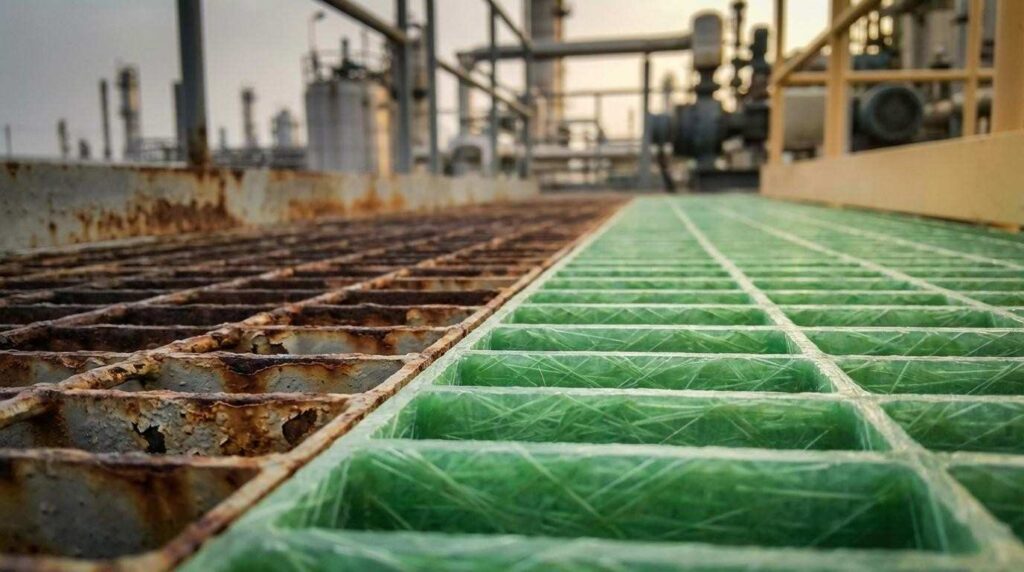
Industrial access systems are often treated as secondary components, until failure causes safety incidents, shutdowns, or unplanned maintenance. In sectors such as oil and gas, chemical processing, desalination, power, marine, and mining, gratings operate in environments defined by:
Continuous moisture or chemical exposure that degrades traditional materials.
High UV radiation and ambient temperatures common in Middle Eastern installations.
Coastal salinity and airborne chlorides that accelerate corrosion.
Electrical and explosion-risk zones requiring non-conductive, non-sparking materials.
FRP gratings are engineered specifically to address these conditions. Their behavior cannot be evaluated using the same assumptions applied to steel or aluminium. Material science, not thickness alone, determines performance.
Fibers are pulled through a resin bath and heated die. Profiles are assembled into grating panels using tie bars.
High fiber alignment in the span direction. Anisotropic behavior with high stiffness along the primary load path.
Better performance over longer spans. Functions similarly to beam-based systems, but without corrosion risk.
Continuous glass rovings are interwoven in a lattice pattern. Resin saturation and heat curing form a single monolithic panel.
Nearly equal strength in both directions within the panel plane. Loads are redistributed through the surrounding mesh.
Openings and penetrations can be cut with less concern for directional weakness. Well suited for platforms, walkways, trench covers, and drainage areas.
Air entrapment within the laminate acts as a stress concentrator. Under cyclic or concentrated loading, voids initiate cracking.
Typically below 1% for industrial applications.
Controlled resin viscosity, mechanical rolling, and vacuum-assisted impregnation.
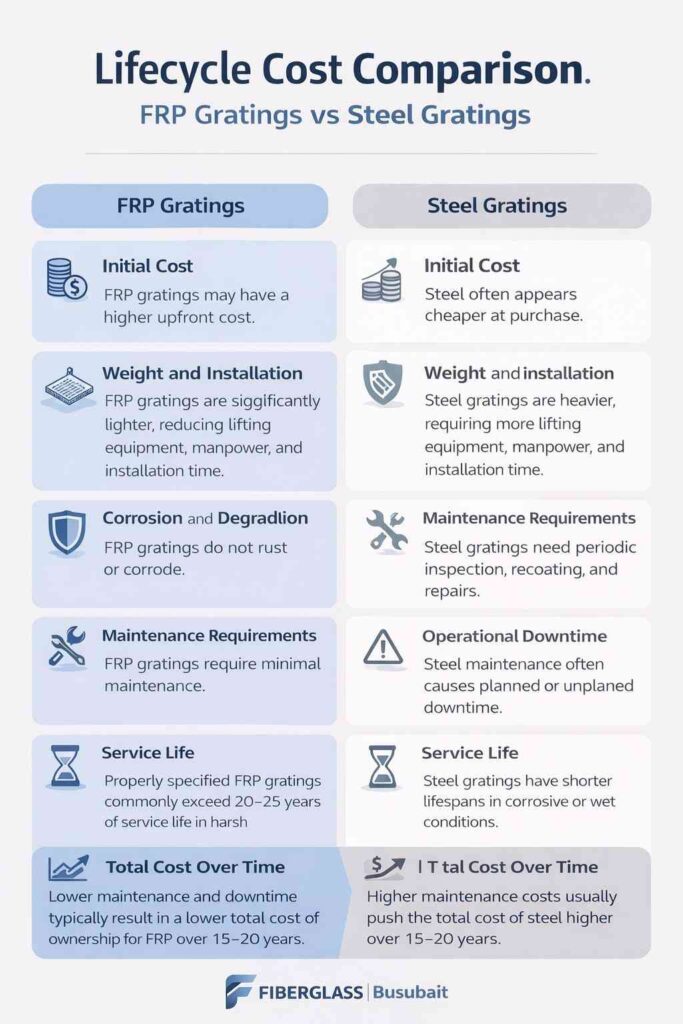
Weight of Steel
Lower Total Cost
Resin by Weight
Years Service Life
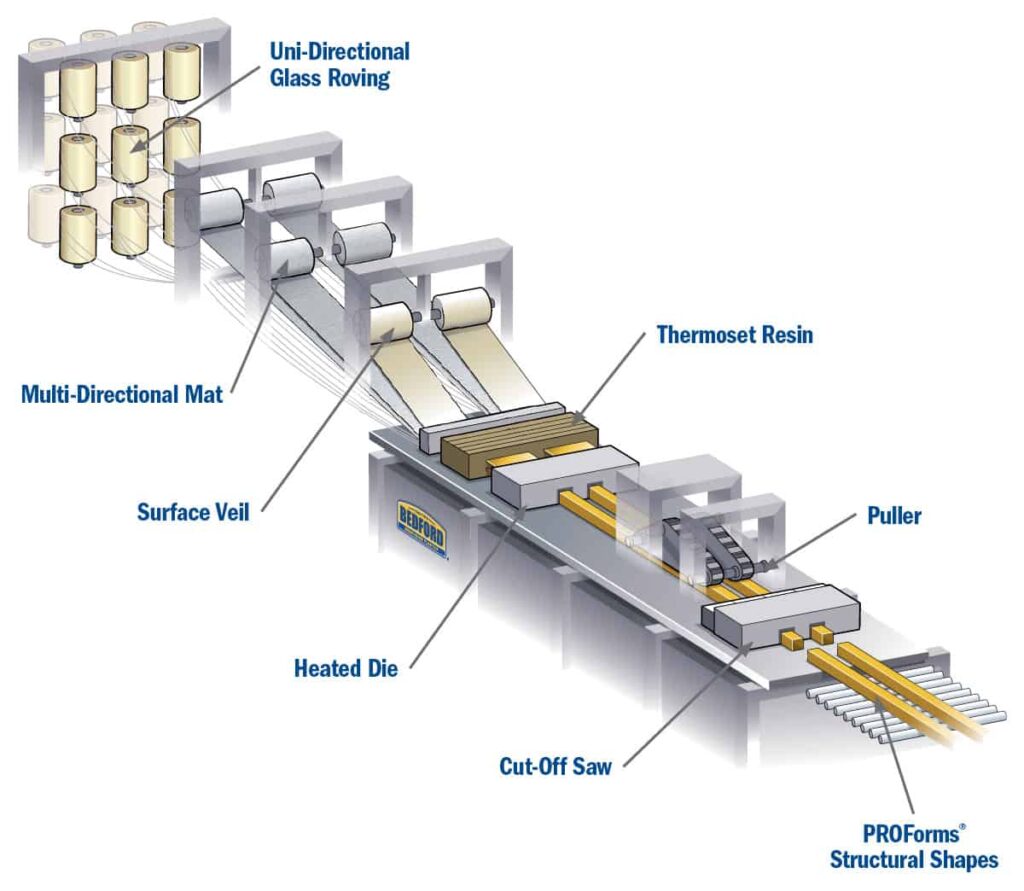
Image Source: Research Gate
FRP gratings typically weigh around one-quarter of steel for comparable load capacity.
Lower foundation and support requirements for structures.
Faster installation and reduced lifting equipment needs.
Optimized load distribution without excessive weight.
| Material | Modulus of Elasticity (psi) | Characteristics |
|---|---|---|
| Steel | ~29,000,000 | High stiffness, permanent deformation under overload |
| Aluminium | ~10,000,000 | Moderate stiffness, lighter than steel |
| Molded GFRP | ~2,800,000 | Flexible but returns to shape elastically |
Deflection governs design more than ultimate strength. Typical comfort limits are Span/100 or Span/120, depending on application.
Complete immunity to saltwater corrosion in coastal and marine environments.
Vinyl ester FRP withstands acid bunds and spill zones with aggressive chemicals.
Weight reduction lowers platform center of gravity. Non-sparking behavior improves safety margins.
Slip resistance and hydrolysis resistance improve safety and longevity in wet environments.
Busubait provides engineered FRP grating solutions designed for Saudi Arabia’s harsh industrial environments. Our technical team can help you select the right resin system, manufacturing method, and specifications for your specific application.
FRP gratings represent a material upgrade driven by advanced composite science. Their durability, safety performance, and resistance to corrosion come from the controlled interaction of glass fibers, resin chemistry, and manufacturing precision.
When specified correctly, FRP gratings deliver reliable service in environments where traditional materials consistently fail. For industrial decision-makers in Saudi Arabia, understanding these scientific principles is key to optimizing safety, reducing lifecycle costs, and ensuring operational continuity in demanding environments.
