Address
Busubait Fiberglass Factory
P.O Box 63113, Dammam 31516
Kingdom of Saudi Arabia
Work Hours
Monday to Friday: 7AM - 7PM
Weekend: 10AM - 5PM

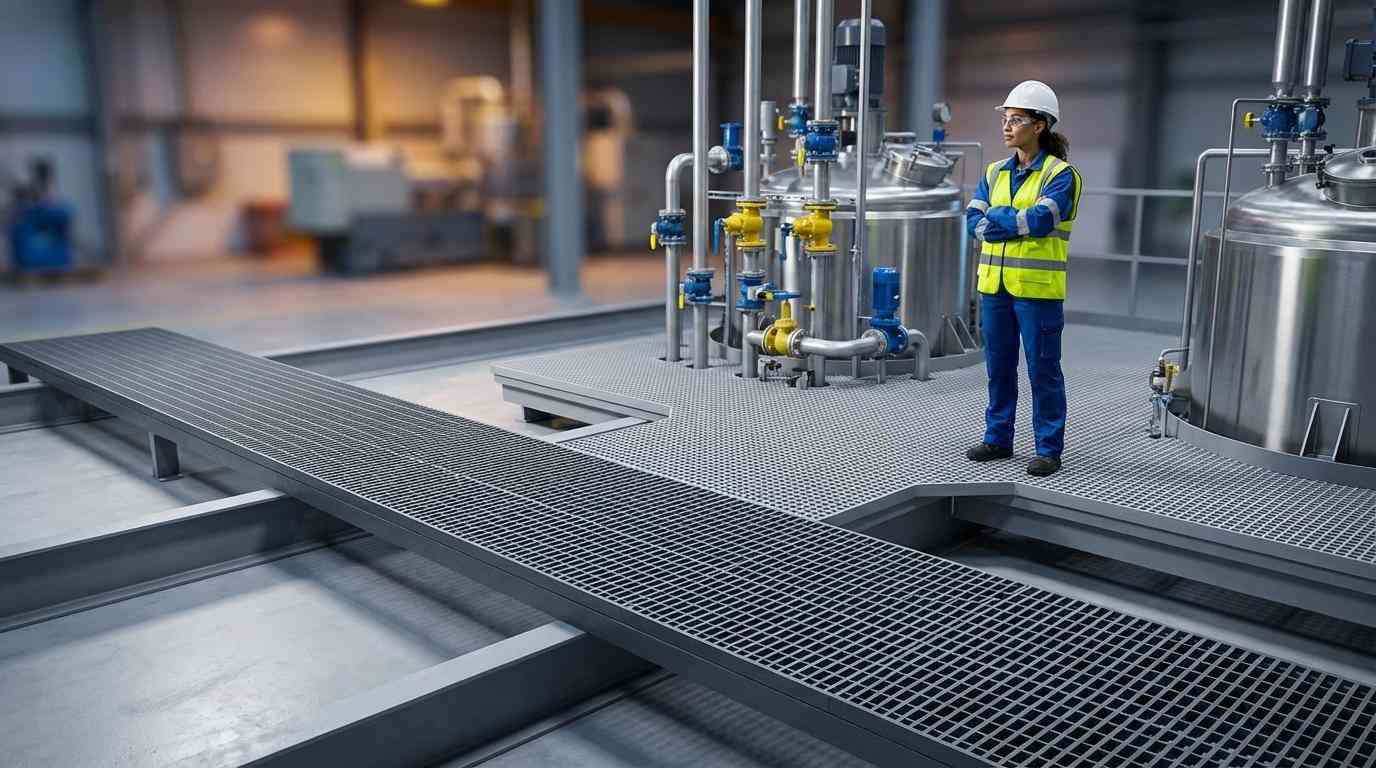
This guide provides a detailed comparison of Molded FRP Grating and Pultruded FRP Grating to assist engineers and procurement managers in specifying the correct type for industrial applications.
Choosing the right FRP grating is a specification decision, not a preference decision. Molded grating and pultruded grating are both proven industrial solutions, but they are designed to solve different engineering problems.
The right choice depends on load, span, environment, and layout complexity. This guide explains the differences clearly, without marketing noise, so you can specify the correct grating for your application. At Busubait, fiberglass grating solutions are engineered to meet industrial load, corrosion, and safety requirements across multiple applications.
There is no universal winner. The correct grating is the one that matches your load, span, environment, and layout requirements. This guide helps you make an informed specification decision based on engineering principles.
Our FRP grating experts can help you select the right solution for your specific application requirements.
FRP stands for Fiberglass Reinforced Plastic. It is manufactured by combining fiberglass reinforcement with thermoset resins.
Excellent performance in chemical, coastal, and wet environments where traditional metals fail.
Significantly lighter than steel, reducing structural support requirements and installation costs.
Long service life with minimal upkeep compared to metal alternatives that require painting or coating.
Spark resistant and electrically non-conductive, making it safer in aggressive industrial conditions.
FRP grating is widely used for walkways, platforms, stair treads, trench covers, and access systems in industrial plants. Its versatility makes it suitable for applications ranging from chemical processing to water treatment facilities.
The fundamental difference between molded and pultruded grating lies in their manufacturing processes, which directly affect their structural properties and performance characteristics.
Invented by William C. Coonrod in 1966, moulded FRP grating is produced by interweaving continuous fiberglass layers in a mold and saturating them with liquid resin.
Composition: Approximately 65-75% resin and 25-35% fiberglass by weight. This high resin ratio makes it the king of corrosion resistance.
Structure: A one-piece, cast panel with a square or rectangular mesh, ensuring strength is uniform throughout.
Continuous fiberglass rovings are pulled through a resin bath and cured through a heated die to form bearing bars, which are then assembled with cross rods to form panels.
The Pultrusion Advantage: Pultruded grating offers significantly higher glass content (60–70%), translating to extraordinary longitudinal stiffness for wide spans.
Structure: Parallel bearing bars, usually I or T profile, with strength concentrated along the bearing bar direction (unidirectional strength).
Email us at fiberglass@busubait.com to request comprehensive technical data sheets with detailed load tables, span charts, and chemical resistance guides for both molded and pultruded grating.
Understanding the fundamental differences in characteristics will help you specify the right grating for your application.
Offers superior corrosion resistance, making it ideal for highly corrosive environments.
Maintains structural integrity when cut, as strength is distributed in both directions. No extra support is needed for cut edges.
Maintains structural integrity when cut, as strength is distributed in both directions. No extra support is needed for cut edges.
High impact absorption, making it ideal for environments where tools or equipment might be dropped.
Results in significantly higher stiffness and strength along the length of the bearing bars.
Strength is primarily along the bearing bars; cross-rods do not carry load.
Ideal for long, unsupported spans where minimizing deflection is crucial.
Requires planning; cutting bars necessitates resealing and edge-banding for structural integrity.
| Feature | Molded FRP Grating | Pultruded FRP Grating | Engineering Nuance |
|---|---|---|---|
| Fiberglass:Resin Ratio | ~30% Glass / 70% Resin | ~65% Glass / 35% Resin | Molded for corrosion; Pultruded for stiffness. |
| Strength Direction | Bi-Directional | Uni-Directional | Molded is forgiving; Pultruded needs orientation planning. |
| Span Capability | Short to Moderate | Long, Unsupported | Pultruded minimizes deflection over long spans. |
| Fabrication | Excellent; easy to cut | Requires planning | Pultruded needs edge-banding when cut. |
| Impact Resistance | High | Moderate | Molded is better for dropped tools or impacts. |
| Corrosion Resistance | Excellent | Very Good | Molded excels in highly aggressive chemical environments. |
| Cost Considerations | Generally Economical | Higher Cost | Pultruded costs more due to strength and manufacturing process. |
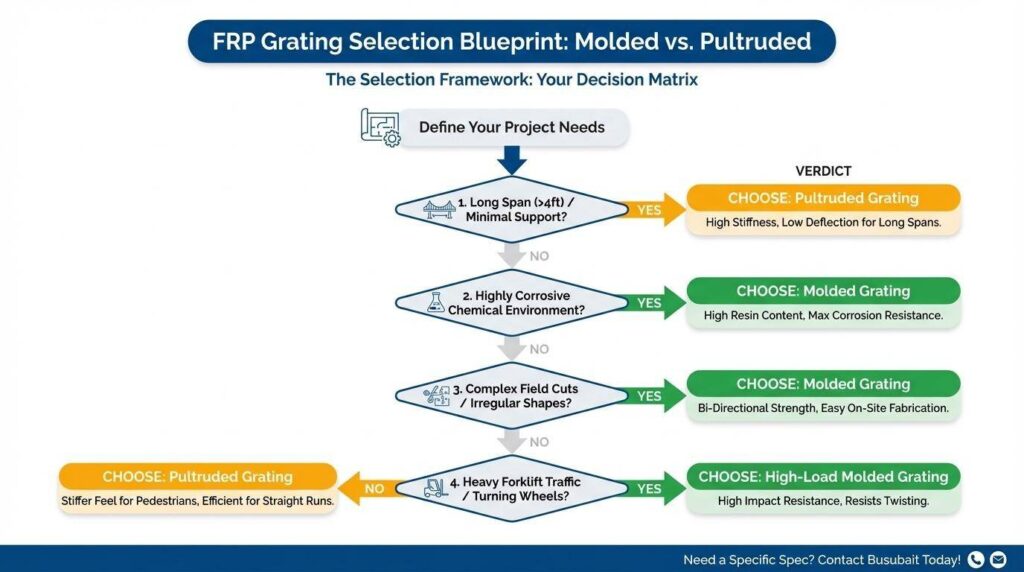
Follow this systematic approach to specify the correct FRP grating for your application.
Identify whether you need support for pedestrian traffic, equipment carts, forklifts, or static/dynamic loads. Load type and magnitude determine the structural requirements.
Determine if you have short spans with multiple supports or long spans with limited support points. This is often the deciding factor between molded and pultruded.
Assess chemical exposure type and concentration, coastal or marine conditions, wet, oily, or washdown areas. Environment dictates resin selection and grating type.
Account for multiple cut-outs, penetrations, irregular shapes, or equipment clearance. Complex layouts favor molded grating for easier fabrication.
Evaluate slip resistance needs, fire performance expectations, and electrical non-conductivity requirements. Safety should never be compromised.
Send us your project requirements and our engineers will recommend the optimal FRP grating solution.
Mistake: Using molded grating for long spans without checking deflection limits.
Solution: Always verify span capabilities against load requirements. Pultruded grating is specifically engineered for long-span applications where deflection control is critical.
Mistake: Ignoring load direction in pultruded grating layouts.
Solution: Pultruded grating must be oriented with bearing bars perpendicular to the primary load direction. Failure to do so significantly reduces load capacity.
Mistake: Cutting pultruded bearing bars without reinforcement planning.
Solution: Any cuts to pultruded bearing bars require proper edge-banding and resealing to maintain structural integrity and corrosion resistance.
Mistake: Selecting surface finish without considering slip risk in wet or oily conditions.
Solution: Always specify appropriate grit surfaces or serrated tops for areas where slip resistance is critical for worker safety.
Mistake: Choosing resin based on cost instead of chemical exposure requirements.
Solution: Match resin type to the specific chemical environment. Vinyl ester resins offer superior chemical resistance for aggressive environments despite higher cost.
Pultruded grating is stronger and stiffer due to higher fiberglass content and unidirectional reinforcement. However, “stronger” depends on direction – molded grating has more balanced, bi-directional strength while pultruded has superior strength along the bearing bars.
Molded grating is often preferred in aggressive chemical environments due to higher resin content (65-75% resin vs. 25-35% fiberglass). The resin-rich surface provides better corrosion resistance against chemical spills and fumes. However, both types can be manufactured with chemical-resistant resins like vinyl ester for demanding applications.
Yes, molded grating handles field cut-outs exceptionally well without major loss of strength. Its bi-directional reinforcement means cut edges don’t require additional support. This makes it ideal for retrofit projects or installations with numerous penetrations.
Pultruded grating performs better for long unsupported spans due to its higher stiffness and strength-to-weight ratio. The unidirectional reinforcement along bearing bars minimizes deflection over extended distances, making it the preferred choice for catwalks, bridges, and elevated platforms with limited support points
Share your load requirements, span length, environment, and layout details with our engineering team at fiberglass@busubait.com. We’ll provide detailed recommendations, technical data, and quotations to ensure you select the optimal solution for your project.
Pultruded grating is better for strength, stiffness, and long-span structural applications where deflection control is critical.
Molded grating is better for corrosion resistance, impact tolerance, and complex layouts requiring multiple cut-outs or field modifications.
The Bottom Line: There is no universal winner. The correct grating is the one that matches your load, span, environment, and layout requirements. Making the right specification decision requires understanding the engineering principles behind each manufacturing process and how they translate to real-world performance.
These characteristics make FRP gratings particularly suitable for safety-critical utility environments.
Although FRP moulded gratings may have a higher initial cost than steel, multiple studies highlight lower total lifecycle cost due to:
Our FRP specialists are ready to help you make the right choice for your specific application.
