Address
Busubait Fiberglass Factory
P.O Box 63113, Dammam 31516
Kingdom of Saudi Arabia
Work Hours
Monday to Friday: 7AM - 7PM
Weekend: 10AM - 5PM

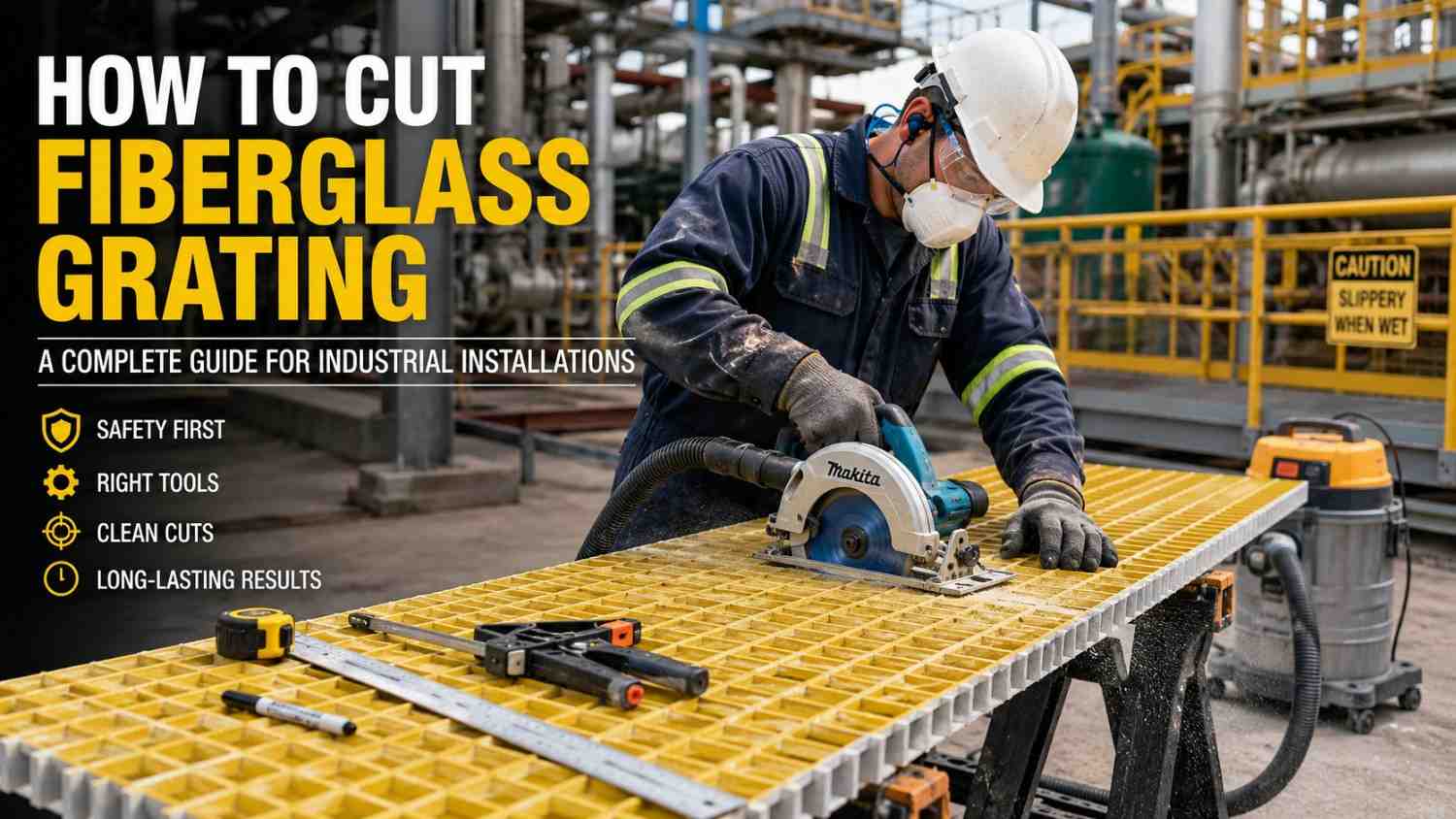
A fiberglass grating panel rarely fits perfectly straight out of the crate. Whether you’re installing a new access platform at a chemical processing plant, replacing corroded steel flooring during a refinery shutdown, or modifying a walkway around pipes, cable trays, equipment bases, or structural columns, some level of onsite fabrication is almost inevitable.
Fortunately, Fiberglass Reinforced Plastic (FRP) grating is designed with field fabrication in mind. Unlike traditional steel grating—which often requires welding, flame cutting, grinding, repainting, and hot work permits—FRP can usually be cut using standard power tools equipped with the right composite-cutting blades.
“This ease of fabrication is one of the reasons fiberglass grating has become the preferred flooring material across industries such as oil and gas, petrochemicals, desalination, water and wastewater treatment, marine infrastructure, mining, food processing, and power generation.”
Why FRP Grating Is Growing Worldwide
Global demand continues to grow steadily. More industries are adopting corrosion-resistant composite flooring. Asia-Pacific represents the largest share of the market due to rapid industrialization and infrastructure expansion.
Water and wastewater treatment is among the fastest-growing application sectors. FRP performs exceptionally well in wet and chemically aggressive environments.
Installation is significantly faster than steel in many applications. No welding, repainting, or hot work is required for most installations.
Industries Benefiting from FRP Grating:
• Chemical processing facilities
• Petrochemical plants
• Offshore platforms
• Refineries
• Desalination plants
• Marine terminals
• Water and wastewater treatment facilities
• Power generation plants
• Mining operations
• Food and beverage manufacturing
Across industrial sectors, facility owners are replacing conventional steel grating with FRP because it offers excellent corrosion resistance, lower maintenance requirements, and faster installation. If you’re still comparing FRP with traditional materials, you may also find our article on Fiberglass Myths: Industrial Material Decisions useful, as it addresses several misconceptions that influence material selection.
The short answer is yes—and that’s one of its biggest advantages.
Unlike many traditional industrial flooring materials, fiberglass grating is specifically engineered to allow onsite modifications without requiring specialised fabrication equipment. Installers can trim panels, create openings for pipes and equipment, adjust dimensions, and fabricate inspection access points using common power tools fitted with composite-cutting blades. This flexibility saves both time and labour during installation.
Flexibility During Maintenance: Plant shutdowns rarely go exactly as planned. Existing pipework may differ slightly from engineering drawings, equipment positions may have changed over time, or previously hidden structural members may only become visible after old flooring has been removed. Being able to modify a fiberglass grating panel on site—without sending it back to a fabrication shop—helps maintenance teams stay on schedule and minimise costly downtime.
Because FRP is a composite material rather than a metal, it doesn’t rust after cutting, and no welding is required. In many industrial facilities, this significantly simplifies installation planning while reducing safety risks associated with hot work. To better understand the different types, load capacities, and industrial applications, explore our Fiberglass Gratings & Pultruded Profiles solutions.
Although fiberglass grating is manufactured in standard panel sizes, very few industrial installations consist entirely of perfect rectangles. Almost every project requires some level of field modification. Here are the most common situations where cutting becomes necessary.
Industrial plants contain hundreds of process lines carrying chemicals, steam, compressed air, water, or gases. These pipes often pass directly through walkways and platforms, making circular or irregular cut-outs one of the most common fabrication tasks. Because molded fiberglass grating distributes loads in multiple directions, it generally accommodates these modifications particularly well.
Platforms frequently surround process equipment that wasn’t designed around standard grating dimensions. During installation, panels often require trimming around pumps, heat exchangers, pressure vessels, instrumentation skids, valve stations, and storage tanks. Accurate fabrication helps ensure safe access while maintaining the integrity of the flooring system.
Support columns, beams, and structural frames rarely align perfectly with standard panel sizes. Creating neat notches around these structural elements improves the finished appearance of the installation while eliminating unnecessary gaps that could become trip hazards.
Modern industrial facilities often route electrical and instrumentation services beneath walkways. Cable trays, conduit runs, junction boxes, and utility penetrations frequently require custom openings that can only be produced during installation.
Many facilities incorporate trench drains, inspection chambers, valve pits, or removable access covers within their flooring systems. These openings almost always require custom fabrication to ensure the grating fits securely while still allowing easy maintenance access.
One of the most common applications involves replacing old steel grating with fiberglass during maintenance shutdowns. Although the original platform dimensions remain unchanged, years of plant modifications often mean the replacement panels require trimming around additional pipework, new equipment, or altered structural supports.
This is one of the most common questions engineers and installers ask—and understandably so. After all, industrial flooring must safely support personnel, equipment, and maintenance loads throughout its service life.
The good news: Standard installation cuts do not normally compromise the performance of fiberglass grating when they are properly planned and executed. Simple modifications such as trimming panel edges, creating pipe penetrations, or producing access openings are considered normal fabrication practices.
Problems generally arise only when excessive material is removed without considering how the grating carries load. For example, cutting through several primary load-bearing members in a pultruded grating panel can reduce its structural capacity if the modification isn’t accounted for in the design.
✓ Which direction do the bearing bars run?
✓ Will the opening remove multiple structural members?
✓ Is reinforcement required?
✓ Does the manufacturer provide fabrication guidance?
✓ Should the project engineer review the modification?
Planning takes only a few minutes, but it can prevent expensive mistakes later.
| Feature | Molded Fiberglass Grating | Pultruded Fiberglass Grating |
|---|---|---|
| Load distribution | Bidirectional | Primarily along bearing bars |
| Field modifications | Excellent | Requires more planning |
| Pipe penetrations | Easy | Moderate |
| Irregular cut-outs | Excellent | Good |
| Long-span applications | Good | Excellent |
| Heavy industrial loads | Good | Excellent |
Pultruded grating is built differently. Instead of a fully integrated grid, it consists of parallel load-bearing bars connected by cross rods. Most of its strength lies in those bearing bars.
Before cutting: Identify bearing bar direction, minimize removal of primary structural members, follow engineering drawings carefully, reinforce large openings where specified
Molded grating is manufactured as a single, integrated grid in which the load is distributed across both directions. This bidirectional strength makes it particularly forgiving during field fabrication.
Best for: Numerous pipe penetrations, irregular platform layouts, circular cut-outs, frequent onsite modifications, maintenance retrofits
Choosing the right cutting equipment is one of the biggest factors in achieving clean, accurate cuts while protecting the structural integrity of fiberglass grating.
For most industrial installations, a handheld circular saw fitted with a composite-cutting blade delivers the best balance of speed, accuracy, and ease of use. It produces straight, consistent cuts while allowing installers to fabricate large grating panels quickly.
• Trimming grating panels to size
• Cutting full-width sections
• Fabricating walkways and access platforms
• Production cutting of multiple panels
• General onsite installation work
Pro Tip: Whenever possible, support the saw with a straightedge or guide rail. This simple step helps produce cleaner, straighter cuts while reducing operator fatigue during long fabrication sessions.
An angle grinder fitted with a diamond cutting disc is extremely useful when working in confined spaces where a circular saw cannot easily reach. Many maintenance technicians keep one available for quick adjustments during plant shutdowns.
• Edge trimming
• Small corrective cuts
• Tight installation areas
• Modifying already-installed grating
• Removing small sections
Note: Because angle grinders operate at very high speeds, they generally generate more dust than circular saws. Whenever practical, use local dust extraction or work in a well-ventilated area.
Not every installation involves straight cuts. Industrial platforms often require circular openings around process pipes, drains, valves, instrumentation, and structural columns. A jigsaw fitted with a carbide-grit or fine-tooth composite blade provides excellent control when creating these more intricate shapes.
• Pipe penetrations
• Equipment openings
• Rounded notches
• Inspection hatches
• Irregular cut-outs
Tip: Allow the blade to follow the marked line naturally. Trying to force tight curves usually causes rough edges and unnecessary blade wear.
When fabricating large numbers of panels in a workshop, a band saw offers exceptional consistency and repeatability. Manufacturers often use band saws when producing custom panel layouts or repetitive production runs.
• Batch fabrication
• Precision workshop cutting
• Multiple identical panels
• Custom industrial projects
• Factory fabrication
Note: Although band saws are less common on construction sites, they remain one of the best options for controlled fabrication environments.
Selecting the correct blade is just as important as choosing the right power tool. Since fiberglass contains abrasive glass fibres, ordinary steel blades quickly lose their cutting edge. As they become dull, they generate excessive heat, produce rough edges, and require more force from the operator.
Best Overall Performance
If you regularly fabricate fiberglass grating, a continuous-rim diamond blade is generally the best investment.
• Long service life
• Minimal edge splintering
• Smooth cutting action
• Lower vibration
• Excellent for repetitive work
Best Value for Contractors
One of the most popular choices among installation contractors.
• Readily available
• Lower purchase cost
• Clean, accurate cuts
• Suitable for most work
• Good blade life
Ideal for Precision Work
One of the most popular choices among installation contractors.
• Readily available
• Lower purchase cost
• Clean, accurate cuts
• Suitable for most work
• Good blade life
Wood or Metal Blades
One of the biggest mistakes new installers make.
• Rough edges
• Increased vibration
• More airborne dust
• Excessive heat
• Blade binding
Expert Recommendation: If you’re cutting more than a handful of FRP panels, invest in a quality diamond or carbide blade from the beginning. It will improve both the quality of the installation and the overall efficiency of the project.
Fiberglass grating is safe to fabricate when proper precautions are followed, but cutting produces fine airborne dust that can irritate the skin, eyes, and respiratory system. Wearing suitable PPE protects workers while creating a cleaner and more comfortable working environment.
Many installers focus entirely on producing accurate cuts. Experienced fabricators know that good dust management is equally important. Fine fiberglass particles can:
• Reduce visibility while cutting
• Irritate exposed skin
• Increase cleanup time
• Settle on nearby equipment
• Create an untidy workspace
Position a Vacuum: Capturing dust at its source dramatically reduces airborne particles. Keep the vacuum nozzle close to the cutting blade.
Use Damp Cloths: On smaller jobs, placing damp disposable cloths around the cutting area helps trap loose fibres.
Isolate Work Areas: Use temporary clear plastic sheeting to prevent dust from spreading into adjacent work areas.
Clean During Work: Remove dust regularly using a vacuum. Avoid dry sweeping.
Field Insight: Experienced FRP installers often say that good housekeeping starts before the first cut. Taking a few minutes to position a vacuum, organise the workspace, and isolate the cutting area can reduce cleanup time considerably while making the job safer and more comfortable for everyone involved.
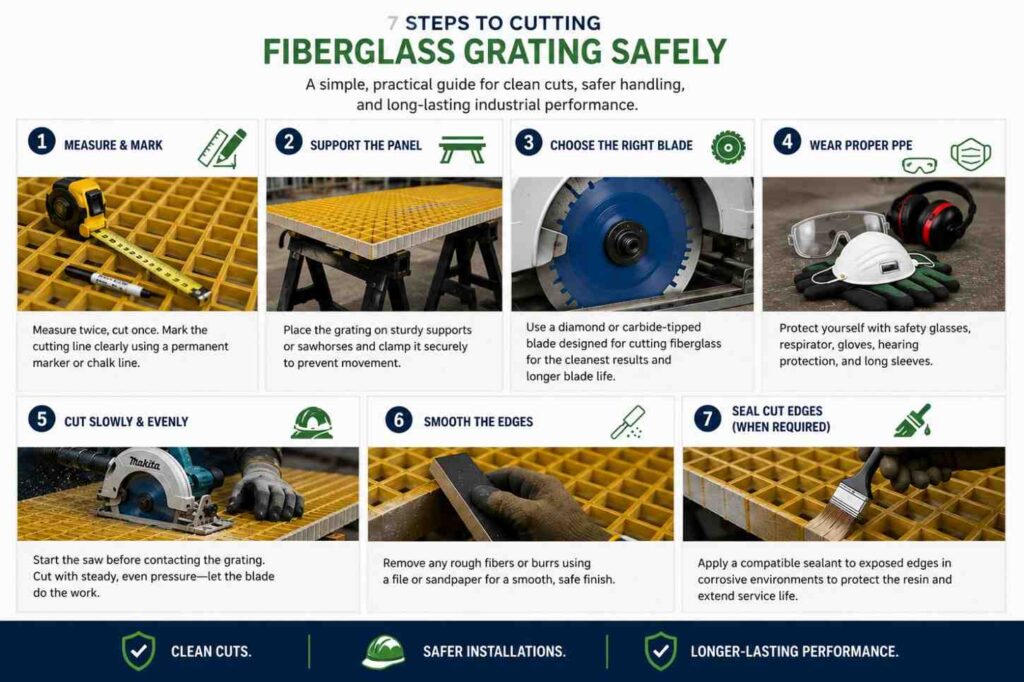
Every successful installation starts with accurate measurements. Even a small measuring error can lead to wasted material, installation delays, and costly replacements. Before marking the panel, take the time to verify all dimensions against the project drawings and inspect the installation area for any obstructions. Pay particular attention to process pipes, structural columns, cable trays, equipment foundations, drain openings, expansion joints, and existing support members.
Pro Tip: Experienced fabricators rarely rely on a single measurement. They measure twice, compare the panel against the installation drawings one final time, and only then begin cutting.
A stable workpiece is essential for both safety and cutting accuracy. Never attempt to cut fiberglass grating while it is loosely positioned or supported only at one end. Place the panel on sturdy sawhorses or a fabrication table, support both sides of the cutting line, clamp the panel securely before cutting, and ensure the offcut section is also supported.
Pro Tip: When appearance is important, some fabrication shops sandwich the grating between two sheets of scrap plywood before clamping. This simple technique helps minimise edge splintering.
Before starting the saw, adjust the blade depth. A common mistake is setting the blade much deeper than necessary. Excessive blade depth increases friction, generates unnecessary heat, creates more vibration, and reduces operator control. Adjust the blade so it extends only slightly beyond the thickness of the fiberglass grating.
Pro Tip: Before switching on the saw, inspect the blade carefully. If the cutting edge is chipped, worn, or excessively dull, replace it before beginning the job.
Start the saw before the blade comes into contact with the fiberglass. Once the blade reaches full operating speed, guide it steadily along the marked cutting line. Avoid forcing the saw through the material. Keep both hands firmly on the tool, maintain a steady feed rate, let the blade do the work, and follow the marked line carefully.
Pro Tip: Slower cuts generally produce better results. Maintaining a controlled cutting speed not only improves edge quality but also extends blade life and reduces finishing work.
For applications requiring curved cuts, a jigsaw fitted with a carbide-grit or fine-tooth composite blade usually provides the greatest control. Drill a starter hole inside the marked outline, insert the jigsaw blade through the opening, follow the marked line slowly, and allow the blade to turn naturally around curves.
Pro Tip: If cutting grit-top fiberglass grating, cut from the smooth underside whenever practical. This helps minimise chipping on the walking surface.
After completing the cut, inspect every edge carefully. It’s normal to find small burrs or loose fiberglass strands after fabrication. Use fine metal files, 80–120 grit sandpaper, sanding blocks, or rotary deburring tools. Apply light, even pressure while sanding. Once the edges have been smoothed, vacuum the panel thoroughly.
Pro Tip: A few extra minutes spent finishing the cut saves far more time during installation. Smooth edges make the panel easier to position and improve overall appearance.
Although fiberglass doesn’t rust like steel, cutting exposes the internal glass fibres and resin at the edge of the panel. In aggressive chemical environments, many manufacturers recommend sealing freshly cut edges. Edge sealing is commonly recommended for chemical processing plants, marine environments, desalination facilities, wastewater treatment plants, fertilizer plants, and acid storage areas.
Pro Tip: Compatible polyurethane coatings or approved resin systems are typically used for this purpose. Always follow the recommendations provided for the specific resin system being used.
Cutting technique is only one part of the equation. The quality of the fiberglass grating itself has a direct influence on how cleanly it cuts, how accurately it fits, and how well it performs over its service life.
| Quality Factor | Lower-Quality FRP | High-Quality FRP |
|---|---|---|
| Resin distribution | Inconsistent | Uniform |
| Fibre pull-out | Greater | Cleaner cut edges |
| Splintering | More | Minimal edge chipping |
| Dimensions | Variable | Accurate, consistent |
| Finishing work | More required | Easier fabrication |
| Material waste | Higher | Better installation efficiency |
Choosing a high-quality product doesn’t just improve durability—it also makes fabrication easier, reduces rework, and helps installers achieve a more professional finish.
An experienced manufacturer does far more than simply supply grating panels. They can help you:
• Select the most suitable grating type
• Recommend the right resin system
• Provide custom panel layouts
• Supply factory-fabricated panels where required
• Offer technical guidance for installation and maintenance
Working with a trusted manufacturer early in the project can reduce installation challenges and improve long-term performance.
Fiberglass grating has earned its place as one of the most widely specified industrial flooring materials because it combines corrosion resistance, lightweight construction, and exceptional fabrication flexibility. Unlike traditional steel grating, it can be modified onsite using standard composite-cutting tools, allowing installers to create precise openings around pipes, equipment, trenches, and structural supports without the need for welding or extensive post-processing.
As this guide demonstrates, achieving clean and reliable results depends on more than simply choosing the right saw. Careful planning, accurate measurements, selecting the appropriate blade, managing fiberglass dust, and understanding the structural differences between molded and pultruded grating all contribute to a safer installation and better long-term performance.
While onsite fabrication is ideal for many applications, projects involving repetitive layouts, complex cut-outs, or tight shutdown schedules often benefit from factory-fabricated panels. Working with an experienced manufacturer not only improves dimensional accuracy but also reduces onsite labour and helps keep projects on schedule.
Ultimately, the quality of the fiberglass grating itself plays just as important a role as the tools used to cut it. Well-manufactured panels with consistent resin distribution and precise dimensions are easier to fabricate, require less finishing, and provide dependable performance for years to come.
Whether you’re installing new walkways in a petrochemical facility, upgrading flooring at a wastewater treatment plant, or specifying corrosion-resistant platforms for a marine project, following the best practices outlined in this guide will help you achieve safer, cleaner, and more efficient installations.
Choosing the right grating is just as important as using the correct cutting technique. At Busubait, we manufacture molded and pultruded fiberglass grating engineered for demanding industrial environments. Our solutions are used across oil & gas, petrochemical, marine, power generation, water treatment, and infrastructure projects where corrosion resistance, durability, and long service life are essential.
