Address
Busubait Fiberglass Factory
P.O Box 63113, Dammam 31516
Kingdom of Saudi Arabia
Work Hours
Monday to Friday: 7AM - 7PM
Weekend: 10AM - 5PM

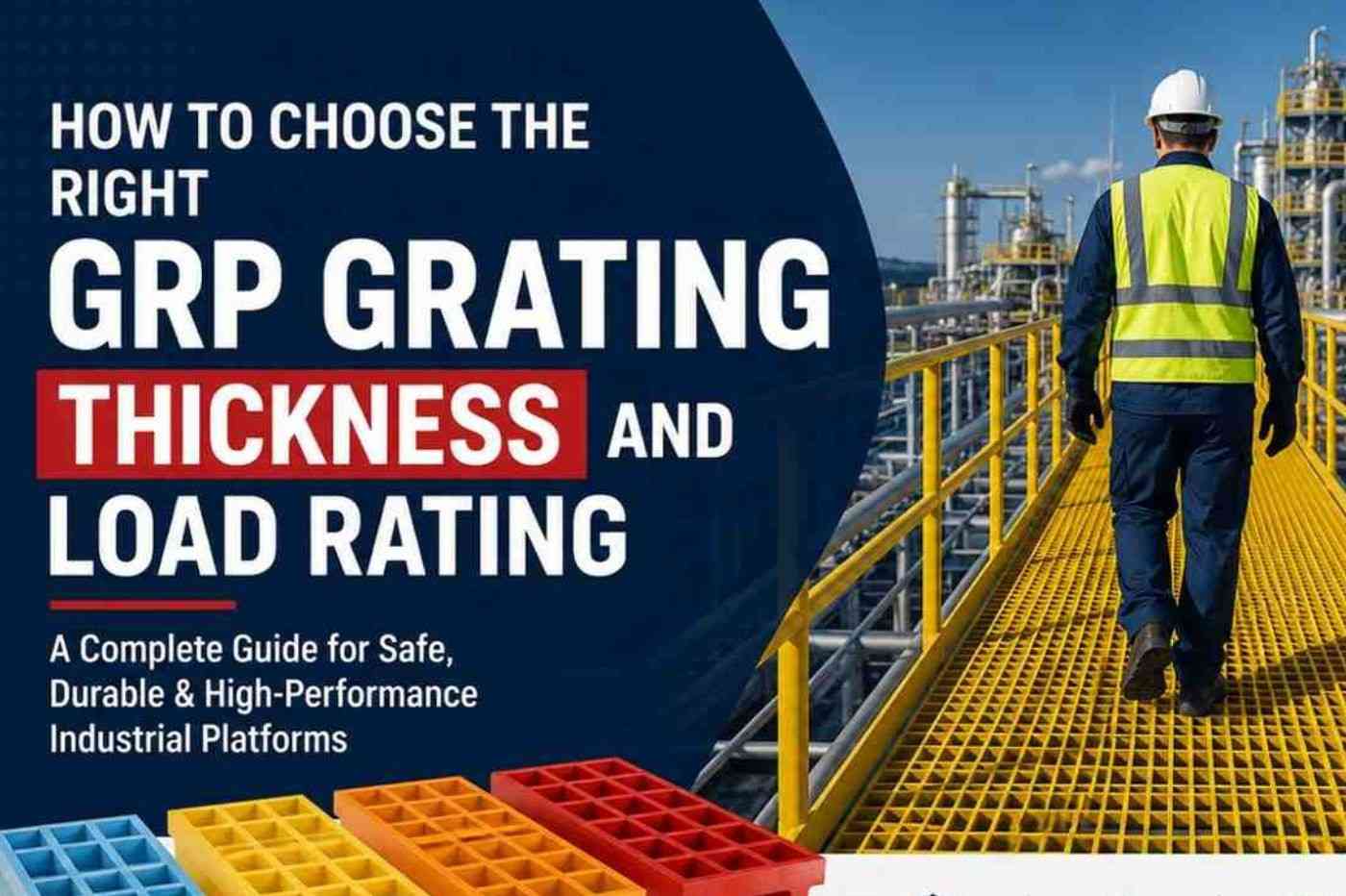
In industrial environments, grating failures rarely happen because the material itself is weak. More often, the problem starts much earlier — during specification. A walkway may look structurally sound during installation, but if the wrong GRP grating thickness or load rating was selected, issues begin appearing over time. Excessive deflection, vibration under foot traffic, maintenance problems, and even safety risks can develop when the grating does not match the actual operating conditions.
That’s why selecting the right GRP grating involves more than simply choosing a corrosion-resistant material. Engineers and procurement teams must evaluate load type, support span, traffic conditions, and environmental exposure together. This guide explains how industrial teams choose the correct GRP grating thickness and load rating for safe, durable, and long-lasting performance.
If you’re involved in engineering, procurement, or project execution, this guide will help you focus on what actually influences long-term performance—not just upfront pricing.
Industrial flooring systems are exposed to much harsher conditions than standard commercial walkways. Chemical exposure, moisture, saltwater, equipment traffic, and heavy maintenance activity all place continuous stress on grating systems. Traditional steel grating often struggles in these environments because corrosion eventually weakens the structure and increases maintenance costs. That’s one reason many facilities now prefer corrosion-resistant fiberglass systems like fiberglass gratings and pultruded profiles for industrial platforms and walkways.
Performs excellently in aggressive chemical environments without degradation
Requires significantly less maintenance compared to traditional steel systems
Easy to transport, handle, and install with reduced labor costs
Anti-slip walking surfaces designed for wet and corrosive environments
Naturally non-sparking and electrically insulating for sensitive areas
Proven durability in marine and demanding industrial applications
A 25mm pedestrian walkway panel and a 50mm forklift-rated grating panel may look similar at first glance, but their structural capabilities are completely different. These advantages only deliver long-term value when the correct grating specification is selected.
Many buyers assume thicker grating automatically means stronger grating. In reality, thickness is only one part of the equation. Load rating, support span, grating type, and deflection behavior all influence performance.
GRP grating thickness refers to the depth of the load-bearing bars in the panel. Common industrial thicknesses include 25mm, 30mm, 38mm, and 50mm, each designed for specific applications.
In general, thicker gratings provide:
Important: Thickness alone does not determine whether a grating is suitable for a project. A 38mm panel installed over an excessively long span can still flex beyond acceptable safety limits.
Load rating defines how much force the grating can safely support under specific conditions. Industrial load ratings usually consider three main load categories, each requiring different structural specifications.
Understanding your specific load requirements is essential for selecting the appropriate grating thickness and type. Manufacturers provide detailed load tables that correlate thickness, span distance, and maximum allowable loads.
1. Uniformly Distributed Load (UDL) – Weight spread evenly across the surface (groups of workers, general foot traffic, stationary equipment)
2. Concentrated Load – Force applied to a small area (toolboxes, equipment wheels, maintenance carts). These are often more demanding than evenly distributed loads.
3. Vehicular or Dynamic Loads – Forklifts, trolleys, and industrial transport equipment. Dynamic loads introduce vibration and impact forces, requiring heavier-duty grating systems and shorter support spans.
| Thickness | Typical Application | Load Capacity | Best For |
|---|---|---|---|
| 25mm | Light pedestrian walkways | Low to moderate | Access platforms, maintenance zones |
| 30mm | General industrial access | Moderate | Utility plants, processing facilities |
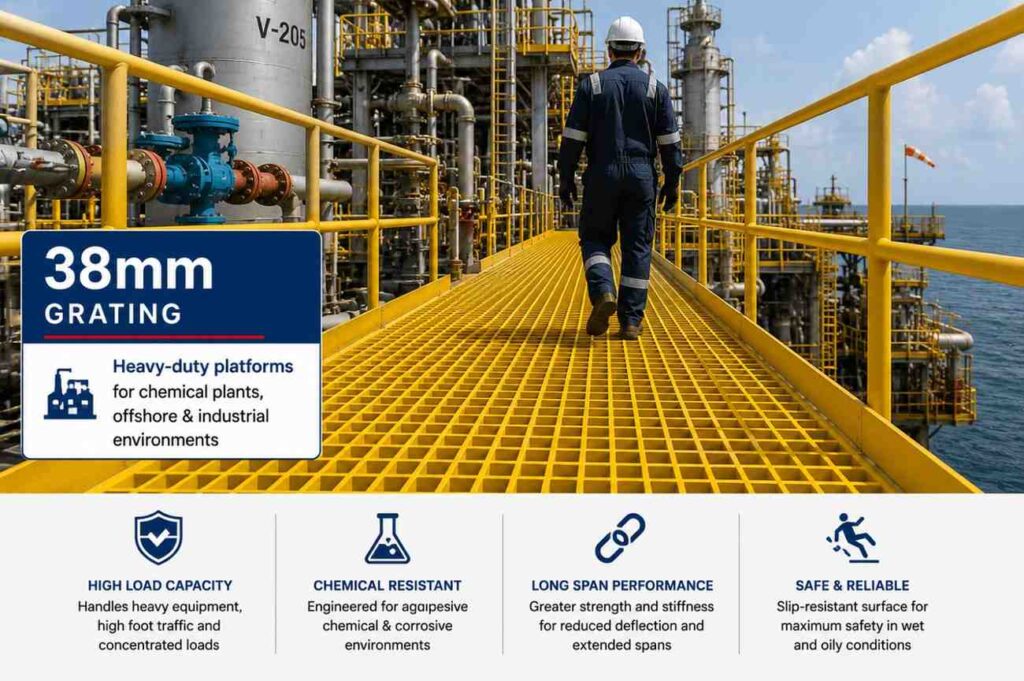
| 38mm | Heavy-duty platforms | High | Chemical plants, offshore systems |
| 50mm | Forklift and vehicular loads | Very high | Loading platforms, heavy equipment zones |
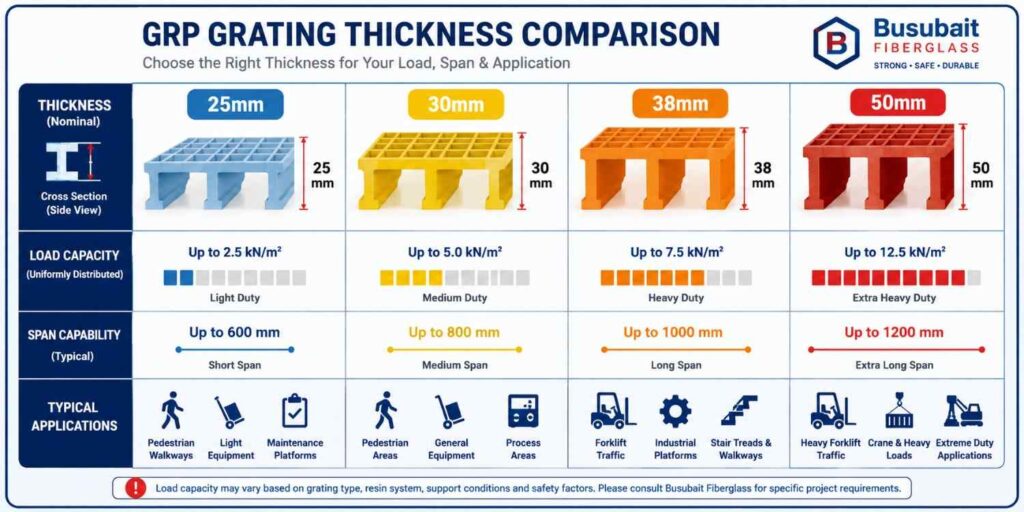
Different industrial environments require different grating strengths. Selecting the correct thickness depends on both traffic type and support conditions.
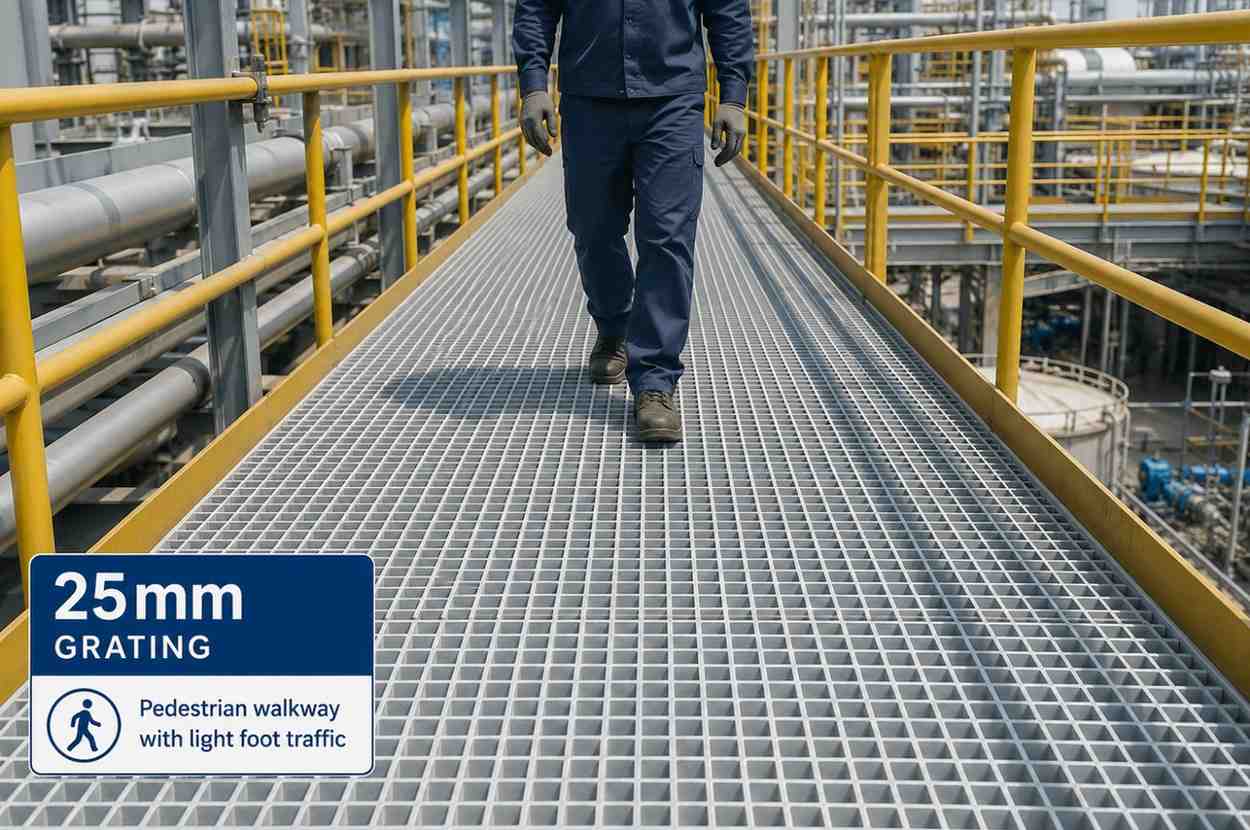
25mm GRP grating is commonly used in areas with minimal traffic and shorter spans. Typical applications include pedestrian walkways, access platforms, maintenance zones, and rooftop access paths.
This thickness is usually sufficient where loads remain relatively light, equipment traffic is limited, and spans are short. It is often chosen for its economical cost and lightweight installation.
Ideal for: Low-traffic areas, temporary access, cost-sensitive projects
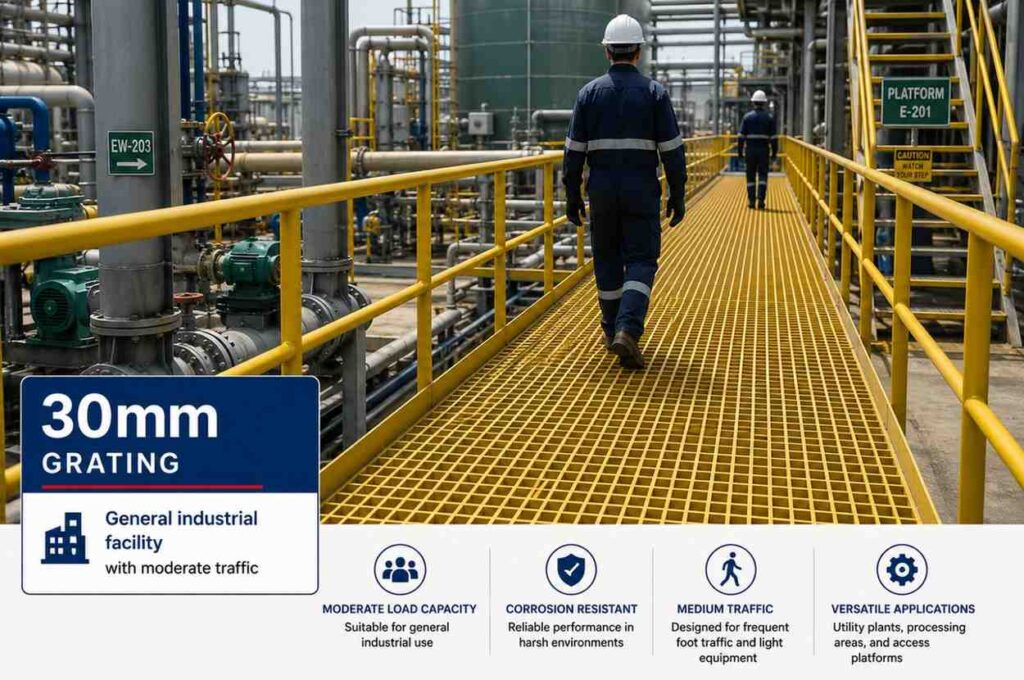
30mm grating is considered a practical industrial standard for many facilities. It works well in utility plants, processing facilities, equipment access platforms, and general industrial flooring.
This thickness balances structural performance, installation flexibility, and cost efficiency. For many medium-duty industrial applications, 30mm grating offers reliable performance without unnecessary overdesign.
Ideal for: Medium-traffic areas, standard industrial platforms, balanced performance needs
38mm grating is widely used in demanding industrial environments where higher loads and larger spans are expected. Typical applications include chemical processing platforms, heavy maintenance walkways, offshore access systems, and high-traffic industrial areas.
Compared to thinner panels, 38mm grating provides greater rigidity, reduced deflection, improved worker comfort, and better support for rolling loads. This is one of the most commonly specified thicknesses in petrochemical and utility facilities.
Ideal for: Heavy-traffic areas, chemical plants, offshore platforms, demanding environments
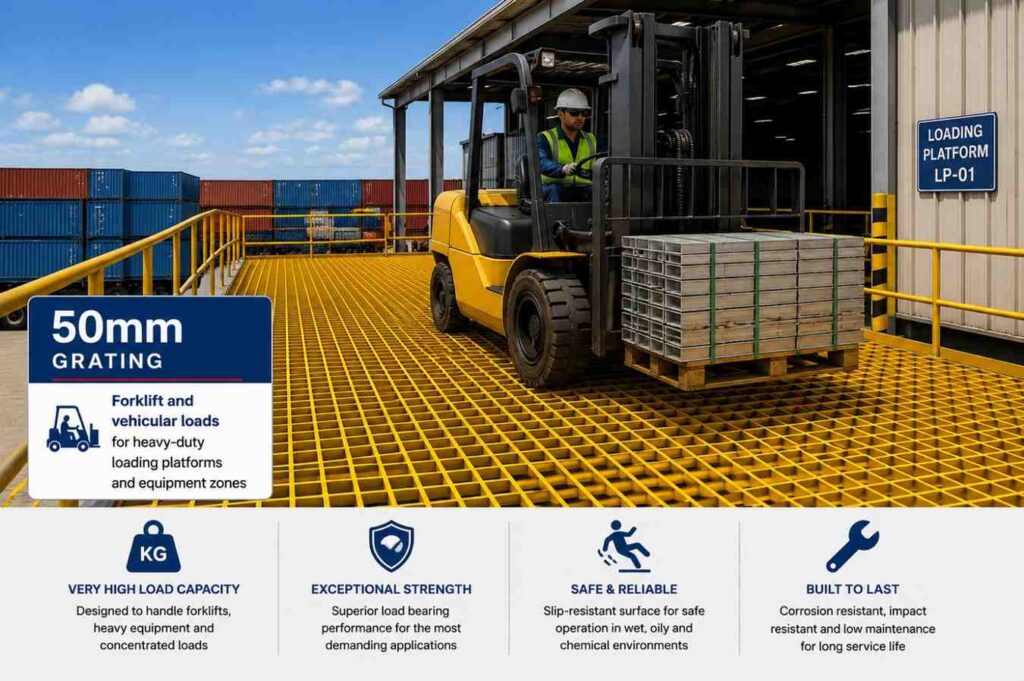
50mm GRP grating is designed for extra heavy-duty conditions. Applications may include forklift traffic zones, vehicle access areas, industrial loading platforms, and heavy equipment movement paths.
These systems usually require engineered support structures, carefully controlled spans, and detailed load calculations. For dynamic or vehicular loads, manufacturers should always verify the load tables before installation.
Ideal for: Forklift traffic, vehicular loads, extreme duty applications, long-span requirements
One of the most overlooked factors in grating selection is unsupported span distance. Even a thick grating panel can fail if the span between supports becomes too large.
As span increases, load capacity decreases, deflection increases, and structural stress rises. A common specification mistake is selecting grating thickness based only on traffic type while ignoring support spacing.
Note: These ranges are general guidelines only. Actual performance depends on manufacturer specifications and support design.
| Thickness | Approximate Span Range | Performance Notes |
|---|---|---|
| 25mm | Up to 600mm | Short spans only; limited load capacity |
| 30mm | Around 900mm | Standard industrial spans; good balance |
| 38mm | Around 1200mm | Longer spans; heavy-duty performance |
| 50mm | 1500mm or more | Maximum span capability; vehicular loads |
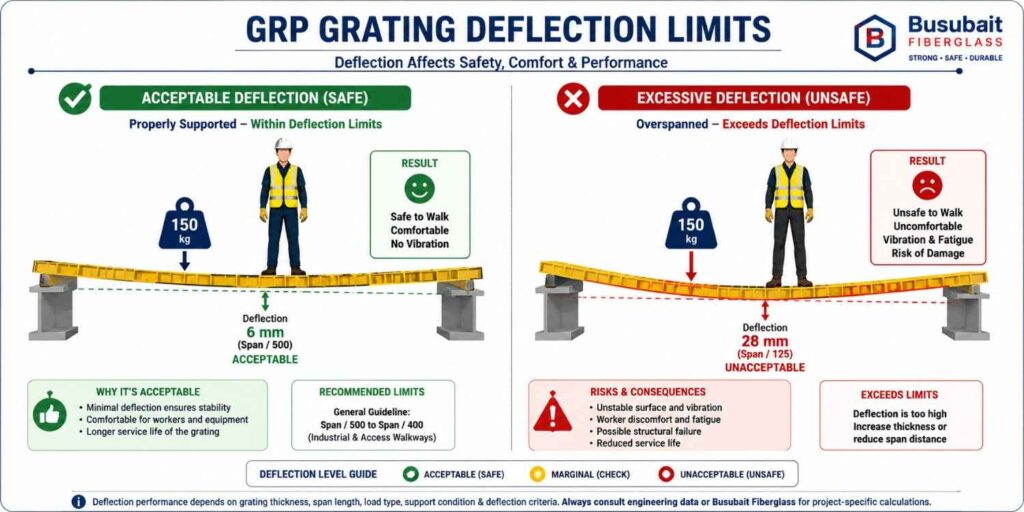
Overspanning can create several operational problems including excessive bending, worker discomfort, a “springy” walking feel, long-term structural fatigue, and increased safety risk. In severe cases, concentrated loads can damage the grating permanently. Overspanned panels may still appear visually intact while operating outside safe engineering limits.
Unlike steel, GRP grating naturally flexes slightly under load. Some deflection is normal and expected. The key issue is whether the deflection remains within acceptable safety limits.
Industrial standards often limit deflection to a fraction of the span length to prevent instability, vibration, worker discomfort, and tripping hazards. Excessive flexing may not always cause structural failure immediately, but it reduces user confidence and increases operational concerns.
In high-traffic facilities, controlling deflection is just as important as supporting the load itself. This is why deflection analysis should be part of every grating specification process.
Verify deflection limits match industry standards for your application
Ensure support spacing is appropriate for the grating thickness
Consider worker comfort and safety when evaluating deflection
Test deflection under actual load conditions if possible
Monitor deflection over time for signs of structural fatigue
Not all GRP gratings behave the same way structurally. The two most common types are molded and pultruded grating systems, each with distinct advantages for specific applications.
Molded grating provides multidirectional strength and excellent corrosion resistance. It is commonly used in chemical plants, wastewater facilities, desalination plants, and marine environments.
Advantages include:
Molded grating is often preferred in corrosive environments where structural loads are moderate.
Pultruded grating offers higher directional strength and better span capability. It is commonly used for long-span platforms, heavy-duty walkways, equipment access systems, and industrial structures with higher loading demands.
Advantages include:
Compared to molded systems, pultruded grating generally performs better under heavy linear loads.
| Characteristic | Molded Grating | Pultruded Grating |
|---|---|---|
| Strength Direction | Multidirectional | Directional (along load path) |
| Best For | Chemical/corrosive environments | Heavy loads and long spans |
| Customization | Easier to customize | Limited customization |
| Cost | Generally lower | Generally higher |
| Span Capability | Moderate | Excellent |
Many industrial facilities use both types depending on the application zone, selecting molded grating for chemical-resistant areas and pultruded grating for high-load zones.
Industrial conditions vary significantly from one facility to another. The correct grating specification depends heavily on environmental exposure.
Chemical plants require materials that resist acids, alkalis, aggressive cleaning chemicals, and corrosive fumes. GRP grating is widely used because it helps reduce corrosion damage, maintenance shutdowns, and coating failures associated with steel. This is especially important for elevated maintenance platforms and process walkways.
Key Benefits: Superior chemical resistance, reduced maintenance costs, longer asset life
Marine facilities expose grating systems to saltwater, humidity, UV exposure, and continuous moisture. GRP grating performs well in offshore conditions because it does not rust like conventional steel systems. Its lightweight structure also simplifies installation in offshore platforms.
Key Benefits: No rust or corrosion, lightweight for offshore installation, proven durability in harsh marine conditions
Desalination and wastewater facilities often experience continuous moisture exposure, chemical dosing environments, and slippery walking conditions. GRP grating provides corrosion resistance, anti-slip performance, and long-term durability. Many industrial operators now replace steel systems with fiberglass alternatives to reduce long-term maintenance costs.
Key Benefits: Moisture-resistant, anti-slip surfaces, chemical compatibility, reduced lifecycle costs
Projected GRP Grating Market Value by 2033
CAGR Market Growth Rate
Asia-Pacific Market Share
Lower Carbon Footprint vs Steel
GRP gratings also carry a 32% lower carbon footprint compared to equivalent steel gratings over the product lifetime, and the manufacturing process uses up to 25% less energy than comparable metal grating production.
Specification errors can shorten system lifespan and create unnecessary operational risks. Here are the most common mistakes to avoid:
Traffic alone does not determine the correct grating. Span distance and support conditions are equally important factors.
Small wheels and equipment loads often create higher stress than general foot traffic. Ignoring concentrated load conditions is a common industrial mistake.
Even structurally safe grating can create operational concerns if it flexes excessively under normal walking conditions.
Molded and pultruded systems are designed for different structural requirements. Choosing the wrong type can increase costs or reduce performance.
Before finalizing a grating specification, review the following comprehensive checklist to ensure optimal selection:
Expected traffic type: Pedestrian, equipment, or vehicular?
Maximum load weight: What is the heaviest load the grating will support?
Uniform vs concentrated loads: How is the load distributed?
Span distance: What is the unsupported span between supports?
Support spacing: How are supports arranged?
Chemical exposure conditions: What chemicals or corrosive materials are present?
Slip resistance requirements: Is anti-slip surface needed?
Maintenance frequency: What is the expected maintenance schedule?
Environmental exposure: Temperature, moisture, UV, or other environmental factors?
Worker safety requirements: Any special safety or electrical considerations?
This approach helps reduce both underdesign and unnecessary overspecification, ensuring you select the optimal grating for your specific application.
Some applications require detailed engineering evaluation. Professional consultation becomes important when dealing with forklift traffic, long unsupported spans, offshore platforms, dynamic equipment loads, or custom industrial structures.
Experienced manufacturers can help evaluate span-to-load relationships, deflection behavior, grating type selection, and support recommendations. Industrial suppliers like Busubait Fiberglass provide engineered fiberglass solutions for sectors including petrochemical, desalination, utility, and industrial processing applications.
Busubait offers comprehensive product ranges and completed industrial fiberglass projects for application-specific solutions. Our team of engineers can help you navigate complex specification requirements and ensure your grating system performs optimally for decades.
Most industrial GRP gratings are manufactured with anti-slip surfaces designed for wet and corrosive environments. However, surface type matters — coarse grit surfaces generally provide better slip resistance in oily or high-moisture areas than smooth-top panels. Always specify anti-slip options for wet or slippery environments.
Yes. GRP grating is naturally non-conductive, making it suitable for electrical substations, control rooms, and industrial platforms where electrical insulation is important. This is one of the key advantages over traditional metal grating systems.
With proper installation and maintenance, GRP grating can last 25-30+ years in most industrial environments. In some marine and chemical applications, systems have demonstrated performance exceeding 40 years. Lifespan depends on environmental conditions, load application, and maintenance practices.
Span calculation requires considering grating thickness, load type, maximum load weight, and acceptable deflection limits. Always consult manufacturer load tables and engineering specifications for your specific grating type. For complex applications, professional engineering consultation is recommended.
Yes, GRP grating can be cut and customized on-site using standard tools. However, for optimal performance and safety, it’s recommended to order pre-cut panels from the manufacturer whenever possible. Custom cutting should follow manufacturer guidelines to maintain structural integrity.
GRP grating requires minimal maintenance compared to steel. Regular cleaning with water and mild detergent is usually sufficient. In harsh chemical environments, periodic inspection for surface degradation is recommended. Unlike steel, GRP grating does not require painting, coating, or rust prevention treatments.
Choosing the right GRP grating thickness is not simply about selecting the thickest panel available. A successful specification balances load requirements, support span, deflection limits, environmental exposure, and long-term maintenance expectations.
When thickness, load rating, and structural support are properly aligned, GRP grating can provide decades of safe and corrosion-resistant performance in demanding industrial environments. For critical industrial applications, consulting experienced fiberglass specialists early in the design process can help avoid costly specification mistakes later.
Our team of experienced engineers at Busubait Fiberglass is ready to help you select the perfect grating solution for your industrial application.
