Address
Busubait Fiberglass Factory
P.O Box 63113, Dammam 31516
Kingdom of Saudi Arabia
Work Hours
Monday to Friday: 7AM - 7PM
Weekend: 10AM - 5PM

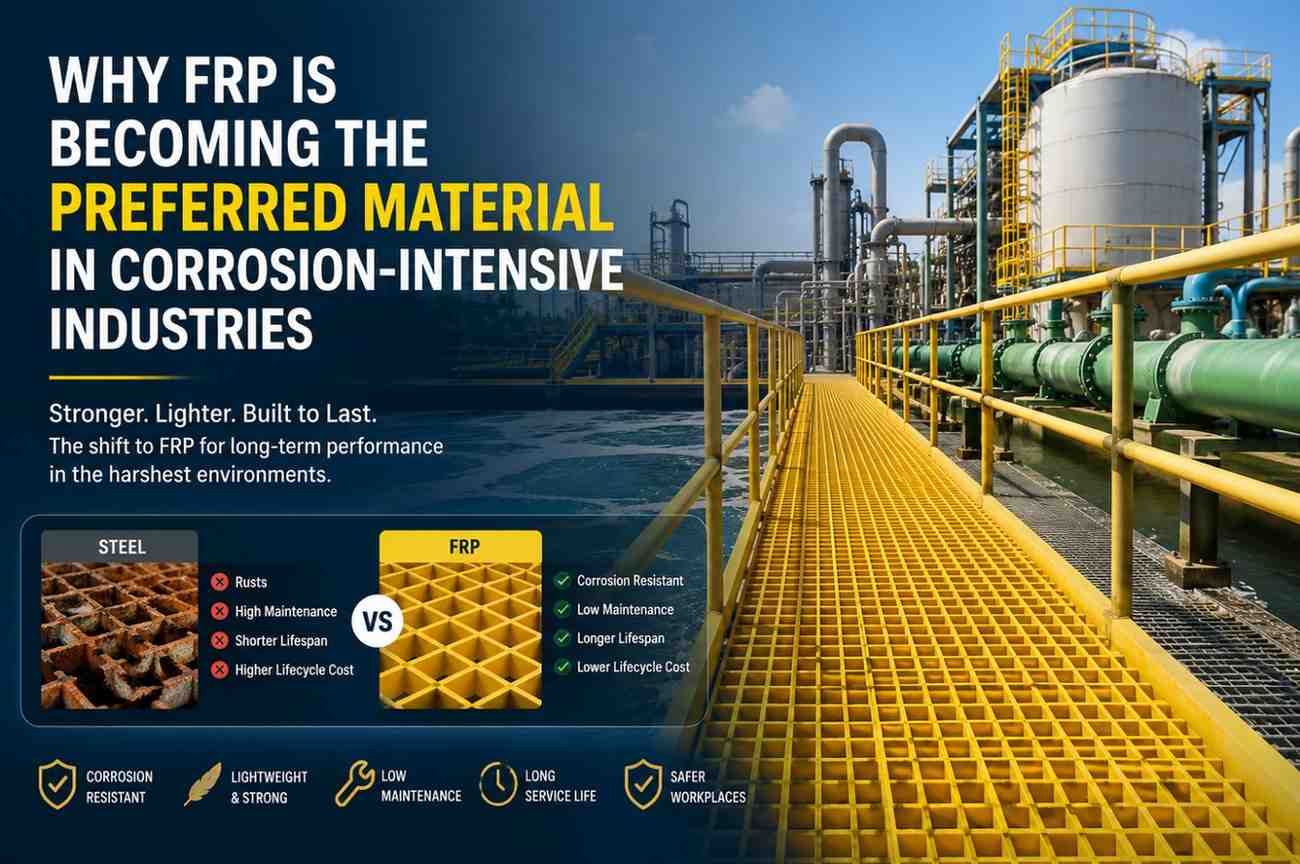
Overcoming the trillion-dollar challenge of industrial corrosion with advanced Fiber Reinforced Plastic solutions.
Corrosion has become one of the most expensive and persistent challenges across industrial infrastructure. From chemical plants to marine environments, constant exposure to moisture and chemicals causes traditional materials like steel to deteriorate far faster than expected.
Why traditional metals fail in aggressive environments.
The science behind FRP’s inherent resistance.
Economic benefits: Lower maintenance & longer lifespan.
Real-world applications in Chemical, Water & Marine sectors.
To overcome these issues, industries are increasingly shifting toward Fiber Reinforced Plastic (FRP). Known for its exceptional corrosion resistance, lightweight strength, and long-term durability, FRP is rapidly becoming a preferred material for industrial applications where conventional materials struggle to perform reliably.
Global industrial studies highlight why material selection is a critical long-term operational decision.
GLOBAL ANNUAL COST
Equivalent to 3.4% of the world's GDP. Prevention best practices could save up to $875 billion annually.
LIFESPAN ADVANTAGE
FRP systems last 3–4 times longer than traditional steel in highly corrosive industrial environments.
MAINTENANCE REDUCTION
Facilities switching to FRP report a 60% reduction in maintenance costs over a 10-year period.
WEIGHT REDUCTION
Significantly lowering transport, handling, and labor costs during large-scale industrial installations.
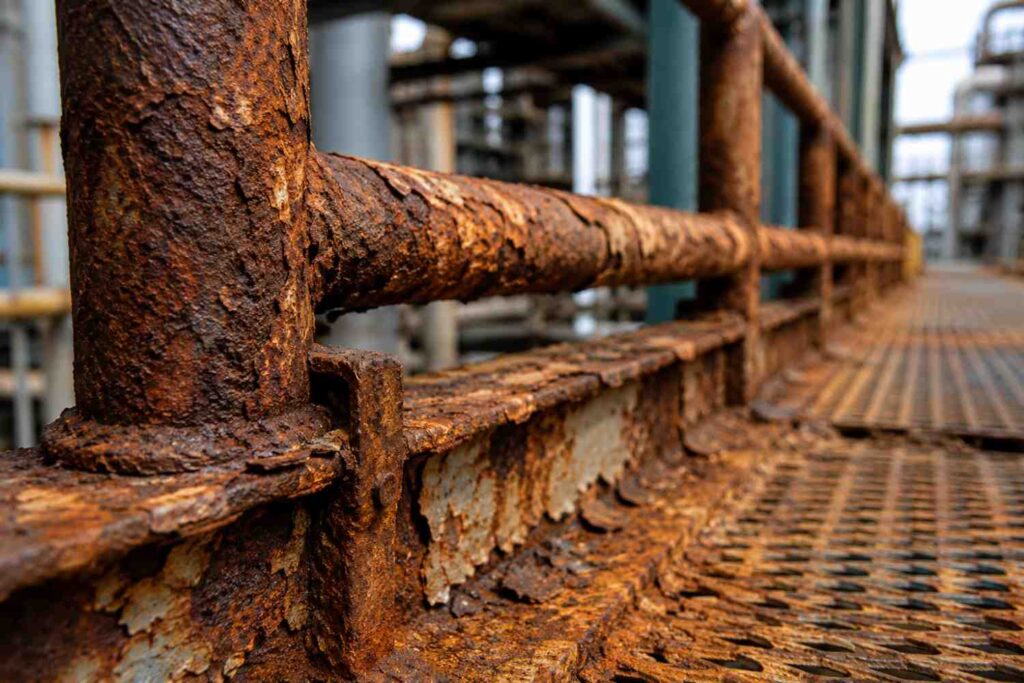
Industrial corrosion is more than a surface-level issue. In many facilities, it directly affects operational efficiency, worker safety, and long-term infrastructure reliability. Over time, even coated or galvanized materials begin to fail.
In a chemical plant in Tamaulipas, Mexico, traditional steel scaffoldings were constantly failing due to aggressive corrosive agents. The facility replaced these expensive, high-maintenance structures with
FRP molded grating platforms.
60% reduction in maintenance costs over 3 years.
Installation time cut in half due to lightweight properties.
Zero corrosion-related downtime since the switch.
While steel and aluminum offer strength, they struggle in aggressive industrial environments where moisture and chemicals are continuously present.
Carbon steel remains widely used because of its structural strength and relatively lower upfront cost. However, in chemical plants and coastal facilities, it is highly prone to rust formation and chemical attack.
Structural weakening
Surface deterioration
Frequent repainting requirements
Stainless steel offers better resistance than carbon steel, but it is not immune. In environments with chlorides or acids, it can still experience severe failure modes.
Pitting & Crevice corrosion
Stress corrosion cracking
Significantly higher project costs
Galvanized steel’s zinc coating provides temporary protection. Once the layer deteriorates, the underlying steel becomes vulnerable to rapid rust.
Routine inspections required
Recoating and repainting needs
Earlier replacement cycles
Fiber Reinforced Plastic (FRP) is a composite material made by combining reinforcing fibers with a polymer resin matrix. Unlike metals, FRP does not rely on protective coatings; its inherent material composition makes it naturally resistant to aggressive environments.
Withstands acids, alkalis, and solvents without degradation.
Will not rust, rot, or warp even when submerged in saltwater.
Safest choice for electrical and utility infrastructure.
Comparable strength to steel at 1/4th the weight.
Industries are not switching to FRP for a single reason. The growing adoption is being driven by a combination of operational, economic, and safety benefits that directly affect long-term plant performance
Maintenance is one of the largest operational expenses in corrosion-heavy industries. Traditional materials often require continuous inspection, repainting, and repair to prevent deterioration.
FRP significantly reduces these maintenance demands because it:
For facilities where shutdowns directly affect production revenue, reducing maintenance frequency can deliver major operational advantages.
Industrial facilities are increasingly prioritizing materials that provide longer service life with fewer interruptions. FRP systems often outlast conventional materials in aggressive environments because they are not susceptible to rust or chemical degradation.
This longer lifespan helps businesses:
Corroded structures can become serious safety hazards. Rusted platforms, weakened handrails, and deteriorated access systems increase the risk of workplace accidents.
FRP improves industrial safety because it offers:
This is one reason why many facilities are replacing metal walkways and access systems with FRP gratings and pultruded profiles.
While FRP may sometimes involve a higher upfront investment than standard steel systems, the long-term economics are often significantly better.
The total cost advantages come from:
For many industrial facilities, FRP becomes more cost-effective over the full operational lifecycle of the system.
Different industries face different corrosion challenges. FRP has gained widespread acceptance because it can be engineered for highly specific industrial conditions while maintaining long-term performance.
Storage tanks , process vessels , and scrubber systems.
Ducting systems, platforms, and piping infrastructure.
Offshore platforms, docks, and desalination facilities.
Cable trays, cooling towers, and access platforms.
FRP is now used across a wide range of industrial systems where corrosion resistance, lightweight performance, and durability are critical operational requirements.
FRP gratings are widely used for industrial walkways, platforms, drainage covers, and access systems in corrosive facilities.
Their advantages include:
Industrial facilities increasingly use FRP gratings and pultruded profiles in chemical plants, offshore facilities, and wastewater environments.
FRP tanks are designed for long-term storage and processing of corrosive chemicals and industrial liquids.
They are commonly used for:
Solutions like FRP tanks and dual laminate equipment help industries improve chemical resistance and operational durability.
Industrial exhaust and ventilation systems are constantly exposed to corrosive gases and fumes. Traditional ducting materials often degrade quickly in these conditions.
FRP ducting systems are increasingly preferred because they offer:
Access systems in corrosive facilities require long-term structural reliability and worker safety.
FRP ladders, platforms, and handrails provide:
These systems are widely used across marine, chemical, and utility sectors.
A side-by-side performance breakdown in corrosive environments.
| PROPERTY | FRP | STEEL | GALVANIZED STEEL |
|---|---|---|---|
| Corrosion Resistance | Excellent | Low | Moderate |
| Maintenance Needs | Low | High | Moderate to High |
| Weight | Lightweight | Heavy | Heavy |
| Electrical Conductivity | Non-conductive | Conductive | Conductive |
| Lifespan | Long (30+ Years) | Moderate | Moderate |
| Coating Needs | Minimal | Frequent | Periodic |
FRP is particularly beneficial for facilities operating in:
For many industries, the shift toward FRP is not simply about replacing metal. It is about improving long-term operational reliability while reducing the ongoing burden of corrosion management.
Businesses evaluating corrosion-resistant infrastructure solutions should consider:
Yes. FRP grating is non-conductive, making it safer around electrical systems and utility infrastructure. It is also slip resistant and corrosion resistant.
FRP usually requires much lower maintenance than steel because it does not rust or need frequent repainting. This helps reduce repair costs and operational downtime.
FRP is commonly used in chemical processing, wastewater treatment, oil and gas, marine infrastructure, desalination plants, and power industries where corrosion resistance is critical.
Selecting the right FRP systems can make a significant difference in long-term performance and lifecycle costs. Working with experienced industrial fiberglass manufacturers like Busubait ensures your solution is designed specifically for your operational demands.
