Address
Busubait Fiberglass Factory
P.O Box 63113, Dammam 31516
Kingdom of Saudi Arabia
Work Hours
Monday to Friday: 7AM - 7PM
Weekend: 10AM - 5PM

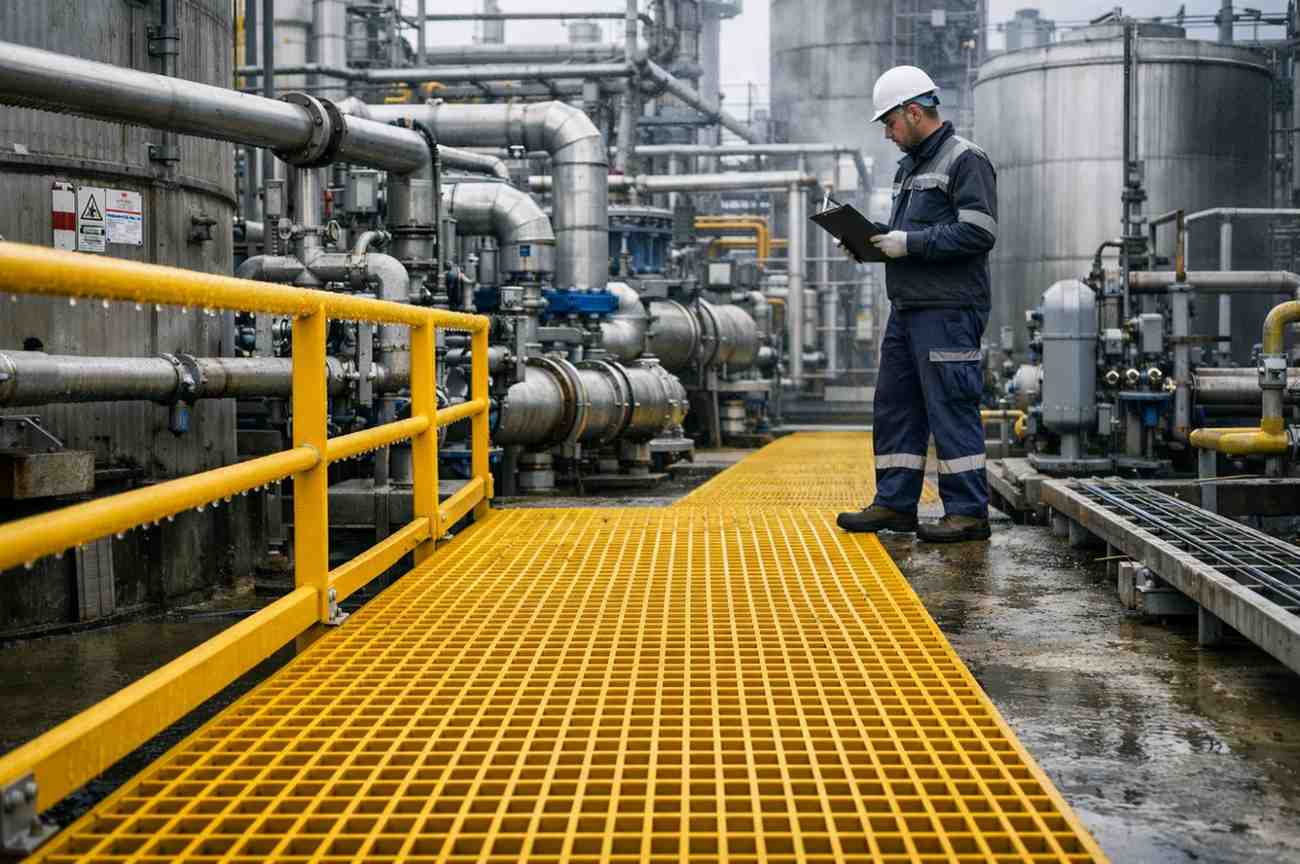
Chemical plants and utility infrastructure operate in some of the most demanding environments. Continuous exposure to corrosive chemicals, moisture, saltwater, and electrical hazards places extreme stress on conventional materials such as steel and concrete. Over time, this leads to corrosion, safety risks, frequent maintenance, and rising lifecycle costs.
FRP moulded gratings have emerged as a practical alternative for these environments. Their corrosion resistance, structural reliability, and safety characteristics are now supported not only by field use but also by laboratory testing, academic research, and market adoption data.
This article examines the real impact of FRP moulded gratings on chemical and utility infrastructure, supported by industry references, experimental studies, and market statistics.
Common causes include:
Common causes include:
Steel gratings require:
FRP moulded gratings are manufactured by interweaving continuous fiberglass rovings with thermosetting resins such as polyester or vinyl ester in a heated mould. The result is a single-piece, integral panel with uniform resin distribution and bi-directional load-bearing capability.
This structure allows loads to be distributed evenly in both directions, which is especially valuable in industrial platforms and walkways.
Interwoven mesh provides strength in both directions.
~65% resin ratio encapsulates fibers for chemical resistance.
Best for: Complex floor layouts and high chemical splash zones.
Behavior: Behaves like a solid plate during fabrication.
Key Advantages:
Best for: Long spans requiring unidirectional beam strength where exposure is less aggressive.
Behavior: Functions like beams with high directional strength.
Key Advantages:
A peer-reviewed study published in the Iranian Polymer Journal analyzed the load-deflection behaviour of FRP moulded gratings using analytical models, finite element analysis, and experimental data. The results showed strong agreement between theoretical predictions and real-world testing, confirming reliable structural performance under both uniform and concentrated loads.
Deflection control governs design rather than ultimate strength.
Bi-directional stiffness improves load distribution.
Moulded gratings perform consistently across varying mesh sizes.
Experimental testing published by the IOSR Journal evaluated FRP moulded gratings under:
Chemical immersion tests using 10 percent sulphuric acid and 5 percent caustic soda showed negligible weight change, confirming strong resistance to aggressive chemicals.
These results explain why FRP moulded gratings are widely used around chemical storage tanks, process vessels, and drainage systems.
Source: https://www.iosrjournals.org
In chemical plants, FRP moulded gratings are used for:
Safe access around hazardous areas with chemical resistance.
Chemical-resistant covers for drainage and utility trenches.
Non-corrosive platforms for cooling tower maintenance.
Safe flooring around corrosive chemical storage tanks.
Resistance to acids and alkalis maintains structural integrity.
Resistance to moisture and saltwater prevents corrosion failures.
No corrosion-related loss of structural integrity reduces maintenance needs.
Industry case studies show that FRP gratings installed around sulfuric acid tanks maintained long-term performance with minimal maintenance.
Industry evaluations show that lightweight FRP panels also reduce installation labor and equipment requirements, further improving cost efficiency.
Utility and water infrastructure face constant exposure to moisture, chemicals, and electrical equipment.
FRP moulded gratings are commonly used in:
Corrosion-resistant platforms in treatment facilities.
Non-conductive walkways in high-voltage areas.
Saltwater-resistant platforms in coastal plants.
Weather-resistant structures in marine environments.
Non-conductive and non-magnetic properties reduce electrical risks.
Slip-resistant surfaces improve worker safety in spill zones.
Lightweight panels simplify installation and replacement.
These characteristics make FRP gratings particularly suitable for safety-critical utility environments.
| Cost Factor | Galvanized Steel | FRP Moulded Grating |
|---|---|---|
| Material Cost | Low | Medium |
| Installation | High (Heavy, requires more equipment) | Low (Lightweight, easier handling) |
| Maintenance | High (Frequent inspection, repair, repainting) | None (Minimal maintenance required) |
| Lifespan (Corrosive Environment) | 5–7 Years | 20+ Years |
| Safety Cost | Potential Liability (Corrosion, electrical risks) | Risk Mitigation (Slip-resistant, non-conductive) |
Although FRP moulded gratings may have a higher initial cost than steel, multiple studies highlight lower total lifecycle cost due to:
No repainting or corrosion repair needed.
20+ years vs 5-7 years for steel in corrosive environments.
Less maintenance means fewer operational disruptions.
Market data confirms growing adoption of FRP gratings across chemical, utility, marine, and water sectors.
According to Future Market Insights:
2025 Market Value
2035 Projection
Moulded Gratings Share
Annual Growth Rate
Growth is driven by demand for corrosion-resistant and low-maintenance infrastructure materials.
Source: https://www.futuremarketinsights.com/reports/frp-grating-market
(Last updated: August 2025)
From both engineering and operational perspectives, FRP moulded gratings offer.
Backed by academic research and testing.
Laboratory testing confirms durability in aggressive environments.
Slip resistance and electrical insulation reduce hazards.
Lower maintenance and longer service life improve ROI.
Long service life supports infrastructure sustainability goals.
Growing global adoption across industrial sectors.
Source: https://www.futuremarketinsights.com/reports/frp-grating-market (Last updated: August 2025)
Busubait provides engineered FRP moulded grating solutions for chemical plants, utilities, and water infrastructure across Saudi Arabia. Our technical team can help you select the right resin system and specifications for your specific application.
FRP moulded gratings are no longer viewed as niche alternatives. Research studies, experimental testing, and global market data confirm their value in chemical and utility infrastructure where corrosion, safety, and maintenance are critical concerns.
By combining durability, safety, and long-term economic value, FRP moulded gratings play a direct role in improving infrastructure reliability and operational efficiency in harsh industrial environments.
Key Tags:
FRP Gratings
Chemical Plants
Utility Infrastructure
Corrosion Resistance
Industrial Safety
Lifecycle Cost
Saudi Arabia
Industrial Materials
