Address
Busubait Fiberglass Factory
P.O Box 63113, Dammam 31516
Kingdom of Saudi Arabia
Work Hours
Monday to Friday: 7AM - 7PM
Weekend: 10AM - 5PM

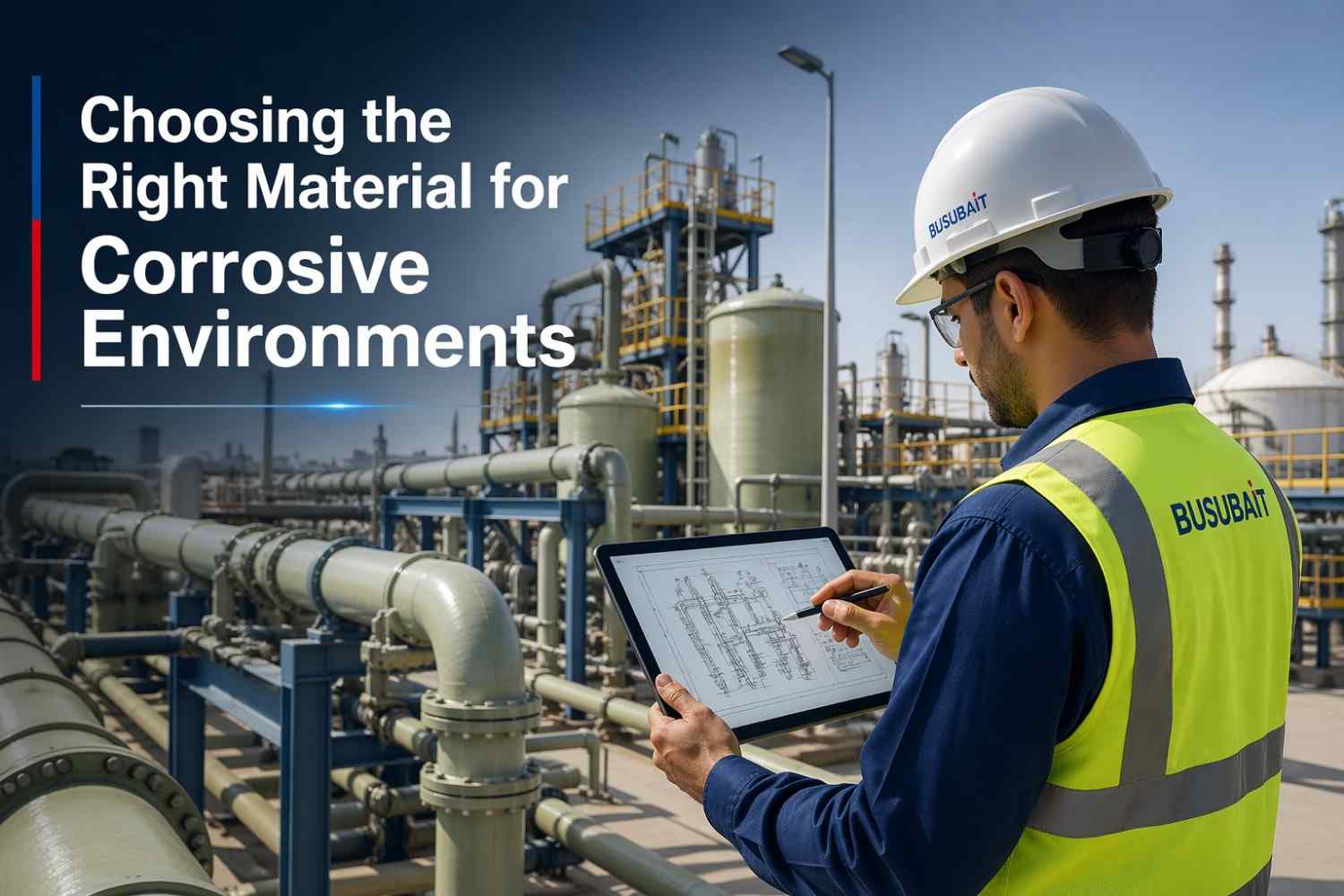
Industrial exhaust systems are not just moving air. They handle acid fumes, moisture, and corrosive gases every single day. Yet, many plants still use GI ducting by default—only to face rust, leakage, and frequent maintenance shutdowns.
In many industrial plants, failures don’t begin with equipment. They begin with material selection.
In Saudi Arabia, operating conditions are more aggressive than most regions:
These factors accelerate corrosion in traditional materials like steel and concrete, leading to:
For engineers and plant operators, corrosion is not just a maintenance issue. It directly affects:
✓ Plant reliability
✓ Worker safety
✓ Long-term operational costs
Fiber Reinforced Plastic (FRP) is a composite material made from:
This combination creates a material that behaves very differently from metals:
The key factor is resin selection. Different resin systems are designed to handle specific chemicals, temperatures, and operating conditions. That is why FRP is not just a material choice—it is an engineered solution tailored to the environment.

FRP does not rust, pit, or degrade like metals.
✓ Resistant to acids, alkalis, and solvents
✓ Performs well in chemical processing environments
✓ Maintains structural integrity even with continuous exposure
FRP offers strength comparable to steel, but at a much lower weight.
✓ Easier handling and installation
✓ Reduced load on supporting structures
✓ Ideal for retrofitting existing plants
Traditional materials often require coatings, repainting, and frequent inspection.
✓ No corrosion-related repairs
✓ Reduced downtime
✓ Longer lifecycle
FRP offers non-conductive properties and design flexibility.
✓ Non-conductive properties
✓ Fire-retardant options available
✓ Custom fabrication capabilities
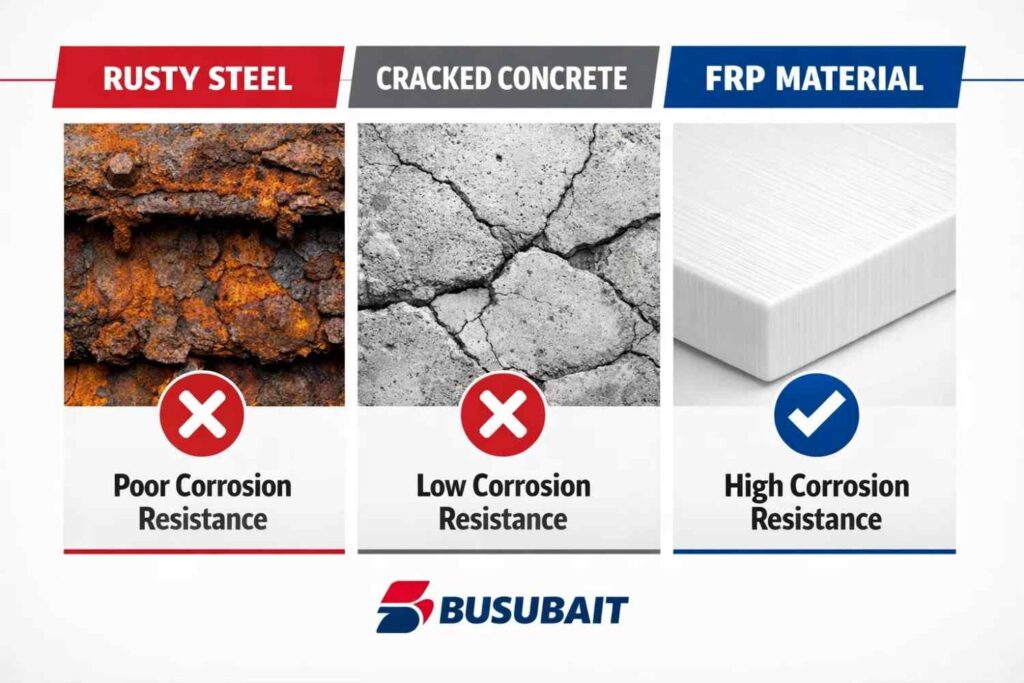
✗ Corrodes when exposed to moisture and chemicals
✗ Requires coatings and regular maintenance
✗ Susceptible to pitting and crevice corrosion
✗ Not always reliable in chloride-rich environments
✗ Absorbs chemicals over time
✗ Leads to structural degradation
FRP avoids these issues because it is non-metallic and chemically resistant, making it the superior choice for corrosion-intensive environments.
Acid storage, alkali solutions, and industrial chemicals
Leak-proof performance and corrosion resistance
Leak-proof performance and corrosion resistance
Corrosion resistance and anti-slip surfaces
Scrubbers, reaction vessels, and process tanks
Tailored products for specific industrial needs
Hydrocarbons and corrosive chemicals
Acids and alkalis exposure
Chlorine and moisture environments
Abrasive and corrosive materials
Market Insight: The Middle East and Africa region accounts for approximately 30% of the global oil and gas corrosion protection market, driven by Saudi Arabia’s vast onshore and offshore oil infrastructure facing particularly severe corrosion challenges in the Persian Gulf region, where high salinity and temperature fluctuations accelerate corrosion rates.
FRP performance depends on proper design and selection. Key factors include:
Based on chemical exposure
Temperature and pressure requirements
Testing and validation
Design and fabrication excellence
This is where working with an experienced manufacturer becomes important. When evaluating a manufacturer, consider their in-house capabilities, industry experience, customization abilities, and quality certifications.
In corrosion-intensive industries, material selection has a direct impact on plant safety, operational efficiency, and long-term cost. What may seem like a simple material decision at the design stage often determines how frequently a system fails, how much maintenance is required, and how reliable the plant remains over time.
FRP offers a practical approach to addressing these challenges. Its resistance to corrosion, minimal maintenance requirements, and long service life make it well suited for chemical and industrial environments where traditional materials struggle to perform consistently.
For engineers evaluating materials, FRP is not just an alternative to steel or concrete. It is often a more reliable long-term solution. Considering FRP early in the design stage can help avoid repeated maintenance issues and improve overall system performance.
FRP is preferred because it resists corrosion from acids, alkalis, and chemical exposure. Unlike metals, it does not rust or degrade, making it suitable for long-term use in harsh environments.
Steel is prone to rust and requires coatings and maintenance. FRP, on the other hand, is inherently corrosion-resistant and requires minimal upkeep, resulting in lower lifecycle costs.
FRP is widely used in storage tanks, piping systems, ducting, scrubbers, and structural components like gratings and handrails.
Yes, but it depends on the resin system used. Selecting the right resin ensures that FRP can perform effectively under specific temperature and chemical conditions.
Key factors include chemical compatibility, operating temperature, pressure conditions, and the quality of design and manufacturing.
FRP requires significantly less maintenance compared to steel. It does not need regular painting or corrosion protection, which reduces downtime and maintenance costs.
While the initial cost may be higher, FRP is more cost-effective over time due to its durability, low maintenance, and longer service life.
Get expert advice and high-quality FRP solutions tailored to your needs.
