Address
Busubait Fiberglass Factory
P.O Box 63113, Dammam 31516
Kingdom of Saudi Arabia
Work Hours
Monday to Friday: 7AM - 7PM
Weekend: 10AM - 5PM

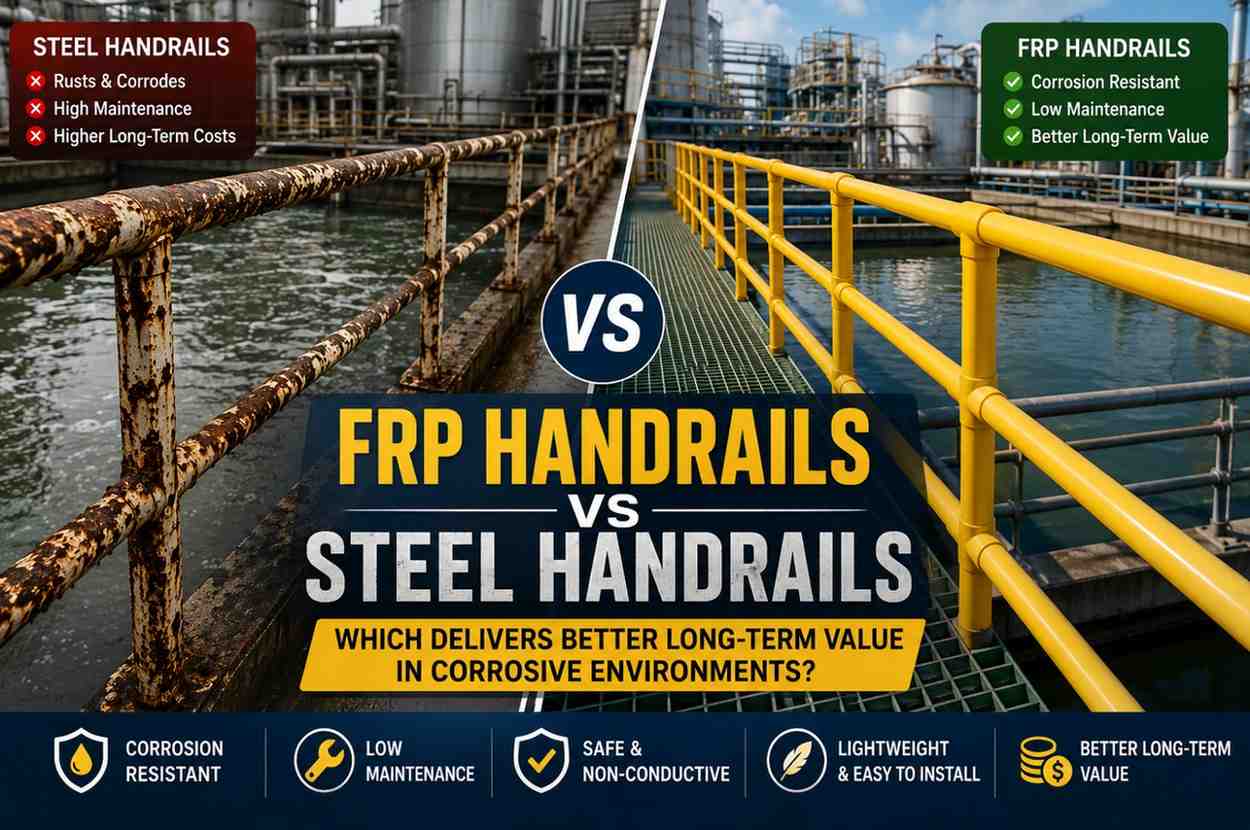
Compare FRP and steel handrails for corrosive industrial environments. Learn which option offers better durability, safety, and lower maintenance costs.
Industrial facilities invest heavily in equipment, piping systems, and process infrastructure, yet one critical component often receives less attention until problems arise: handrails. In chemical plants, wastewater treatment facilities, desalination plants, offshore platforms, and mining operations, handrails are continuously exposed to moisture, chemicals, and harsh environmental conditions that can accelerate material degradation.
For decades, steel has been the default choice for industrial handrail systems. However, increasing maintenance costs, recurring corrosion issues, and stricter safety requirements have prompted many facilities to evaluate FRP (Fiberglass Reinforced Plastic) handrails as an alternative. Similar composite technologies are already widely used in FRP gratings and pultruded profiles across industrial facilities because of their corrosion-resistant properties.
“This article compares FRP handrails and steel handrails across corrosion resistance, installation, maintenance, safety, durability, and lifecycle costs to help engineers, maintenance teams, and project stakeholders make informed decisions for long-term industrial performance.”
Handrails protect workers around platforms, walkways, tanks, and elevated areas. Failure can lead to serious safety incidents.
Selecting the right material is an important asset management decision rather than a simple procurement choice.
Corrosion-induced failure leads to maintenance expenses, downtime, and operational disruptions.
Industrial environments expose handrails to a variety of corrosive conditions that can significantly reduce the service life of traditional structures.
Chemical vapors, acids, and caustic substances can attack exposed surfaces.
Continuous moisture exposure creates ideal conditions for corrosion.
Outdoor environments combine UV exposure, temperature fluctuations, and humidity.
Salt-laden coastal air accelerates oxidation and rust formation.
Wastewater treatment processes generate corrosive gases and compounds.
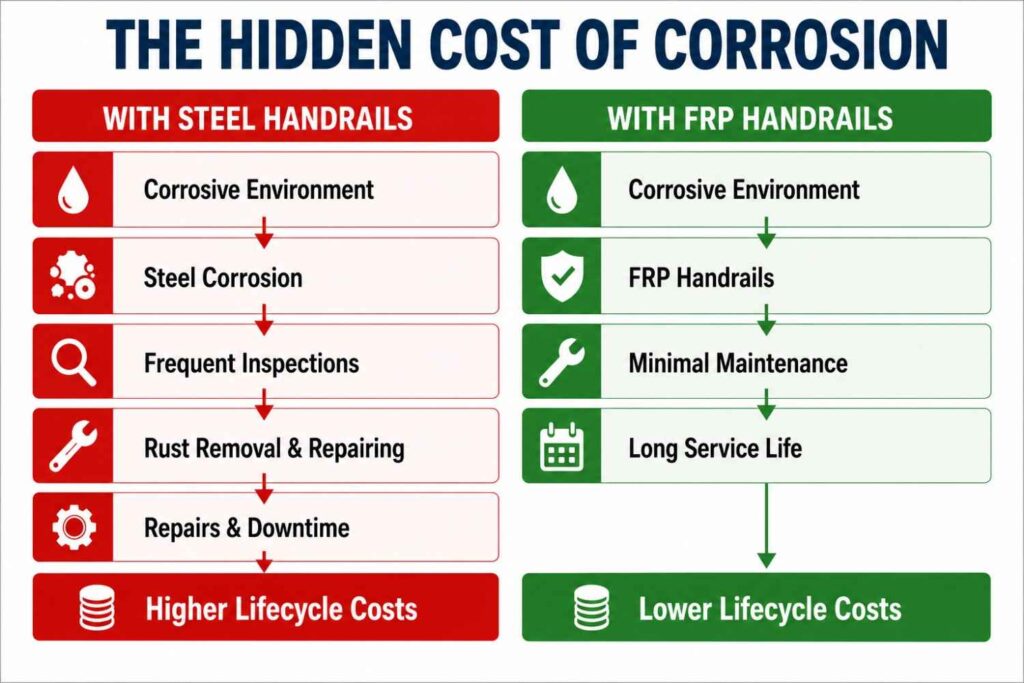
Corrosion affects far more than appearance. It creates a cycle of ongoing maintenance and repair that impacts operational budgets. Common costs include:
"According to the NACE International IMPACT Study, the global cost of corrosion is estimated at approximately US$2.5 trillion annually, representing around 3.4% of global GDP."
Steel has been the preferred material for industrial handrails for decades due to its strength, availability, and familiarity among engineers and contractors. However, its performance depends heavily on environmental conditions and maintenance practices.
The Challenge: Steel naturally reacts with oxygen and moisture. While galvanized coatings help, scratches and chemical exposure can compromise protective layers, allowing corrosion to spread beneath the surface.
FRP (Fiberglass Reinforced Plastic) handrails are composite structures manufactured using fiberglass reinforcements and corrosion-resistant resin systems. Unlike steel, FRP does not contain iron and therefore cannot rust.
Most industrial FRP handrails are produced through pultrusion, where fiberglass is saturated with resin and pulled through a heated die to form rigid structural profiles.
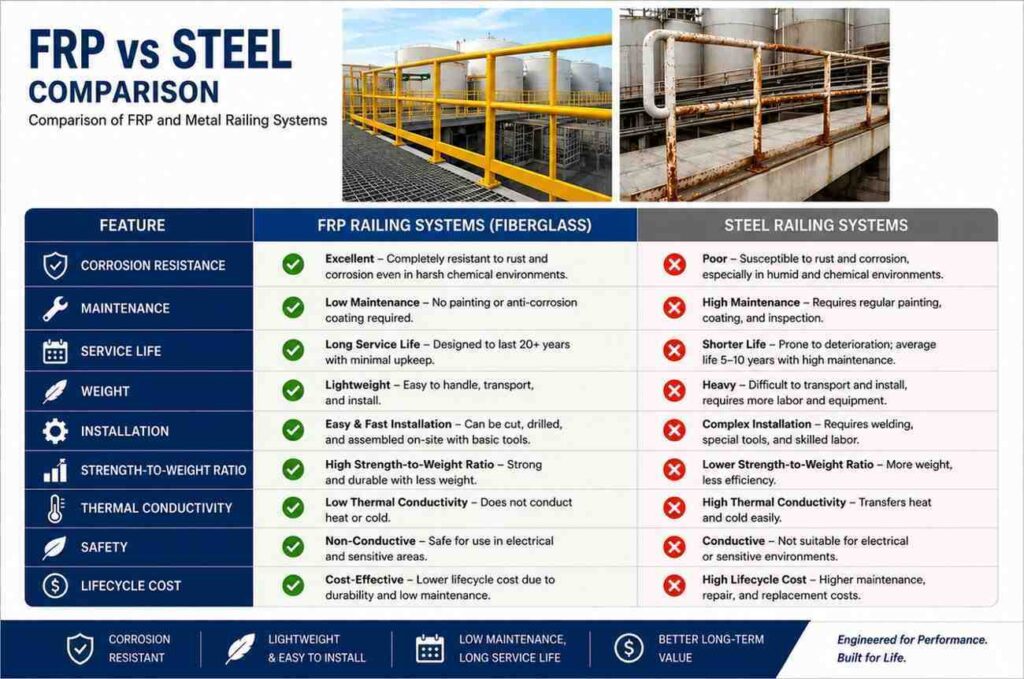
While both materials have strengths, their performance differs significantly when evaluated against key industrial requirements.
| Feature | FRP Handrails | Steel Handrails |
|---|---|---|
| Corrosion Resistance | Immune to rust/oxidation. Resistant to acids, alkalis, and salts. | Vulnerable to rust. Depends entirely on protective coatings. |
| Weight | Up to 75% lighter. Easier transport & handling. | Heavy. Often requires lifting equipment. |
| Installation | On-site fabrication with standard tools. No hot-work. | Requires cutting, welding, and crane lifts. |
| Electrical Safety | Non-conductive. No shock hazards. | Conductive. High electrical risk. |
| Maintenance | Minimal. No painting or coating required. | High. Regular inspection and repainting needed. |
| Structural Strength | Excellent strength-to-weight ratio. Flexible. | Superior impact resistance and rigidity. |
Installation efficiency can significantly impact project schedules and budgets. Explore the differences in logistics.
“A project highlighted by Wellco Industries involved a multi-story rooftop installation where galvanized steel guardrails were initially specified. Switching to FRP eliminated the need for a crane lift, simplified installation, and allowed the work to be completed ahead of schedule.”
The resulting labor and equipment savings reportedly offset much of the difference in material costs, demonstrating that installation efficiency impacts project economics as much as purchase price.
Initial purchase price tells only part of the story. Steel may cost less upfront, but maintenance expenses accumulate over time through repainting, corrosion repairs, and inspections.
FRP often results in lower total ownership costs due to reduced maintenance.
Market research indicates steady growth for the global FRP market over the next decade, driven by demand for durable infrastructure.
Chemical plants routinely expose infrastructure to acids, alkalis, and solvents. FRP complements fiberglass process vessels for a durable strategy.
Refineries prioritize non-conductive and non-sparking characteristics for improved operational safety.
Exposure to moisture and hydrogen sulfide makes FRP ideal for maintaining long-term structural integrity with less maintenance.
Mining environments expose infrastructure to chemicals and abrasive conditions where FRP reduces maintenance demands.
Saltwater is aggressive for steel. FRP's immunity makes it ideal for desalination facilities and marine terminals.
Every facility operates under unique conditions. Consider these factors.
Evaluate chemical exposure, saltwater, and humidity levels.
Consider long-term maintenance resources vs upfront cost.
Check for electrical hazards and ignition risks.
Include inspection, replacement, and downtime costs.
High-quality industrial FRP handrails typically incorporate UV-resistant resin systems and surfacing veils designed for long-term outdoor exposure.
Individual sections are usually replaced rather than repaired. However, modular designs often make replacement straightforward and efficient.
Yes. FRP handrail systems can be customized with different resin systems, colors, dimensions, and configurations to suit specific industries and operating conditions.
Steel handrails continue to serve many industrial applications, particularly where high impact resistance is primary. However, in facilities where corrosion, chemical exposure, and maintenance costs are persistent concerns, FRP handrails often provide a more practical long-term solution.
As more industrial operators focus on lifecycle performance rather than upfront cost alone, the shift toward corrosion-resistant materials continues to grow. For facilities evaluating access structures, considering FRP can help improve reliability and reduce maintenance burdens.
