Address
Busubait Fiberglass Factory
P.O Box 63113, Dammam 31516
Kingdom of Saudi Arabia
Work Hours
Monday to Friday: 7AM - 7PM
Weekend: 10AM - 5PM

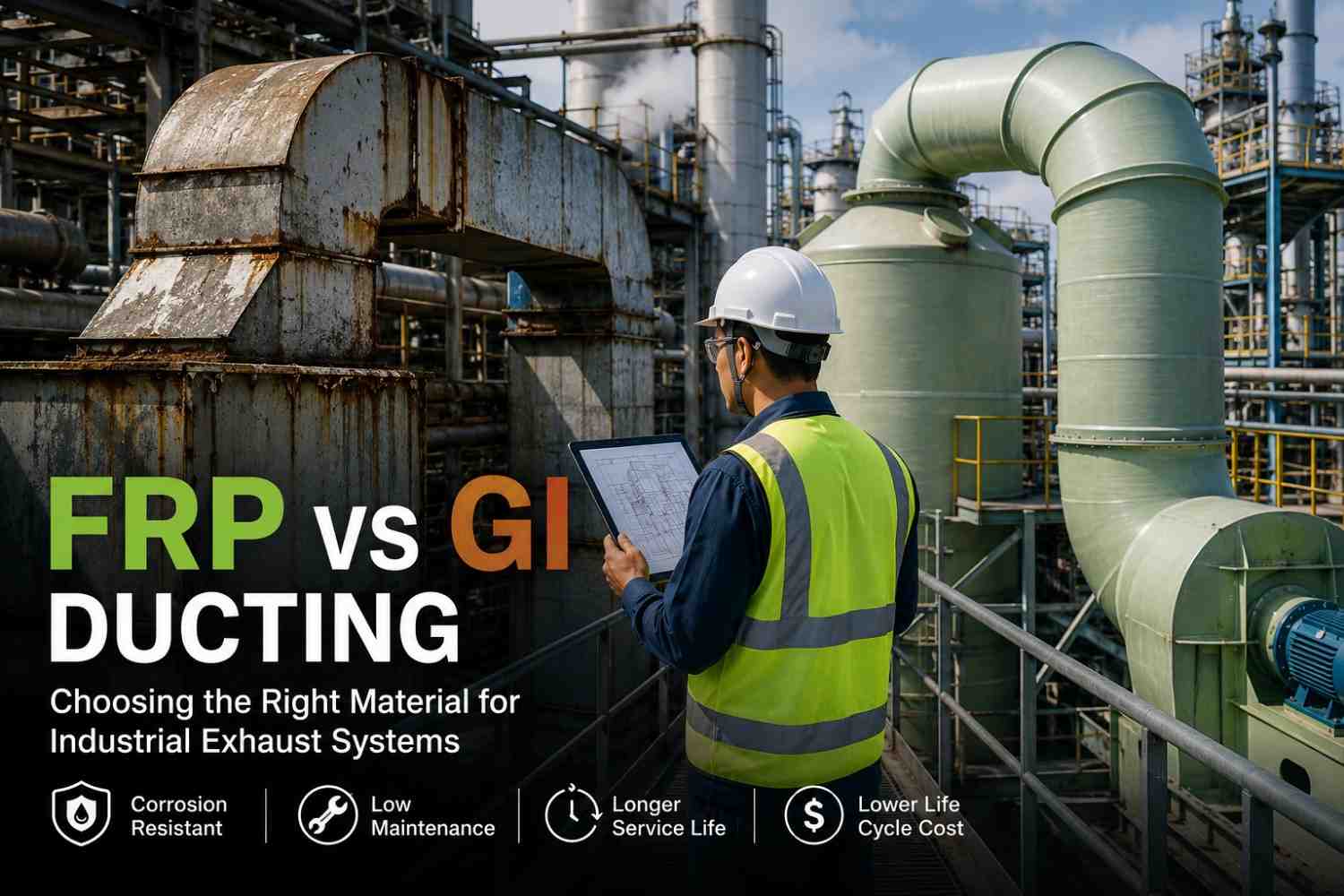
Industrial exhaust systems operate in some of the harshest environments across chemical plants, fertilizer facilities, wastewater treatment units, mining operations, and manufacturing industries. The performance and reliability of these systems depend heavily on one critical factor — the ducting material.
Among the most commonly used materials for industrial exhaust ducting are FRP (Fiberglass Reinforced Plastic) and GI (Galvanized Iron) ducting. While both serve important functions, their performance varies significantly depending on environmental exposure, maintenance expectations, corrosion risk, and operational demands.
If you’re involved in engineering, procurement, or project execution, this guide will help you focus on what actually influences long-term performance—not just upfront pricing.
Key Insight: This comprehensive guide compares FRP ducting vs GI ducting for industrial exhaust systems, covering corrosion resistance, durability, maintenance, lifecycle cost, industrial applications, and long-term operational value to help you make the right choice for your facility.
Over 20–30 years, FRP typically delivers significantly lower total cost of ownership compared to GI in corrosive environments. Annual maintenance cost for FRP in corrosive or outdoor environments runs approximately 0.5–1% of installed cost versus 2–5% for painted or coated steel. Over a 25-year lifecycle, total maintenance cost for FRP systems is documented at 60–80% below steel alternatives in comparable service environments. IncomePultrusion
FRP: 0.5–1% of installed cost
GI: 2–5% of installed cost
FRP saves up to 80% in maintenance costs
Total maintenance cost for FRP systems is documented at 60–80% below steel alternatives in comparable service environments
Significant long-term savings
✓ Extract contaminated air
✓ Handle corrosive fumes
✓ Maintain safe workplace conditions
✓ Support environmental compliance
Material choice directly impacts how long your system will operate effectively
Different materials require varying levels of maintenance and inspection
Weight and support requirements affect installation and infrastructure costs
Proper material selection ensures operational reliability and worker safety
Five critical considerations for proper manufacturer selection
FRP ducting is manufactured using fiberglass reinforcement combined with thermosetting resin systems such as polyester or vinyl ester. This combination creates a lightweight, corrosion-resistant material designed for aggressive industrial environments.
✓Chemical processing plants
✓Fertilizer industries
✓Scrubber exhaust systems
✓Wastewater treatment plants
✓Coastal industrial facilities
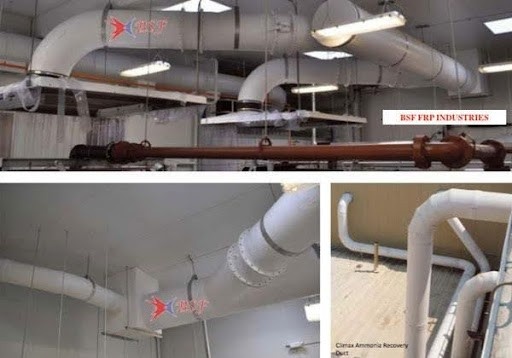
According to industrial manufacturers, FRP ducting systems offer excellent resistance to acids, alkalis, solvents, moisture, and chemical fumes, making them suitable for highly corrosive exhaust applications.
GI ducting is fabricated using galvanized iron sheets coated with zinc to improve corrosion resistance. GI ducting is widely used in commercial and general ventilation applications due to its cost-effectiveness and ease of fabrication.
Important Note: However, GI ducting’s performance declines significantly in chemically aggressive or moisture-heavy environments. Its zinc coating acts as a sacrificial layer, and once compromised, corrosion spreads rapidly.
Corrosion resistance is one of the biggest advantages of FRP ducting. FRP systems resist:
✅ Acids
✅ Alkalis
✅ Solvents
✅ Wet chemical fumes
✅ Salt-laden coastal air
GI ducting performs adequately in dry and non-corrosive environments. However:
✅ Moisture damages the zinc coating
✅ Corrosive fumes accelerate rust formation
✅ Long-term chemical exposure weakens the structure
✅ Premature failure in chemical plants
FRP ducting is extensively used in Flue Gas Desulfurization (FGD) applications because of its ability to withstand corrosive gases and wet exhaust conditions.
| Environment | FRP Ducting | GI Ducting |
|---|---|---|
| Chemical Plants | Excellent | Poor to Moderate |
| Coastal Facilities | Excellent | Moderate |
| Wastewater Plants | Excellent | Moderate |
| Commercial HVAC | Good | Good |
| Wet Scrubber Exhaust | Excellent | Poor |
FRP ducting is significantly lighter than GI ducting.
Advantages:
✅ Easier transportation
✅ Reduced structural support requirements
✅ Faster installation handling
✅ Lower installation labor burden
GI ducting is heavier and requires more support.
Requirements:
✅ Stronger support structures
✅ More installation effort
✅ Higher structural loading
✅ Increased infrastructure costs
FRP ducting requires minimal maintenance because:
✅ It does not rust
✅ It does not require repainting
✅ It resists chemical degradation
✅ Routine inspections ensure long-term performance
GI ducting requires extensive maintenance including: </p?
✅ Regular corrosion inspections
✅ Repainting or recoating
✅ Rust treatment
✅ Periodic replacement in harsh environments
Depending on resin selection, FRP ducting can typically withstand temperatures between approximately 80°C and 120°C.
Modern resin systems improve:
✅ Chemical resistance
✅ Heat tolerance
✅Structural rigidity
GI ducting offers strong physical durability and good impact resistance.
Characteristics:
✅ Strong physical durability
✅ Good impact resistance
✅High rigidity
✅ However, temperature resistance alone should not determine material selection in corrosive environments
FRP ducting offers:
✅ Easier handling
✅Lower transportation cost
✅ Custom fabrication flexibility
✅ Reduced structural support needs
GI ducting remains easier for:
✅ Standard HVAC fabrication
✅ Commercial ventilation systems
✅Fast on-site installation in non-corrosive environments
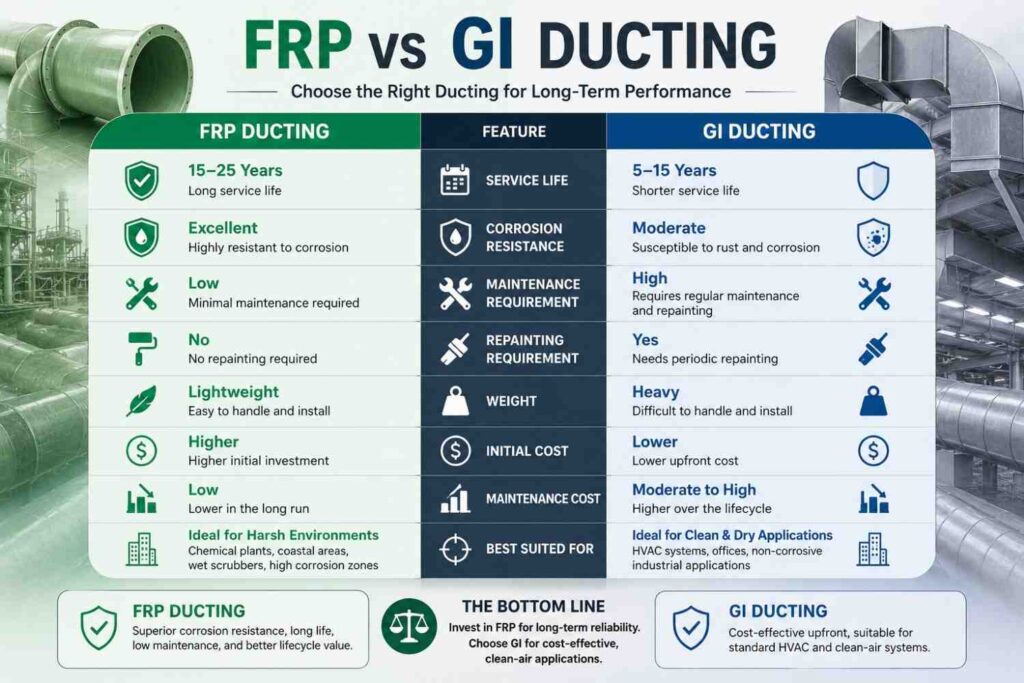
| Parameter | FRP Ducting | GI Ducting |
|---|---|---|
| Average Service Life | 15–25 Years | 5–15 Years |
| Maintenance Frequency | Low | High |
| Repainting Requirement | No | Yes |
| Corrosion Repair Cost | Minimal | Moderate to High |
| Downtime Risk | Low | Moderate |
| Property | FRP Ducting | GI Ducting |
|---|---|---|
| Initial Cost | Higher | Lower |
| Weight | Lightweight | Heavy |
| Corrosion Resistance | Excellent | Moderate |
| Maintenance Cost | Low | Moderate to High |
| Structural Support Requirement | Lower | Higher |
| Coastal Suitability | Excellent | Moderate |
| Chemical Resistance | Excellent | Limited |
| Expected Lifecycle Value | High | Moderate |
For applications requiring superior corrosion resistance and long-term durability
✓
For clean-air systems with limited moisture or chemical exposure
✓Exhaust contains corrosive fumes — Acids, alkalis, or chemical vapors are present
✓Facility operates near coastal regions — Salt-laden air and moisture exposure
✓Long-term durability is critical — You need a system that lasts 20+ years
✓Downtime reduction is important — Minimize operational interruptions
✓Maintenance budgets must remain low — Reduce ongoing operational costs
✓Airflow is clean and dry — No corrosive fumes or moisture exposure
✓Application is commercial HVAC — Standard ventilation and air conditioning
✓Initial budget is the main priority — Lower upfront capital costs
✓Corrosion exposure is minimal — Non-aggressive environmental conditions
Industries are increasingly shifting toward corrosion-resistant composite systems due to escalating maintenance expenses
Facilities demand systems that operate reliably for 20-30 years with minimal intervention
Decision-making now prioritizes total cost of ownership over initial purchase price
Stricter environmental and safety regulations drive adoption of reliable, durable materials
FRP Adoption Growth: FRP ducting adoption is growing rapidly across chemical industries, water treatment infrastructure, coastal industrial projects, and heavy-process manufacturing facilities as organizations recognize the long-term value proposition.
Many maintenance engineers report that GI ducting performs poorly once exposed to acidic fumes or continuous moisture. The zinc coating acts as a sacrificial layer, so once it starts reacting with corrosive vapors, the base steel becomes exposed and rusting accelerates rapidly. In several industrial forum discussions, engineers mentioned seeing holes develop within just a few years in humid or chemical-heavy environments.
Not necessarily. Stainless steel performs well in many applications, but engineers in chemical processing discussions often point out that certain acidic vapors — especially chlorides and sulfur compounds — can still damage stainless grades over time. FRP is usually preferred when corrosion resistance is the primary concern because it does not rust and can be engineered specifically for chemical compatibility.
They can help temporarily, but many field engineers warn that coatings eventually fail at joints, bends, supports, or scratched areas. Once the coating is compromised, corrosion spreads underneath. This is one reason why several process engineers recommend FRP instead of relying on painted GI ducts in corrosive exhaust systems.
Plant operators often notice:
In many real-world cases discussed online, internal corrosion was discovered only after airflow efficiency dropped significantly.
FRP systems generally require less corrosion-related maintenance, but engineers still recommend periodic inspections for UV exposure, joint integrity, and resin surface wear. Unlike GI ducts, maintenance is usually preventive rather than reactive replacement due to rust damage.
Several engineers in industrial forums mention that even if the main duct is corrosion-resistant, metal louvers and terminal components often become the weak point. Acidic fumes can condense near discharge points and rapidly corrode galvanized components. That is why many facilities standardize FRP for the entire exhaust path, including stacks, dampers, and louvers.
Both FRP ducting and GI ducting serve important roles in industrial exhaust systems, but their suitability depends entirely on operating conditions. GI ducting remains a practical solution for clean-air HVAC and non-corrosive ventilation systems due to its lower initial cost and strong structural performance.
However, in aggressive industrial environments involving chemicals, moisture, salt-laden air, or corrosive fumes, FRP ducting offers superior long-term value through:
✓Excellent corrosion resistance
✓Reduced maintenance
✓Lower lifecycle costs
✓Longer operational lifespan
Selecting the right ducting material is not simply a cost decision. It is an operational decision that directly impacts reliability, maintenance frequency, downtime, and infrastructure longevity. Consider your facility’s specific environmental conditions, chemical exposure, budget constraints, and long-term operational goals when making this critical choice.
Contact Busubait for expert guidance on FRP and GI ducting systems tailored to your industrial needs.
