Address
Busubait Fiberglass Factory
P.O Box 63113, Dammam 31516
Kingdom of Saudi Arabia
Work Hours
Monday to Friday: 7AM - 7PM
Weekend: 10AM - 5PM

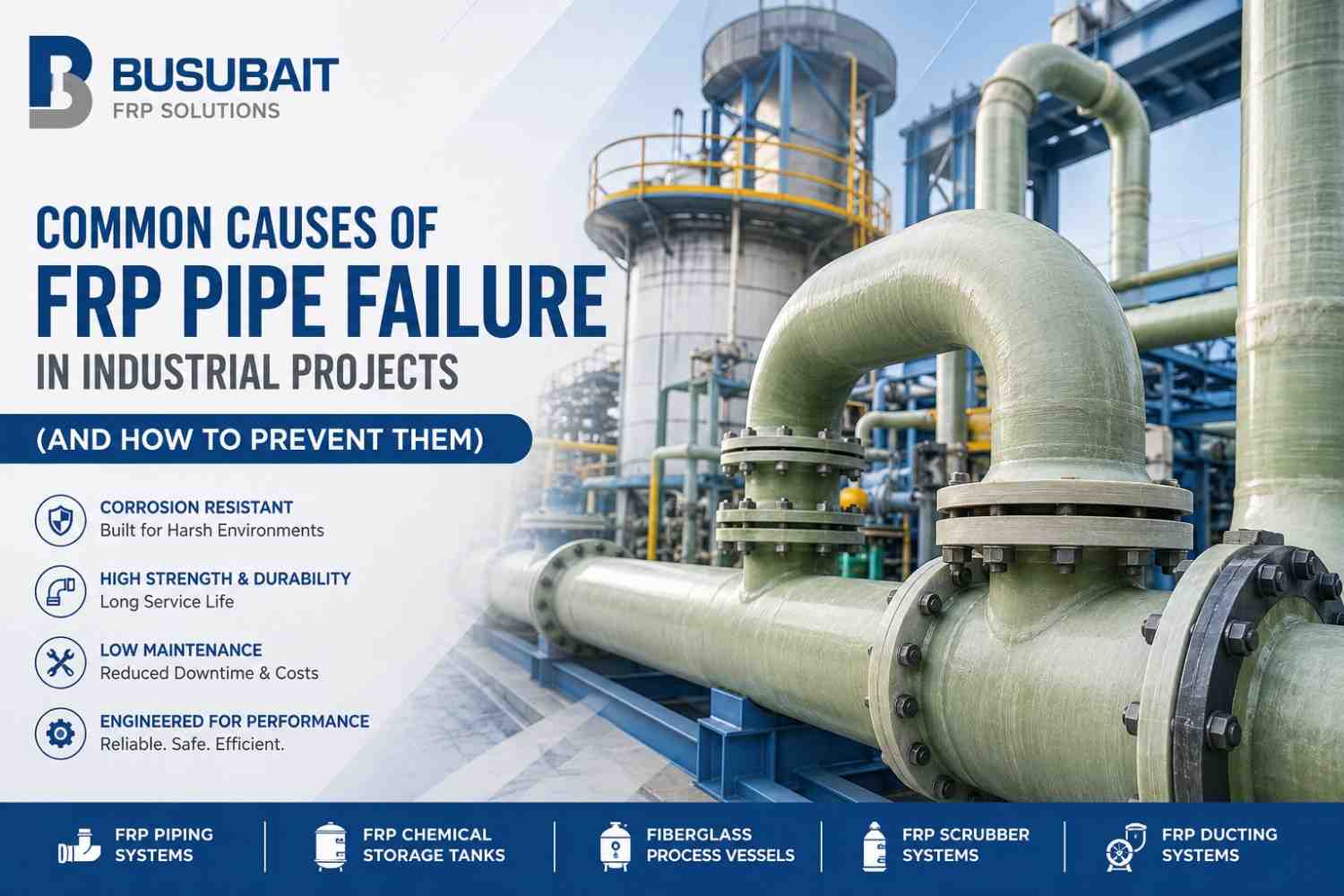
Discover the most common causes of FRP pipe failure in industrial projects and learn how proper design, installation, and material selection can prevent costly issues.
FRP (Fiberglass Reinforced Plastic) piping systems have become a preferred solution for industries that operate in highly corrosive environments. From chemical processing plants and petrochemical facilities to water treatment and desalination projects, FRP pipes offer exceptional corrosion resistance, lightweight construction, and long service life compared to traditional metallic piping systems.
However, despite their advantages, FRP pipe failures still occur across industrial projects. These failures can result in unplanned downtime, production losses, costly repairs, and safety concerns. In many cases, the root cause is not the material itself but avoidable issues such as improper installation, incorrect resin selection, inadequate support design, pressure surges, or insufficient maintenance.
This article explores the most common causes of FRP pipe failure in industrial applications, explains why they occur, highlights warning signs to watch for, and provides practical strategies to help engineers and plant operators maximize the lifespan of their piping systems.
Corrosion remains one of the biggest challenges facing industrial infrastructure worldwide. According to the NACE International IMPACT Study, corrosion costs the global economy approximately USD 2.5 trillion annually, equivalent to roughly 3.4% of global GDP. The study further estimates that implementing corrosion prevention best practices could reduce these costs by 15–35%, potentially saving hundreds of billions of dollars every year. This is one of the primary reasons industries increasingly rely on corrosion-resistant materials such as FRP piping systems.
USD 4.70 Billion
USD 8.99 Billion
6.71%
Unlike steel pipes, FRP pipes are composite materials made from reinforcing glass fibers and engineered resin systems. This combination provides excellent chemical resistance and high strength-to-weight ratios.
However, FRP behaves differently from metal. It responds differently to mechanical loads, temperature fluctuations, vibration, and installation stresses. Most failures occur when these unique characteristics are overlooked during design, installation, or operation.
FRP pipe performance depends on two critical components:
When either component becomes compromised, the integrity of the entire piping system can be affected.
The growing demand for corrosion-resistant infrastructure is reflected in the FRP pipe market itself. According to Precedence Research, the global FRP pipe market was valued at approximately USD 4.7 billion in 2025 and is projected to reach nearly USD 9 billion by 2035. As more facilities adopt FRP technology for critical process applications, understanding the causes of premature failures becomes increasingly important.
Installation errors remain one of the most common causes of premature FRP piping failures. Unlike steel systems, FRP requires specialized handling, alignment, bonding, and torque procedures. Applying conventional steel piping practices to FRP often creates long-term reliability issues.
Misalignment introduces stress concentrations into the piping system.
Common installation mistakes include:
Over time, these stresses can lead to cracking, leakage, and joint separation.
Pipe supports are critical to maintaining structural integrity.
When supports are spaced too far apart, excessive deflection can occur, causing:
Facilities using long process lines should pay particular attention to support design when installing FRP piping systems.
Many FRP piping systems rely on bonded joints.
Failures commonly occur when:
Even small shortcuts during installation can significantly reduce joint strength.
One of the most frequently reported installation issues involves over-tightening flange bolts.
Unlike steel flanges, FRP flanges can crack when excessive torque is applied.
One of FRP’s biggest advantages is corrosion resistance. However, that performance depends heavily on selecting the correct resin system.
The resin acts as the primary barrier between process fluids and the reinforcing glass fibers.
When the resin is chemically incompatible:
Eventually, aggressive chemicals can reach the reinforcing fibers and compromise the pipe structure.
Many chemical facilities choose vinyl ester resin systems because of their excellent resistance to acids, alkalis, and aggressive process chemicals.
The same principles apply when selecting FRP chemical storage tanks for corrosive applications.
For highly aggressive service environments, engineers may also evaluate dual laminate equipment for enhanced chemical resistance.
High-velocity fluids and abrasive slurries can gradually wear away the resin-rich corrosion barrier.
Industries such as mining, wastewater treatment, and chemical processing should carefully evaluate flow conditions during design.
Facilities handling aggressive chemicals often integrate FRP piping with fiberglass process vessels to create complete corrosion-resistant process systems.
FRP pipes possess excellent tensile strength but are more sensitive to bending and localized stress than steel.
Common causes include:
Excessive bending often leads to cracking and joint failures.
Buried FRP pipelines may experience stress from:
Ground settlement can create bending stresses that exceed design limits.
Industrial environments expose piping systems to forklifts, maintenance equipment, and accidental impacts.
Repeated impacts can initiate cracks that worsen over time.
Prolonged sunlight exposure can cause:
Outdoor piping systems are continuously exposed to:
Protective coatings and routine inspections help minimize these effects.
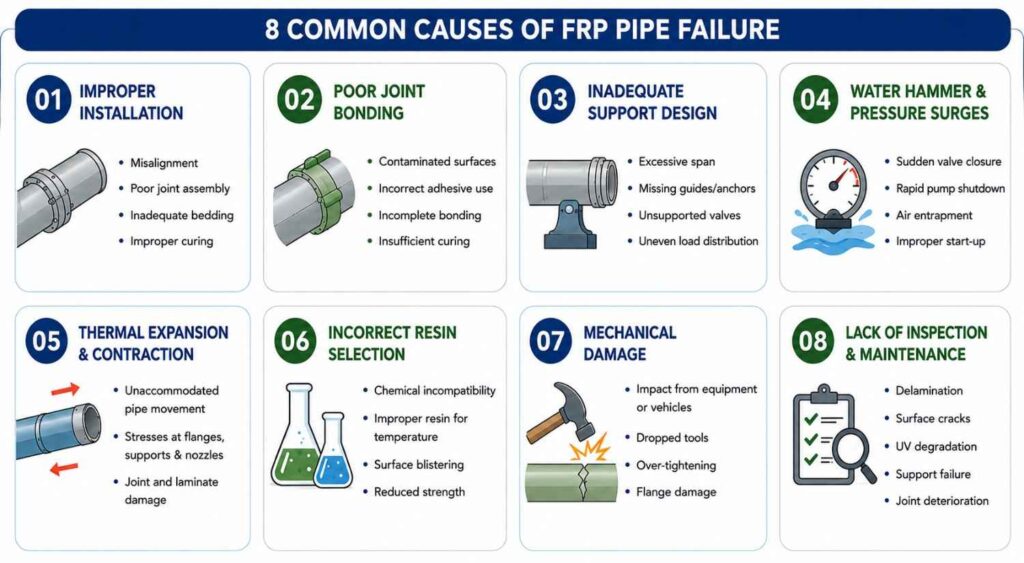
FRP piping systems often provide warning signs before a major failure occurs.
Preventing failures requires a combination of proper engineering, installation, and maintenance.
Select the correct resin system for the process fluid
Follow manufacturer installation procedures
Design supports and anchors correctly
Allow for thermal expansion
Conduct routine inspections
Monitor vibration and pressure surges
Most FRP pipe failures can be traced back to preventable issues such as installation errors, incorrect resin selection, inadequate support design, pressure surges, manufacturing defects, or environmental exposure. Understanding these causes allows engineers and plant operators to improve reliability, reduce maintenance costs, and avoid unexpected downtime.
When properly engineered, installed, and maintained, FRP piping systems can deliver decades of dependable service in demanding industrial environments. Whether you’re designing a new facility or upgrading an existing one, selecting the right materials and working with experienced FRP specialists can significantly improve long-term performance.
For facilities evaluating corrosion-resistant process infrastructure, solutions such as FRP piping systems, FRP chemical storage tanks, and fiberglass process vessels can provide durable, long-term performance in challenging industrial applications.
No. Properly designed and installed FRP piping systems are highly reliable. Most documented failures are linked to installation errors, poor joint construction, support issues, or operational conditions rather than the pipe material itself.
Common failure modes include cracking, delamination, joint leakage, blistering, excessive deflection, and localized structural damage caused by mechanical or thermal stresses.
Not necessarily. Hairline cracks may be cosmetic, but deeper cracks can indicate laminate damage. Any crack should be inspected to determine its depth and potential impact on structural integrity.
Yes. Repeated pressure surges and water hammer events can damage joints, fittings, and pipe sections if surge protection measures are not incorporated into the system design.
In properly designed industrial applications, FRP piping systems can provide service lives exceeding 25–50 years, depending on operating conditions, resin selection, and maintenance practices.
For many chemical, seawater, and wastewater applications, FRP offers superior corrosion resistance and lower lifecycle maintenance requirements compared with carbon steel.
Partner with Busubait for engineered FRP solutions that deliver decades of dependable service.
