Address
Busubait Fiberglass Factory
P.O Box 63113, Dammam 31516
Kingdom of Saudi Arabia
Work Hours
Monday to Friday: 7AM - 7PM
Weekend: 10AM - 5PM

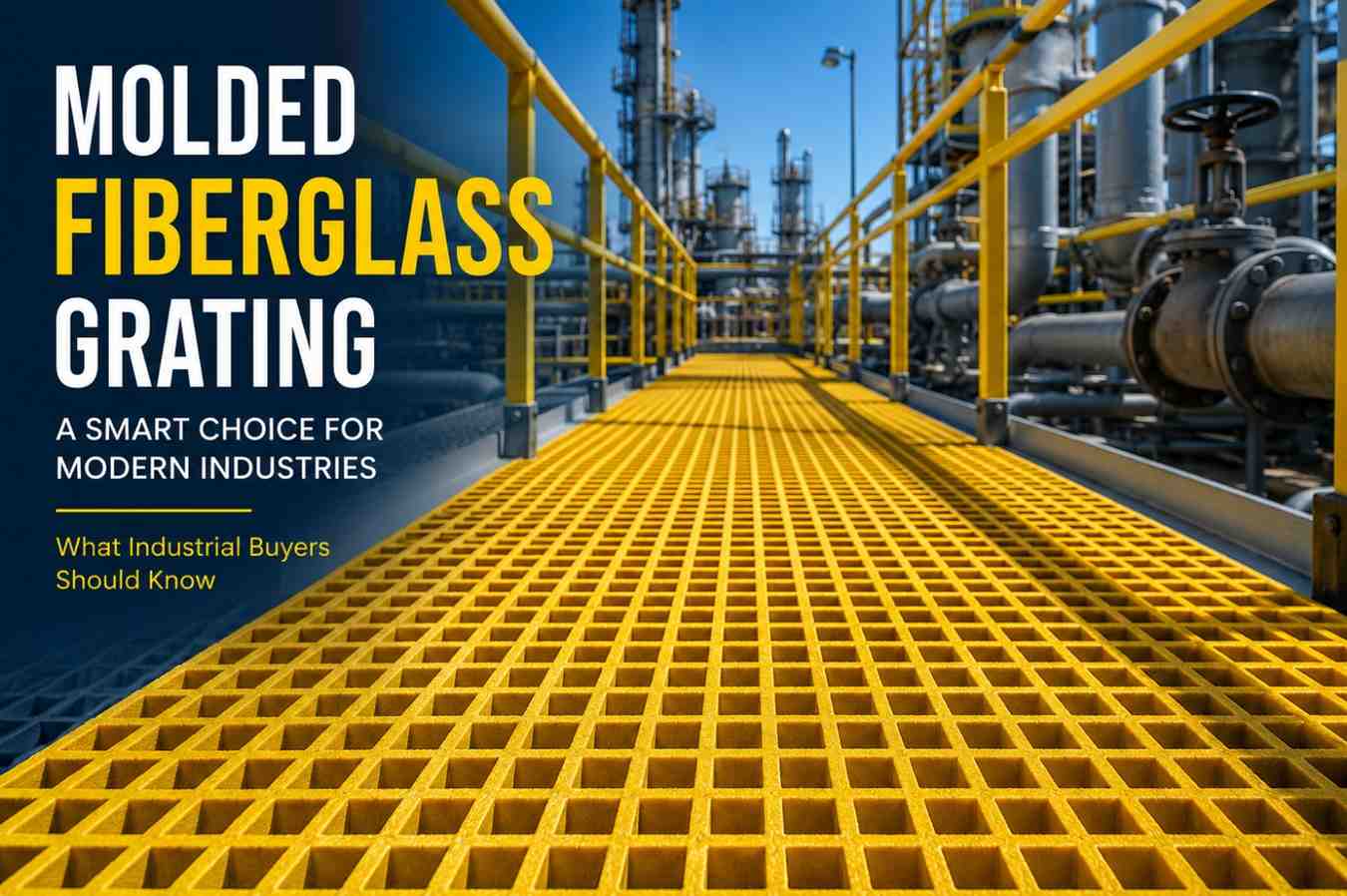
Industrial facilities today operate in some of the harshest environments imaginable. Chemical processing plants handle aggressive acids, wastewater treatment facilities are constantly exposed to moisture, marine structures face continuous salt spray, and oil and gas installations endure corrosive atmospheres around the clock. In these conditions, flooring and access systems must do far more than support foot traffic—they need to remain safe, durable, and reliable throughout years of demanding service.
For decades, steel grating has been the industry standard for industrial walkways and platforms. However, frequent corrosion, rising maintenance costs, and unplanned downtime have prompted many facility owners and engineers to rethink their material choices. Increasingly, molded fiberglass grating is becoming the preferred alternative because it offers exceptional corrosion resistance, lightweight construction, excellent structural performance, and lower maintenance throughout its service life.
Global FRP Grating Market by 2032
Whether you’re specifying materials for a new facility or replacing aging steel grating during a plant upgrade, selecting the right product requires more than comparing initial costs. Engineers and procurement teams must consider chemical exposure, load requirements, worker safety, maintenance expectations, and long-term operating costs. This guide explains everything industrial buyers should know before choosing molded fiberglass grating, helping you make an informed investment that supports reliable plant operations for years to come.
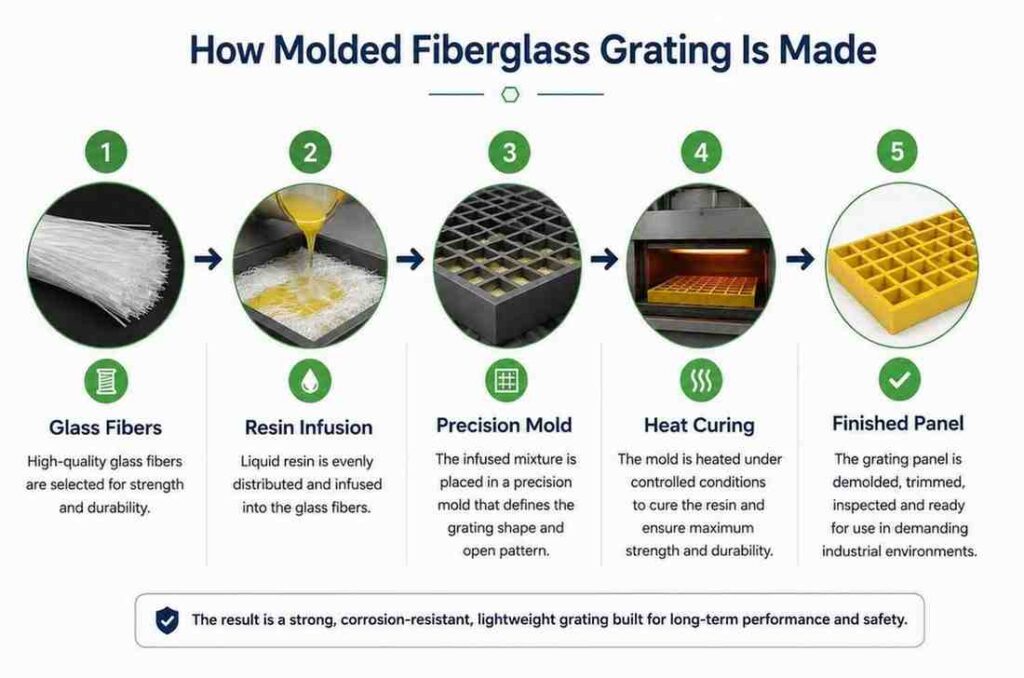
Molded fiberglass grating is a structural flooring system manufactured by combining continuous glass fiber reinforcement with high-performance thermosetting resins in a precision mold. Unlike fabricated steel grating, which relies on welded components and protective coatings, molded fiberglass grating forms a single-piece panel with strength distributed in both directions.
Its open-grid construction allows water, chemicals, and debris to pass through easily while providing a safe walking surface for operators and maintenance personnel. Because the fiberglass reinforcement is fully encapsulated within the resin, the material resists corrosion, requires very little maintenance, and maintains its performance even in challenging industrial environments.
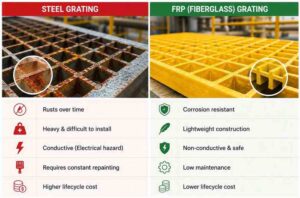
While steel remains a strong structural material, it depends on galvanizing, painting, or protective coatings to resist corrosion. Once these coatings deteriorate, rust develops rapidly, increasing maintenance costs and reducing service life.
Molded fiberglass grating, on the other hand, offers inherent corrosion resistance because the material itself is non-metallic. It does not rust, rot, or deteriorate in the same way as conventional materials, making it particularly suitable for corrosive industrial environments.
Withstands acids, alkalis, and saltwater without rusting or requiring frequent maintenance.
Weighs 1/4 of steel but offers impressive structural performance and easier installation.
Slip-resistant grit surfaces, non-conductive, and thermally insulating properties.
Eliminates the need for periodic sandblasting, repainting, or corrosion repair.
Typical installations include pump stations, chemical dosing areas, acid storage zones, and tank access platforms. Its corrosion resistance significantly reduces maintenance compared to conventional steel flooring.
Commonly installed around clarifiers, sludge tanks, filter galleries, and aeration basins. It resists the combination of moisture, chlorides, and treatment chemicals.
Used in process units, offshore platforms, and pipe bridges. Performs reliably under corrosive operating conditions while supporting heavy industrial activity.
Ideal for docks, jetties, ports, and ship decks where saltwater presents an aggressive corrosion environment.
Installed in washdown areas and processing zones where hygiene and moisture resistance are equally important.
| Feature | Molded Grating | Pultruded Grating |
|---|---|---|
| Load Direction | Bidirectional | Primarily one direction |
| Corrosion Resistance | Excellent | Excellent |
| Impact Resistance | Excellent | Good |
| Long Span Capability | Moderate | Excellent |
| Heavy Structural Loads | Moderate | Excellent |
Molded grating is preferred for multidirectional loading and impact performance, while pultruded is best for long spans.
Determine expected pedestrian traffic, equipment loads, and support spacing.
Polyester: General industrial.
Isophthalic: Better corrosion.
Vinyl Ester: Highly aggressive chemicals.
Choose between Grit top, Concave surface, or Covered grating based on safety needs.
Evaluate UV radiation, saltwater, fire requirements, and operating temperatures.
Although molded fiberglass grating may require a higher initial investment than galvanized steel, the long-term financial picture is often very different.
Steel installations frequently require repainting, corrosion repair, welding, and periodic replacement. Every maintenance shutdown affects productivity and increases operational costs.
Did You Know?
Lifecycle cost studies found that FRP systems can reduce total ownership costs by 30–60% over a 25-year period. Upfront costs are often offset within 3–5 years.
Like any engineered material, molded fiberglass grating must be selected for the correct application. It has excellent impact resistance and corrosion resistance, but excessive loading beyond its design capacity or prolonged UV exposure without the appropriate resin formulation can affect its performance. Choosing the correct resin system, panel thickness, and support spacing helps ensure long-term durability.
No. One of the advantages of molded fiberglass grating is that it can usually be cut and installed using standard fabrication tools fitted with appropriate blades. Panels are typically secured using stainless steel hold-down clips, eliminating the need for welding and reducing installation time compared to steel grating.
The resin should always be selected based on the chemicals, operating temperature, and environmental conditions your facility is exposed to. Polyester resin is for general use, Isophthalic for improved corrosion, and Vinyl Ester for highly aggressive environments. Consulting the manufacturer’s chemical resistance guide is recommended.
Although it requires less maintenance, periodic inspections are recommended. Facilities should check for excessive deflection, mechanical damage, and loose hold-down clips during routine maintenance shutdowns.
Yes. Because it is lightweight and easy to fabricate on-site, it is often used to replace corroded steel grating during plant upgrades. The reduced weight also minimizes additional loads on existing support structures.
Molded fiberglass grating has evolved from being an alternative to steel into a preferred engineering solution for industries operating in corrosive environments. Its combination of corrosion resistance, lightweight construction, slip resistance, and low maintenance makes it particularly valuable for chemical plants, water treatment facilities, and oil and gas installations.
If your facility is planning a new project or replacing aging steel grating, partnering with an experienced fiberglass manufacturer can simplify the specification process. Busubait supports industries with complete FRP access systems designed for reliable, long-term performance.
Get a custom quote for your FRP project today from Saudi Arabia’s trusted manufacturer.
