Address
Busubait Fiberglass Factory
P.O Box 63113, Dammam 31516
Kingdom of Saudi Arabia
Work Hours
Monday to Friday: 7AM - 7PM
Weekend: 10AM - 5PM

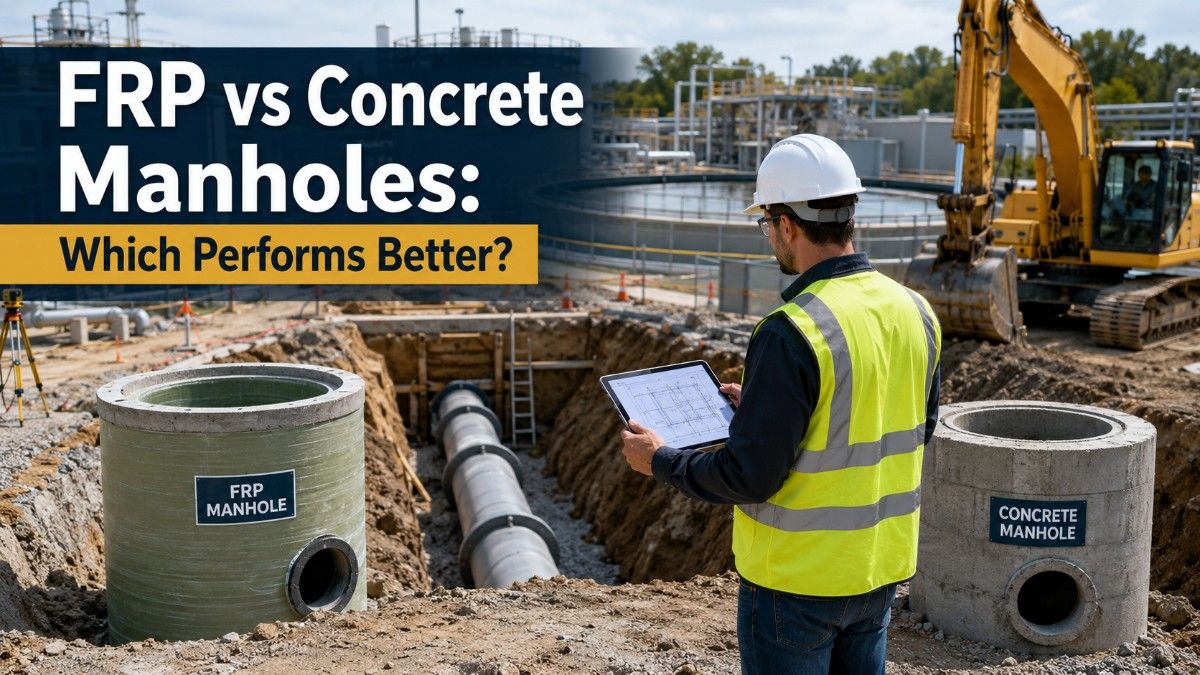
Compare FRP and concrete manholes for wastewater projects. Learn which option performs better for corrosion, installation, maintenance, and lifecycle cost.
Which is better for long-term performance? A practical comparison of corrosion resistance, installation, leakage control, structural design, maintenance, and lifecycle cost.
Manholes are easy to overlook until they start creating problems. In wastewater infrastructure, a manhole is not just an access point. It supports inspection, cleaning, maintenance, flow control, and emergency repair work. When the wrong material is selected, the result can be corrosion, leakage, difficult maintenance, and higher lifecycle cost.
Concrete manholes have been used for decades because they are strong, familiar, and usually cost less upfront. FRP manholes, also known as fiberglass manholes, are now being considered more often in corrosive wastewater environments because they are lightweight, corrosion resistant, and easier to install in many project conditions.
So, which one is better? The answer depends on the wastewater chemistry, site condition, load requirement, installation access, and long-term maintenance plan. This blog compares FRP vs concrete manholes from a practical engineering and project decision-making point of view.
Before comparing both materials, it helps to understand how each one is built and where it usually fits. FRP and concrete manholes serve the same basic purpose. They provide access to underground wastewater, sewer, drainage, or utility systems. The difference is in how they perform under corrosion, load, handling, and maintenance conditions.
An FRP manhole is made from fiber-reinforced plastic. It combines fiberglass reinforcement with a resin system to create a strong, lightweight, and corrosion-resistant structure.
FRP manholes are commonly used in:
FRP can also be fabricated into custom shapes, sizes, and connection details. This is useful when the project needs specific inlet and outlet locations or integration with FRP piping systems.
A concrete manhole is usually made from precast concrete sections. These sections are transported to the site and assembled underground.
Concrete manholes are common in:
Concrete has high compressive strength and is widely understood by contractors. However, in aggressive wastewater environments, concrete may need liners, coatings, sealants, or rehabilitation to protect it from corrosion and leakage.
Here is a simple comparison to help engineers, contractors, and procurement teams understand the main differences.
| Comparison Factor | FRP Manholes | Concrete Manholes |
|---|---|---|
| Corrosion resistance | Excellent in corrosive wastewater and sewer gas environments | Can deteriorate under hydrogen sulfide and acid exposure without protection |
| Weight | Lightweight and easier to handle | Heavy and usually needs lifting equipment |
| Installation | Faster in many projects due to prefabricated construction | Slower because of weight, joints, and section assembly |
| Watertightness | Can be fabricated as monolithic units with fewer leakage points | Joints and seals may become weak points over time |
| Customization | Easier to customize for inlets, outlets, liners, and chambers | Standard sizes are common, but custom options may need special molds |
| Maintenance | Lower corrosion-related maintenance when properly specified | May need coatings, liners, crack repair, or rehabilitation |
| Initial cost | Usually higher upfront | Usually lower upfront |
| Lifecycle cost | Often better in corrosive environments | Can increase over time due to repair and protection needs |
Key insight: This does not mean one material is always better than the other. Concrete may be suitable for many standard drainage and sewer applications. FRP becomes more valuable when corrosion, leakage, access difficulty, and long-term maintenance become major concerns.
Wastewater systems are not gentle environments. Manholes are often exposed to moisture, sewer gases, chemicals, biological activity, and changing flow conditions. In some locations, this exposure is mild. In others, it can be aggressive enough to damage traditional materials.
Concrete manholes can perform well in many standard systems. The problem starts when the sewer environment becomes chemically aggressive. In sanitary sewer systems, organic matter can release hydrogen sulfide gas. Under certain conditions, this can contribute to sulfuric acid formation on the concrete surface. Over time, acid attack can damage the cementitious material.
Common signs of concrete manhole deterioration include:
This is why many concrete manholes in aggressive wastewater systems need protective linings or coatings. Without protection, the structure may require rehabilitation before the expected service life is complete.
FRP manholes are naturally suited for corrosive environments because they do not rust and do not suffer the same acid attack issues as concrete.
In wastewater systems, FRP can help reduce problems caused by:
The resin system matters. A properly selected FRP manhole should match the actual wastewater chemistry, temperature, and site conditions. This is especially important for industrial wastewater projects where chemicals may vary from one facility to another.
For engineers, the main benefit is simple. FRP reduces the need to keep fighting corrosion after installation.
Material performance matters, but installation also affects the total project cost. A manhole that is difficult to transport, lift, align, and seal can slow down site work. This is especially important for EPC contractors, municipal projects, industrial plants, and shutdown-based maintenance work.
Concrete manholes are heavy. They usually require cranes, lifting equipment, skilled rigging, and more site coordination. FRP manholes are much lighter. This makes them easier to transport, unload, move, and position during installation.
This can be helpful in:
Lighter handling can also reduce worker strain and improve installation safety. That does not remove the need for proper installation planning, but it can make the process easier.
Concrete manholes are often installed in sections. Each section needs proper alignment and sealing. If the joint sealing is poor, future leakage can become a problem.
FRP manholes can be supplied as prefabricated or monolithic units. Since there are fewer joints, installation can be faster and more controlled.
This can reduce:
For industrial plants, even a small reduction in installation time can matter. A weekend shutdown or short maintenance window may not allow long civil work.
FRP is lightweight, which is a major handling advantage. But underground, that same light weight needs engineering attention. In areas with high groundwater, FRP manholes must be properly anchored or backfilled to prevent buoyancy. This does not make FRP unsuitable. It simply means the installation design should match the site condition.
Before specifying FRP manholes, engineers should check:
This is an important point. FRP should not be selected only because it is corrosion resistant. It should be selected and installed as a complete engineered system.
Busubait manufactures fiberglass manholes, manhole liners, inspection chambers, FRP pipes, fittings, and custom fiberglass products for industrial and infrastructure applications. If your project involves corrosive wastewater, lift stations, industrial drainage, or manhole rehabilitation, FRP may be a suitable option to evaluate.
Contact Busubait for Wastewater FRP SolutionsLeakage is not just a maintenance issue. In wastewater infrastructure, it can increase operating costs and create environmental risk. A manhole should keep groundwater out and wastewater in. When joints or connections fail, both problems become possible.
Concrete manholes are usually assembled from multiple components. This means the system has joints between sections and at pipe connections.
Over time, these joints may become weak due to:
Groundwater infiltration can increase the volume of flow reaching wastewater treatment systems. This may raise pumping and treatment costs. Wastewater exfiltration is also a concern. If wastewater leaks out of the system, it can affect soil and nearby groundwater.
FRP manholes can be fabricated with fewer joints. In many cases, pipe openings and connections can be integrated into the factory-built structure. This helps reduce leakage points.
Monolithic FRP manholes are useful where watertightness is a priority because they reduce dependence on field-assembled joints. The fewer the joints, the fewer the chances of future seal failure.
FRP inspection chambers can also be customized to match project requirements. This is useful when standard concrete sections do not easily match the site layout or pipe alignment.
Custom fabrication allows for better integration with existing infrastructure and reduces the need for field modifications.
Many project teams first compare material cost. That is natural. But for wastewater infrastructure, the lowest upfront cost does not always mean the lowest long-term cost. Maintenance, repair, shutdowns, rehabilitation, and replacement all matter.
Concrete manholes are usually cheaper to purchase at the beginning. That makes them attractive for large projects with tight budgets. FRP manholes may cost more upfront. However, in corrosive wastewater environments, FRP may reduce long-term maintenance needs.
A fair cost comparison should include:
For a non-corrosive application, concrete may be the practical choice. For a corrosive wastewater or industrial drainage system, FRP may offer better lifecycle value.
Concrete manholes may need regular inspection for cracks, surface damage, corrosion, and leakage. In aggressive sewer conditions, concrete may require:
These repairs can be expensive and disruptive. In municipal networks, repairs may affect roads or public areas. In industrial plants, repairs may interrupt operations or require planned shutdowns.
FRP manholes generally need less corrosion-related maintenance when the material is correctly specified. They are especially useful where the manhole is exposed to sewer gases, acidic wastewater, industrial effluents, or moisture-heavy conditions.
The maintenance benefits include:
FRP is not maintenance-free. Routine inspection is still important. But the goal is to reduce avoidable repairs caused by corrosion.
A common question is: can FRP handle structural loads like concrete? The correct answer is that both materials must be engineered for the application. Load capacity depends on design, depth, soil condition, traffic exposure, and installation details.
Concrete manholes are still a strong choice in many wastewater and drainage projects. They may be suitable when:
Concrete also has high compressive strength, which makes it familiar in civil infrastructure. For standard stormwater and low-corrosion sewer environments, it may be enough.
FRP is strong for its weight, but it should not be treated casually. It must be specified based on project conditions.
Engineers should confirm:
For heavy traffic areas, the cover system and top support design are especially important. FRP may still be used, but it must be designed with the correct loading requirements.
FRP manholes are not required everywhere. But in certain wastewater and industrial conditions, they can solve problems that concrete may struggle with. The strongest use cases include wastewater treatment plants, industrial wastewater and chemical drainage systems, lift stations, remote or restricted-access sites, and concrete manhole rehabilitation or lining projects.
FRP manholes are not required everywhere. But in certain wastewater and industrial conditions, they can solve problems that concrete may struggle with.
Wastewater treatment plants often have moisture, sewer gases, and chemical exposure. Manholes near process areas, wet wells, lift stations, and channels may face aggressive conditions. FRP manholes can be useful in these areas because they resist corrosion and can be fabricated for specific site layouts.
They may be used near:
Industrial wastewater is often more aggressive than normal municipal sewage. It may contain chemicals, oils, acids, alkalis, salts, or elevated temperatures. Concrete can be used in some of these environments, but it often needs protection.
FRP becomes a strong option when the project involves:
The key is resin selection. The FRP system should match the chemical exposure. A manhole exposed to mild wastewater does not need the same specification as one exposed to aggressive industrial effluent.
Lift stations are often exposed to high levels of sewer gas. The confined nature of these structures can make corrosion more severe. FRP manholes and related fiberglass components can help reduce corrosion issues in lift station environments.
For related wastewater infrastructure, readers can also explore Busubait's fiberglass lift station solutions.
Concrete manholes may be difficult to move and install in remote or congested locations. Heavy equipment may not always be practical.
FRP's lightweight nature can help when:
Not every damaged concrete manhole needs full replacement. If the concrete structure is still stable, a liner or corrosion protection system may help extend its service life. FRP manhole liners can be considered where the goal is to protect the interior from further chemical attack.
This is useful when:
Busubait's product range includes manholes, manhole liners, inspection chambers, and corrosion protection lining on concrete and steel. This makes the topic highly relevant for wastewater rehabilitation and infrastructure upgrades.
A fair comparison should also explain where concrete still makes sense. Concrete manholes may be the better choice when:
The important point is not to reject concrete completely. It is still widely used and can perform well in the right conditions. The real issue is using concrete in a harsh wastewater environment without considering corrosion protection. That is where long-term problems often begin.
If you are selecting manholes for a wastewater project, avoid choosing based on price alone. A better approach is to ask practical engineering and maintenance questions before deciding.
Start with the actual fluid and gas exposure.
If corrosion risk is high, FRP should be considered seriously.
The best material on paper may still be difficult to install on site.
If access is limited or fast installation is important, FRP may offer practical benefits.
A low-cost manhole can become expensive if it needs repeated repair.
For aggressive wastewater systems, lifecycle cost often tells a different story than purchase price.
Both FRP and concrete must be designed for the actual load conditions.
A good material can still fail if it is poorly designed or poorly installed.
Saudi wastewater and industrial infrastructure projects often deal with demanding site conditions. Heat, salinity, sewer gases, chemical exposure, industrial effluents, and remote installation areas can all affect material performance. In these conditions, corrosion-resistant materials become more important.
FRP manholes and inspection chambers may be useful for:
Local manufacturing and custom fabrication can also help project teams. Instead of forcing a standard product into a difficult site condition, FRP can be designed around the project's dimensions, pipe connections, and exposure requirements.
Busubait is based in Dammam and manufactures a wide range of fiberglass products for industrial and infrastructure applications. Relevant solutions include fiberglass manholes, manhole liners, inspection chambers, FRP piping and fittings, fiberglass tanks, lift station components, and custom FRP products.
Here is a simple way to think about the decision.
| Project Condition | Better Option to Consider |
|---|---|
| Highly corrosive wastewater | FRP manholes |
| Standard stormwater or low-corrosion sewer | Concrete manholes |
| Limited site access | FRP manholes |
| Lowest upfront cost is the main priority | Concrete manholes |
| Lower long-term maintenance is the priority | FRP manholes |
| Existing concrete corrosion issue | FRP liner or rehabilitation solution |
| Industrial chemical drainage | FRP manholes |
| Heavy conventional civil infrastructure specification | Concrete or engineered FRP based on load requirement |
| High groundwater area | Either option, but FRP needs proper anchoring and backfill design |
| Custom inlet and outlet configuration | FRP manholes |
The decision becomes clearer when you match the material to the environment. Concrete is familiar and strong. FRP is better suited when corrosion resistance, watertightness, and installation flexibility are priorities.
FRP manholes are better in corrosive wastewater, industrial drainage, lift station, and high-maintenance environments. Concrete manholes can still be suitable for standard sewer or stormwater systems where corrosion risk is low.
Concrete manholes can corrode when sewer gases such as hydrogen sulfide contribute to acid formation inside the structure. Over time, this can damage the concrete surface and lead to spalling, cracking, leakage, or rehabilitation needs.
Yes, FRP manholes are suitable for many wastewater treatment plant applications. They are especially useful in areas exposed to sewer gases, moisture, chemicals, and corrosive wastewater. The resin system and structural design should match the actual site condition.
FRP manholes usually cost more upfront than standard concrete manholes. However, they may reduce long-term maintenance, coating, repair, and rehabilitation costs in corrosive environments.
Yes, FRP liners or corrosion protection systems may be used for some concrete manhole rehabilitation projects. A site inspection is needed first to confirm whether lining is suitable or full replacement is required.
Engineers should check wastewater chemistry, hydrogen sulfide exposure, installation depth, soil loads, traffic loads, groundwater level, buoyancy risk, backfill method, and pipe connection details.
FRP manholes are most useful in corrosive wastewater systems, industrial effluent networks, lift stations, chemical drainage areas, remote sites, and rehabilitation projects where concrete corrosion is already a concern.
Yes, concrete manholes are still a good option for many standard sewer, stormwater, and drainage projects. They are widely available, strong, and cost-effective when the environment is not highly corrosive.
If you are comparing FRP and concrete manholes for a new project or rehabilitation work, Busubait can help you evaluate the right fiberglass solution based on your site and application requirements.
Get Expert ConsultationFRP and concrete manholes both have a place in wastewater infrastructure. Concrete manholes remain practical for many standard sewer and drainage systems. They are familiar, strong, and often lower in upfront cost. But in corrosive wastewater environments, concrete may need coatings, liners, repairs, or rehabilitation over time.
FRP manholes become more valuable when corrosion resistance, watertightness, faster handling, and lower long-term maintenance are important. They are especially useful for wastewater treatment plants, lift stations, industrial drainage systems, and concrete manhole rehabilitation projects.
The best choice is not based on habit. It should be based on wastewater chemistry, site access, load requirement, groundwater condition, installation method, and lifecycle cost.
For wastewater projects in Saudi Arabia where corrosion resistance and long-term performance matter, Busubait can support with fiberglass manholes, manhole liners, inspection chambers, FRP piping, lift station components, and custom FRP solutions.
Contact Busubait to discuss your wastewater infrastructure requirements and explore how FRP solutions can improve your project's long-term performance and cost-effectiveness.
Contact Busubait Now