Address
Busubait Fiberglass Factory
P.O Box 63113, Dammam 31516
Kingdom of Saudi Arabia
Work Hours
Monday to Friday: 7AM - 7PM
Weekend: 10AM - 5PM


Industrial exhaust systems are not just moving air. They handle acid fumes, moisture, and corrosive gases every single day. Yet, many plants still use GI ducting by default—only to face rust, leakage, and frequent maintenance shutdowns.
Understanding the critical role of proper grating selection in industrial safety
In many industrial projects across Saudi Arabia, grating is often treated as a simple component. But in reality, it plays a critical role in safety and structural performance. A walkway that flexes under load can feel unsafe for workers. A platform designed without proper load calculations can fail over time. Overdesign can increase project cost without real benefit.
According to OSHA, falls are one of the leading causes of injuries and fatalities in the construction industry. In 2020, there were 401 fatalities in the construction industry, with falls being the leading cause of death. Approximately 10% of fall-related injuries involved walkways and stairways.
Key Insight: Proper grating specification is not just about compliance—it’s about protecting your workforce and ensuring long-term operational safety.

Proper grating selection ensures worker safety and compliance with industry standards.
Avoid overdesign costs while maintaining structural integrity and performance.
Proper selection extends the lifespan of your grating and reduces maintenance costs.
Before selecting the right specification, let’s simplify what these terms really mean in practice.
GRP grating thickness refers to the depth of the load-bearing bars, measured in millimeters. Common options include:
Load rating defines how much weight the grating can safely support without excessive bending (deflection). There are two main types:
The actual load capacity depends on multiple factors working together:
Five critical considerations for proper grating selection
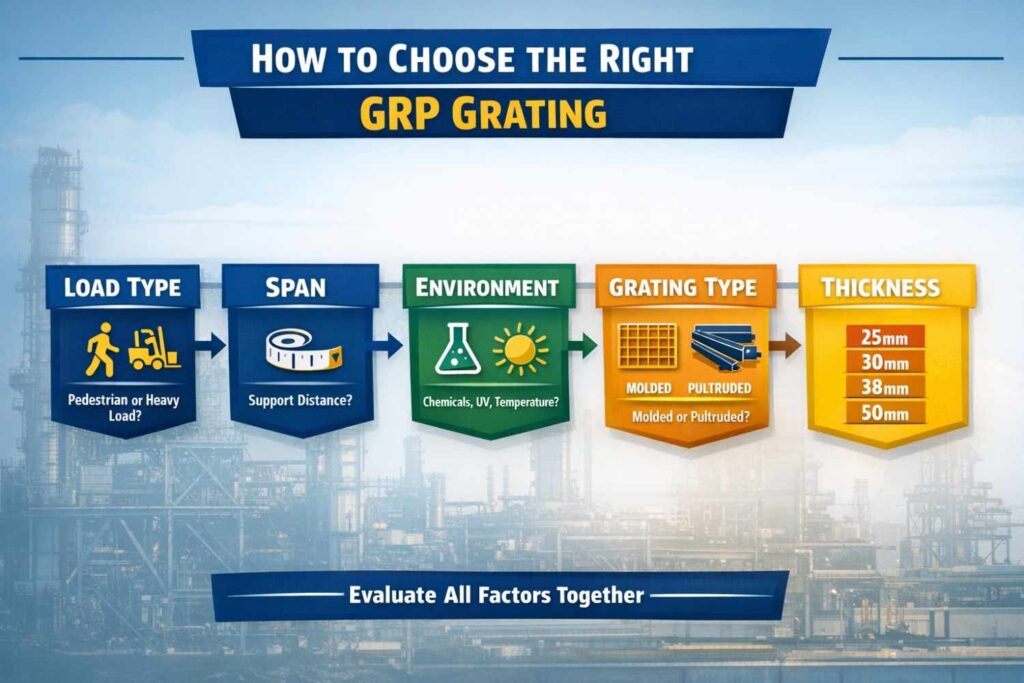
Start by identifying what the surface will handle:
Span is one of the most critical and often ignored factors.
Key Example: A 38 mm grating may support heavy loads over a short span. But the same panel may fail or deflect excessively over a longer span. Reducing support spacing increases strength and safety.
Deflection refers to how much the grating bends under load. Industry practice typically limits deflection to:
Span ÷ 200
This is one of the most overlooked parameters in many projects.
Industrial environments in Saudi Arabia add another layer of complexity:
This is why GRP gratings are widely used instead of steel. If you are working in corrosive environments, you can also explore solutions like FRP Chemical Storage Tanks to understand how fiberglass performs in similar conditions.
Depending on the application, you may also need to consider:
These factors can influence both thickness and grating type. In high-risk environments such as oil & gas or chemical plants, safety requirements are often defined by project specifications or industry standards. Selecting the right combination ensures not just compliance, but also long-term operational safety and reliability.
Industry Insight: Nearly 65% of industrial users of FRP gratings report lower operational costs and longer service performance compared to conventional materials. (Source: Reanin – FRP Grating Market Report)
Quick reference for selecting the right thickness for your application
| Thickness | Typical Use | Load Level | Best For |
|---|---|---|---|
| 25 mm | Walkways | Light | Pedestrian access areas, light-duty platforms |
| 30 mm | Industrial flooring | Medium | General industrial use, moderate foot traffic |
| 38 mm | Platforms & process areas | Heavy | Equipment platforms, heavy machinery areas |
| 50 mm | Equipment & vehicular zones | Very heavy | Forklift areas, high-load zones, vehicular traffic |
Important Note:
Actual performance depends on span and support conditions. Always validate with load tables provided by manufacturers before final specification.
Chemical exposure + moderate load
Heavy load + long span
The image shows different GRP grating thicknesses side by side. Notice how the load-bearing bars increase in depth from 25mm to 50mm. This visual difference directly correlates to the load-carrying capacity and deflection characteristics of each thickness option.

A practical checklist you can follow for your project
Understand whether the grating will carry continuous foot traffic or concentrated loads like equipment or vehicles.
Determine the exact distance between supports, as this directly impacts strength and required thickness.
Evaluate conditions such as chemicals, moisture, UV exposure, or temperature that may affect material performance.
Choose based on load direction and environment. Molded for corrosion resistance, pultruded for higher load capacity.
Ensure the selected grating does not bend beyond acceptable limits under load, typically based on span ratios.
Refer to technical data sheets to confirm that the selected grating meets load and span requirements.
If you need project-specific guidance, you can explore options from experienced FRP grating suppliers in Saudi Arabia to ensure accurate selection.
Learn from the most frequent issues seen in industrial projects
Cost should not be the only factor. Proper specification ensures safety and long-term value.
Span is critical to performance. The same thickness performs differently at different spans.
Excessive deflection compromises safety and reduces grating lifespan.
Pultruded grating is better suited for high-load applications.
Unnecessary over-specification leads to wasted cost without real benefit.
A small specification mistake at this stage can lead to long-term operational risks and safety hazards.
Expert input is essential in these situations
When your application involves multiple load types or unusual loading patterns.
Non-standard span distances that require special engineering calculations.
Chemical, offshore, or extreme temperature conditions requiring specialized solutions.
Major engineering, procurement, and construction projects need comprehensive support.
A manufacturer with in-house engineering capability ensures correct specification and avoids costly mistakes.
Direct access to engineering teams for technical guidance and validation.
The key to successful GRP grating specification
It is about matching:
Proper specification ensures worker safety and confidence.
Correct selection extends the lifespan of your grating.
Reduced maintenance requirements save money over time.
If you are working on an industrial project in Saudi Arabia and need clarity on thickness or load rating, discussing your application with a specialist can help you avoid design errors and unnecessary cost.
Quick answers to common questions about GRP grating selection
25 mm or 30 mm is typically used for pedestrian walkways. The choice depends on the specific span and expected foot traffic patterns. For light-duty walkways with short spans, 25 mm is usually sufficient. For longer spans or higher traffic areas, 30 mm is recommended.
It depends on span and support conditions, but it is commonly used for heavy-duty industrial platforms. The exact load capacity should be determined using manufacturer load tables, which account for the specific span, load type (uniform or point load), and material properties. Typically, 38 mm grating can support several hundred kilograms per square meter depending on these factors.
Pultruded grating has higher load capacity in one direction, making it suitable for heavy loads and long spans. Molded grating, on the other hand, offers bi-directional strength and superior corrosion resistance, making it ideal for chemical environments. The choice depends on your specific application requirements rather than simply choosing the “stronger” option.
Load rating is determined based on thickness, span, and load type, usually using manufacturer load tables. These tables are developed through rigorous testing and engineering analysis. To calculate the load rating for your specific application, you need to: (1) Identify the grating thickness, (2) Determine the span between supports, (3) Specify the load type (uniform or point load), and (4) Reference the manufacturer’s load table with these parameters.
