Address
Busubait Fiberglass Factory
P.O Box 63113, Dammam 31516
Kingdom of Saudi Arabia
Work Hours
Monday to Friday: 7AM - 7PM
Weekend: 10AM - 5PM

Years in Business
Happy Customers
Skilled Professionals
Busubait is a Saudi-based FRP manufacturer with decades of project experience across the Kingdom’s most demanding industrial environments.
Our pipes are not imported and rebranded — they are fabricated in-house at our Dammam plant, which means faster delivery, local engineering support, and full control over quality from raw material to final inspection.
We serve clients in oil and gas processing, petrochemicals, water treatment, desalination, and mining. Many of our projects involve complex piping networks where chemical compatibility, pressure rating, and structural integrity are non-negotiable requirements.
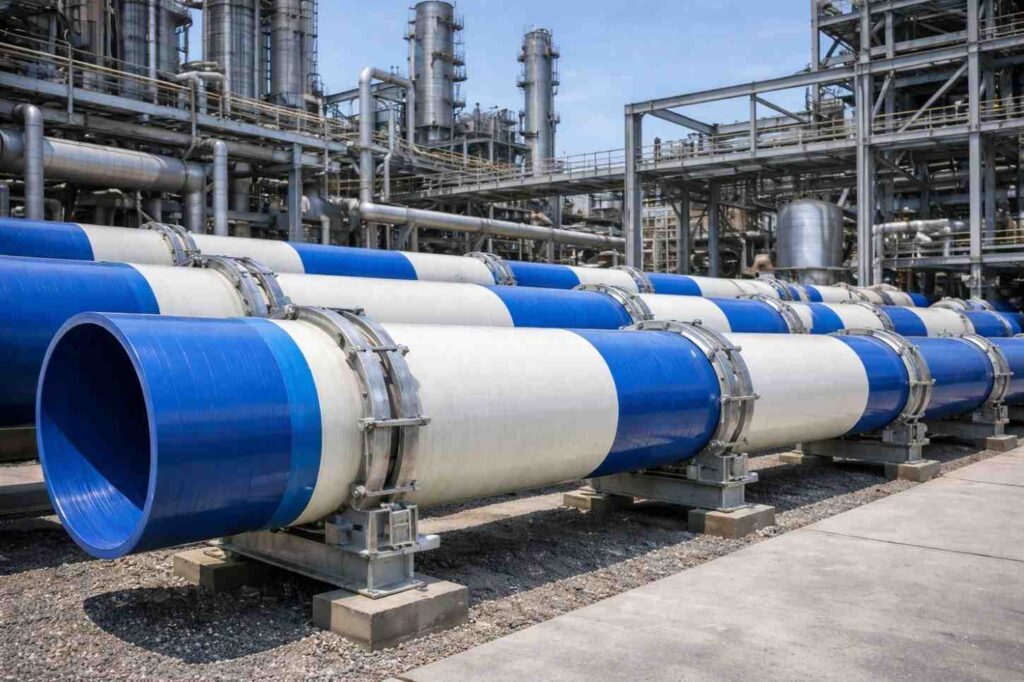
Steel pipes were the default choice for industrial piping for decades. That’s changing — not because steel is inherently bad, but because the environments inside petrochemical plants, desalination facilities, and chemical processing units are genuinely hostile to metal.
FRP has no metallic matrix to corrode. The resin-glass composite is chemically inert to most acids, alkalis, and saline streams. Research shows mild steel can lose over 10mm to corrosion in sulphuric acid within 30 days.
While steel has lower upfront material cost, its annual maintenance burden — rust treatment, repainting every 3–5 years, protective coating renewal — makes it significantly more expensive over 20 years.
A standard carbon steel pipe in DN300 weighs roughly 5–6 times more than an equivalent FRP pipe. Lighter support structures and no welding required means faster installation and lower labor costs.
FRP pipes require no protective coatings and no cathodic protection. Routine inspection is visual — there are no corrosion allowances to monitor, no wall thinning to track, and no coating failures to repair.
In sand-laden fluids and slurry environments, FRP eliminates both chemical corrosion and erosion vulnerability. Studies show FRP can reduce maximum erosion rate by up to five-fold compared to mild steel.
Peer-reviewed research from the Journal of King Saud University and MDPI Materials documents rapid steel failure in acids, saline streams, and erosive environments — exactly where FRP excels.
Our claims are backed by peer-reviewed scientific research:
The decision between FRP, carbon steel, and stainless steel is driven by the specific fluid, operating pressure, temperature, and lifecycle cost expectations of each project. This comparison is informed by peer-reviewed research and industry analysis.
| Property | FRP Pipes | Carbon Steel | Stainless Steel |
|---|---|---|---|
| Corrosion Resistance | Excellent — no coating needed | Poor — rapid degradation in acids, chlorides, and saline environments | Good — but vulnerable to chloride stress corrosion cracking |
| Weight | 75–80% lighter than steel | Heavy — increases support and installation costs | Heavy — similar to carbon steel |
| Lifecycle Cost (20-year) | Low — minimal maintenance, no coating | High — repeated inspection and replacement cycles required | Moderate — periodic inspection and replacement needed |
| Installation | Lightweight; adhesive or flanged joints; no hot-work permits | Requires cranes, welding crews, hot-work permits | Requires specialised welding and controlled conditions |
| Chemical Compatibility | Wide range: acids, alkalis, chlorine, solvents, brine | Limited — requires lining or alloy upgrade in most industrial environments | Limited — not suitable for chloride-rich or certain acid environments |
| Design Life | 25–50 years in corrosive service | 10–15 years with maintenance in aggressive exposure environments | 15–20 years depending on chemical exposure |
FRP piping is not a universal replacement for all piping materials. It performs exceptionally well in corrosive, wet, and chemically aggressive environments.
FRP piping handles corrosive produced water, brine reinjection, firewater distribution, and cooling water systems reliably.
This is where FRP piping offers its clearest advantage. Acids, caustics, solvents, and chlorinated compounds are typical transport media. Learn more about FRP pipes in chemical processing units.
➝ Hydrochloric acid (HCl) transfer lines
➝ Sulphuric acid and caustic soda pipelines
➝ Solvent and chlorinated chemical transport systems
Saudi Arabia operates some of the world's largest desalination capacity. Seawater, hypersaline brine, and chemical dosing streams are all hostile to standard metals.
Saudi Arabia's mining sector generates acidic slurries and process liquors that erode metal piping rapidly. Busubait has supplied piping systems to Ma'aden operations at Ras Al Khair.
Cooling water systems, chemical dosing circuits, and flue gas treatment installations all benefit from FRP piping. Learn more about our FRP ducting systems and air pollution control equipment.
Every industrial facility has unique requirements. Our engineering team works with you to specify the right FRP solution for your specific needs.
Understanding what a supplier can actually manufacture — not just procure and resell — matters when you’re specifying piping for a critical industrial application.
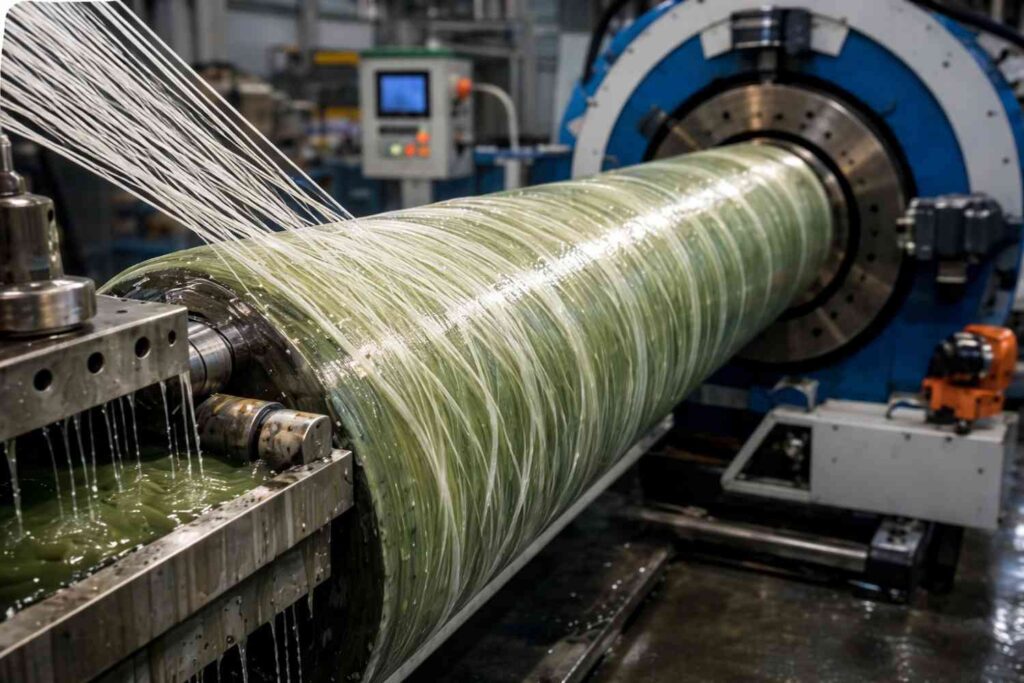
Filament winding is the primary method for producing pressure-rated FRP pipe. Continuous glass fibre rovings are wound onto a mandrel at controlled angles — typically 55° for balanced hoop and axial strength — and impregnated with resin. This produces a consistent, void-free pipe wall with predictable pressure ratings.
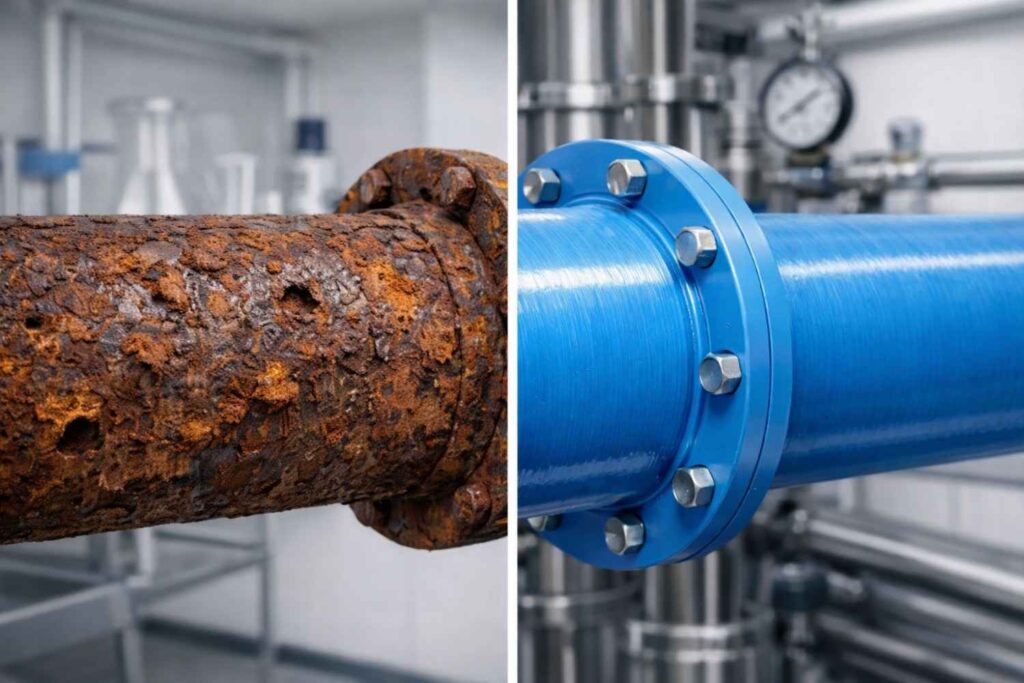
Elbows, tees, reducers, flanges, and complex pipe spool assemblies are fabricated using hand lay-up. This allows us to produce custom configurations that match project-specific dimensions and connection requirements. The image shows the dramatic difference between corroded steel and pristine FRP after equivalent service years.
Not every industrial piping requirement matches a standard catalogue size. We fabricate custom pipe diameters, wall thicknesses, and spool assemblies to match project drawings.
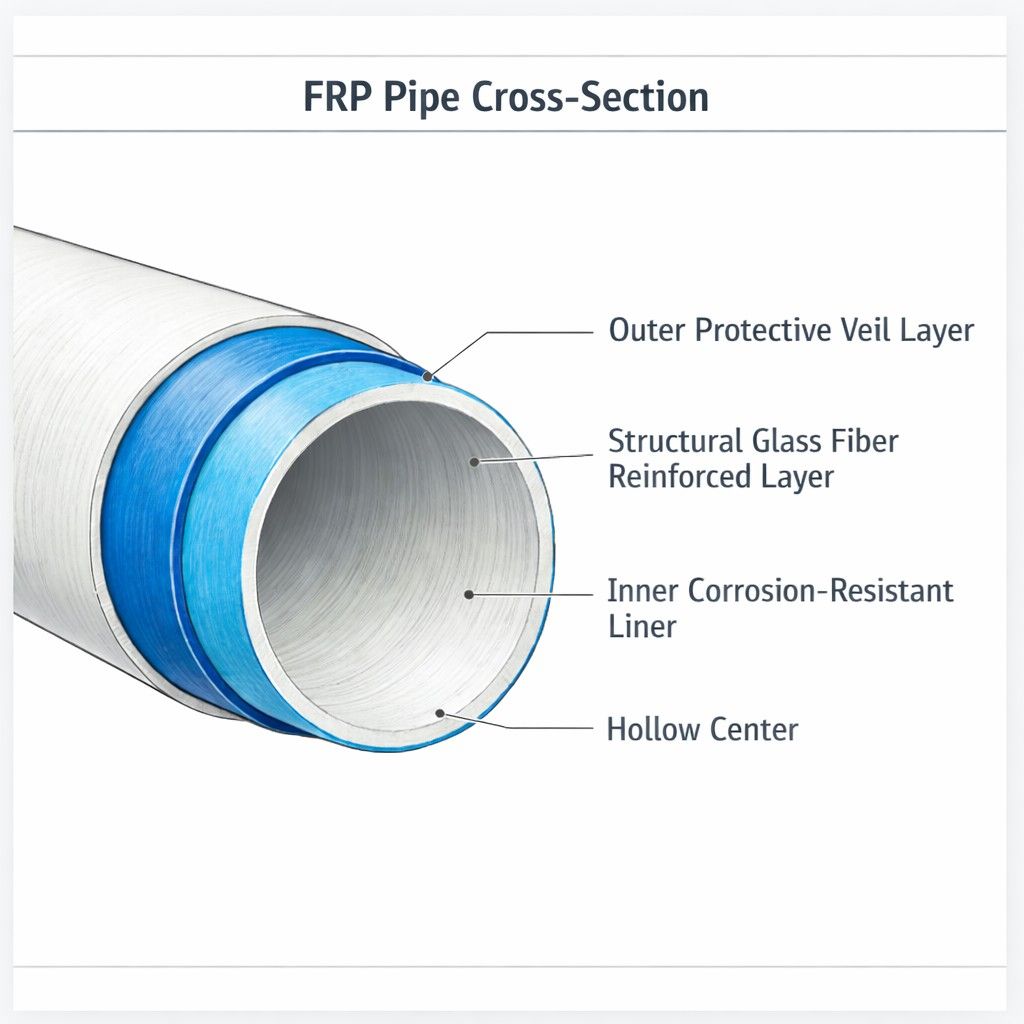
DN50 to DN3000 (filament wound)
To match process conditions
With flanged or adhesive-bonded joints
Including reducing tees and large-radius bends
Vinylester, isophthalic polyester, epoxy — selected for chemical compatibility
ASTM and ISO compliant manufacturing
There is no shortage of FRP piping suppliers in the market. The difference between suppliers becomes clear when a project involves non-standard requirements, tight schedules, or applications where failure is not an option.
Our plant is located in Dammam, within the Eastern Province industrial corridor. Local manufacturing means shorter lead times, easier site visits, and faster response to fabrication queries or design revisions.
FRP piping design involves understanding fluid chemistry, pressure and temperature cycling, joint design, support spacing, and thermal expansion. Our engineers support clients through material selection and system design review.
Our project history includes work for some of Saudi Arabia's largest industrial operators — Ma'aden, SABIC, desalination plants, and utilities. View our completed industrial projects .
Piping systems do not exist in isolation. Most industrial installations need tanks, ducting, gratings, and process equipment. We manufacture the full range from one facility.
ISO 9001:2015 certified with BS & ASTM standards compliance. Every product undergoes rigorous quality assurance before delivery.
Site jointing (adhesive & butt-wrap) and commissioning assistance available. Direct access to engineering team for technical questions and design support.
Get answers to common questions about FRP piping, manufacturing, and applications backed by research and industry experience.
Yes, we are ISO 9001:2015 certified and follow BS & ASTM standards. Every product undergoes rigorous quality assurance and inspection before delivery to ensure compliance with international standards and your project specifications.
Yes, we offer site jointing (adhesive & butt-wrap) and commissioning assistance. Our engineering team is available to support your installation process and ensure proper system startup and performance validation.
Absolutely – we specialize in tailor-made FRP & GRP solutions. From custom pipe diameters and pressure ratings to specialized resin systems for extreme chemical environments, our manufacturing capability supports virtually any industrial requirement.
Lead times vary depending on order size and complexity, but our in-house manufacturing capability typically allows for faster delivery than imported alternatives. Contact our engineering team with your project timeline for a specific quote.
Standard FRP is suitable for continuous service up to approximately 120°C. For higher temperatures, we offer specialized resin systems and dual-laminate designs. Consult with our engineering team to determine the right solution for your temperature requirements.
Peer-reviewed studies directly support FRP’s advantages. Palanivelu et al. (2025) documented up to 10mm of corrosion on mild steel in sulphuric acid over 30 days. Khan et al. (2023) showed FRP can reduce erosion rates by up to 5x compared to steel in slurry environments. Creative Fibrotech’s analysis confirms FRP’s lower lifecycle cost over 20 years.
Years in Business
Satisfied Customers
Skilled Professionals
Projects Completed
Trusted by leading industrial operators across Saudi Arabia and the GCC region.
★★★★★
“Busubait’s FRP piping solved our corrosion problems in our desalination facility. The quality is exceptional, and their engineering support made the entire project seamless.”
Ahmed Al-Rashid
Plant Manager, Desalination Facility
★★★★★
“We’ve been using Busubait’s FRP pipes for our petrochemical operations for over 10 years. Reliable, durable, and their local support is invaluable.”
Fatima Al-Dosari
Procurement Manager, SABIC Partner
★★★★★
“The custom fabrication capability at Busubait is outstanding. They delivered exactly what we needed for our mining operations, on time and within budget.”
Mohammed Al-Ghamdi
Operations Director, Ma’aden