Address
Busubait Fiberglass Factory
P.O Box 63113, Dammam 31516
Kingdom of Saudi Arabia
Work Hours
Monday to Friday: 7AM - 7PM
Weekend: 10AM - 5PM

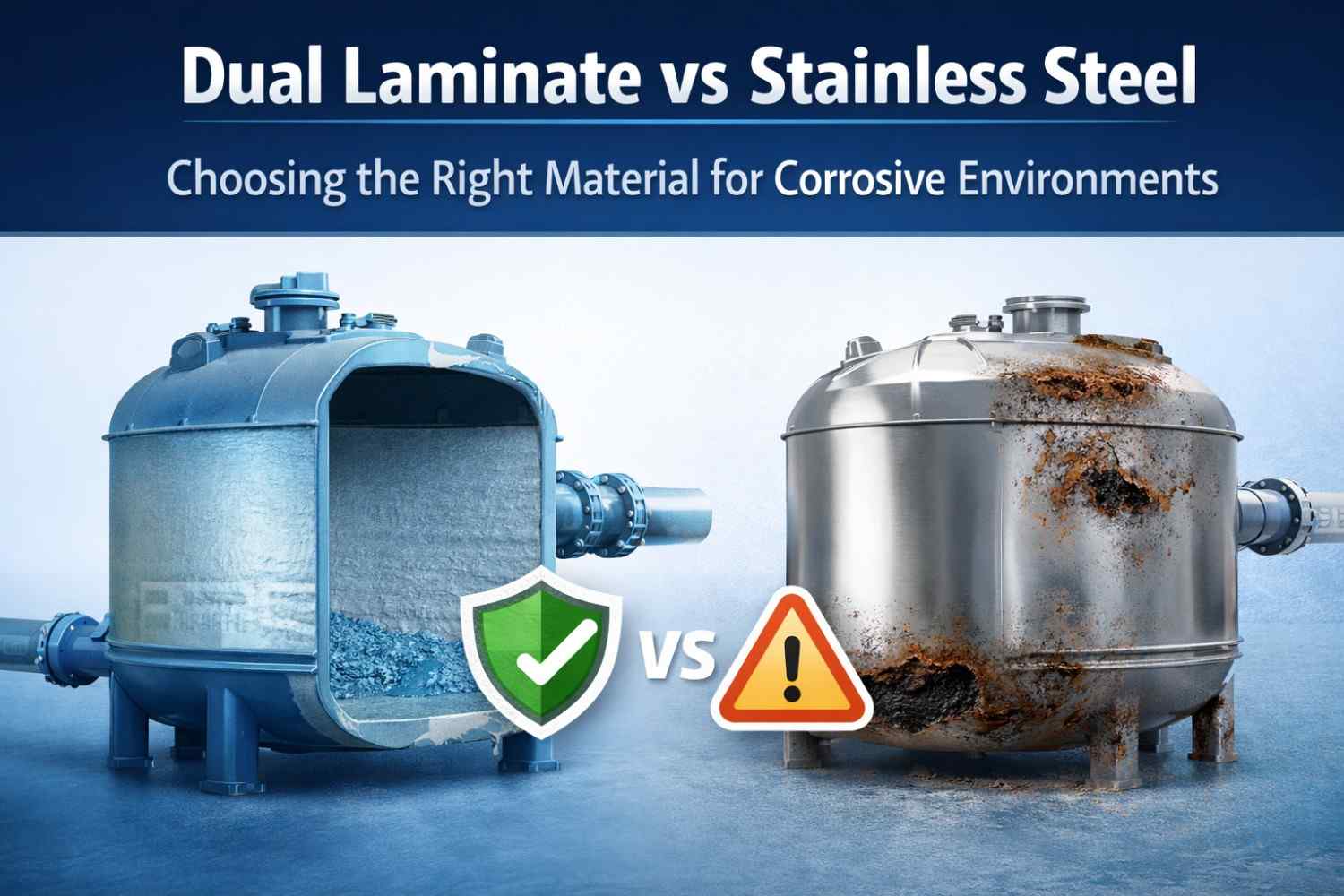
Expert guidance for engineers and procurement teams handling acid storage tanks, chemical transfer piping, and hypochlorite systems.
This is where the comparison between dual laminate vs stainless steel becomes critical.
The material choice affects:
Let us evaluate this from a practical engineering perspective.
Busubait's engineering team can help you select the right material for your specific application.
Dual laminate is an engineered composite system used in corrosion resistant tanks and piping.
The liner resists chemical attack. The FRP shell handles mechanical load. This separation of roles allows dual laminate systems to perform well in aggressive chemical environments where metals struggle.
Busubait Expertise: Busubait manufactures dual laminate tanks and PP / PVDF lined chemical systems for industrial applications in Saudi Arabia. Explore our dual laminate systems →
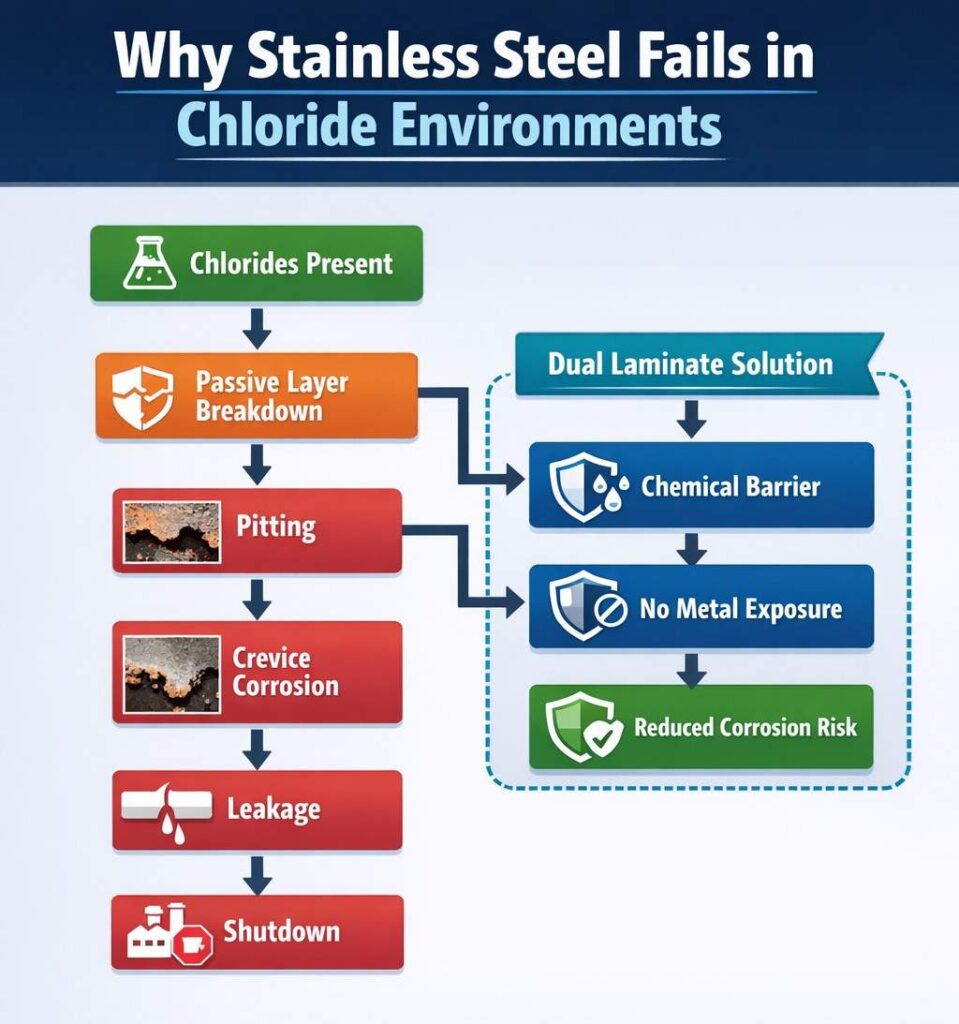
Its corrosion resistance comes from a chromium oxide passive layer. However, this passive layer can break down under certain chemical conditions.
Particularly in:
This is where the comparison becomes application-specific.
Material science research has studied hybrid and composite laminates extensively.
A 2019 study published in Materials Today Proceedings evaluated stainless steel and glass fibre hybrid laminates and concluded:
“The reinforcement of stainless-steel wires has significant impact on the mechanical properties of the sandwiched laminates.”
This supports an important point: Composite systems, when engineered correctly, provide significant structural performance. They are not lightweight substitutes. They are engineered materials.
Another comparative study on steel-FRP systems also demonstrated improved structural behavior when composite reinforcement was integrated. In tank and piping applications, this translates into structural reliability when properly designed.
Understanding failure mechanisms is essential before selecting material. Expand each section below to learn more.
Even 316 stainless steel can experience localized pitting in:
Why pitting is dangerous:
Crevice corrosion often develops at:
The Challenge: These areas are difficult to inspect without shutdown. The corrosion initiates in hidden locations where oxygen depletion creates aggressive conditions.
Regular inspection protocols often miss crevice corrosion until significant damage has occurred, leading to unexpected failures and costly emergency repairs.
When tensile stress and chlorides combine, cracking can initiate. This is particularly relevant in:
Critical Risk: Once initiated, cracks can propagate quickly, sometimes without warning. The combination of mechanical stress and chemical attack creates a synergistic failure mode that is difficult to predict and prevent.
This is one of the most dangerous failure mechanisms in stainless steel systems because it can occur suddenly and catastrophically.
| Chemical Condition | Dual Laminate | Stainless Steel |
|---|---|---|
| Strong Acids | Excellent with correct liner | Grade dependent |
| Chlorides | High resistance | Prone to pitting |
| Hypochlorite | Suitable with compatible liner | Risk of attack |
| Mild Chemical Service | Suitable | Suitable |
| Hygienic Service | Limited | Strong advantage |
Key Insight: Dual laminate allows liner selection based on exact chemical exposure. Stainless steel relies on alloy composition alone, limiting flexibility in aggressive environments.
| Property | Dual Laminate | Stainless Steel |
|---|---|---|
| Temperature Range | Up to 140–160°C (liner dependent) | Up to 400°C+ |
| Pressure Rating | Moderate (typically 10–20 bar) | High (50+ bar) |
| Mechanical Strength | Good (FRP reinforced) | Excellent |
| Weight | Lightweight | Heavy |
| Corrosion Resistance | Excellent in aggressive chemicals | Good in mild to moderate conditions |
| Aspect | Stainless Steel | Dual Laminate |
|---|---|---|
| Inspection Method | Regular NDT (Non-Destructive Testing) | Spark testing, visual inspection |
| Thickness Monitoring | Required | Not required |
| Downtime for Inspection | Significant (internal access needed) | Minimal (external inspection) |
| Corrosion-Related Repairs | Frequent in aggressive environments | Rare (if properly designed) |
| Maintenance Cost | High (ongoing inspection and repair) | Low (minimal corrosion-driven maintenance) |
Follow this systematic approach to specify the correct FRP grating for your application.
Stainless steel remains preferable when:
Dual laminate systems typically operate up to approx. 140–160°C depending on liner selection. For moderate pressure chemical storage tanks and transfer piping, this range is often sufficient.
For very high temperature steam or high-pressure hydrocarbon systems, stainless steel may remain necessary.
Application Fit: If your application requires temperatures below 140°C and pressures below 20 bar, dual laminate is likely a superior choice for corrosive environments. For extreme conditions, stainless steel remains the better option.
Initial cost does not reflect total cost.
A 2007 life cycle cost study presented by AMPP evaluated replacement of metallic piping with dual laminate systems in highly corrosive environments. The study concluded:
“Life cycle cost analysis and proper implementation of dual laminate systems can lead to long term savings over metals for the end users.”
In aggressive environments, lifecycle cost often favors composite systems, sometimes by 30-50% over the system’s lifetime.
Let our engineers analyze your specific application and recommend the best solution for your budget and requirements.
Impact on Operations: For large storage tanks and long piping runs, this difference can significantly affect plant shutdown schedules, reducing operational disruptions and improving overall facility productivity.
The decision between dual laminate vs stainless steel is common in:
Handling aggressive chemical processes and high-corrosion environments requiring reliable, long-lasting infrastructure.
Handling aggressive chemical processes and high-corrosion environments requiring reliable, long-lasting infrastructure.
Handling aggressive chemical processes and high-corrosion environments requiring reliable, long-lasting infrastructure.
Storing and handling phosphoric acid and other corrosive fertilizer components safely and cost-effectively.
Managing chloride-rich brine and seawater in high-corrosion environments where dual laminate excels.
Handling acidic, alkaline, and chemically aggressive treatment processes with minimal maintenance.
Before finalizing specification, confirm these critical parameters:
Exact chemical type and concentration. This is the most important factor in material selection.
Maximum operating temperature. Dual laminate is limited to ~160°C; stainless steel can exceed 400°C.
System pressure requirements. Stainless steel handles higher pressures (50+ bar) more easily.
Any chloride exposure. This is a primary weakness of stainless steel and strength of dual laminate.
Desired system lifespan. Dual laminate typically outlasts stainless steel in aggressive environments.
What happens if the system fails? Higher consequences may justify higher initial costs.
Choose Dual Laminate if:
Choose Stainless Steel if:
Read More: Why FRP Tanks Outperform Traditional Tanks in Chemical Storage →
There is no universal winner. There is only correct alignment between:
The chemical environment determines which material can survive long-term without degradation.
Pressure, vibration, and structural loads must be matched to material capabilities.
Operating temperature range must be within material limits for safe, reliable operation.
Total cost of ownership over the system’s lifetime, not just initial purchase price.
Busubait's experienced engineers are ready to help you make the right material choice for your application.
Whether you need dual laminate tanks, FRP piping, or expert consultation on material selection, Busubait is your trusted partner.
Petrochemical Industrial Center Dammam, Kingdom of Saudi Arabia
+966 508211128
fiberglass@busubait.com
